Bulk Orders. Better Value.
Research institutions, universities and clinical teams qualify for volume discounts. Contact our team to discuss custom formulations and bulk pricing.

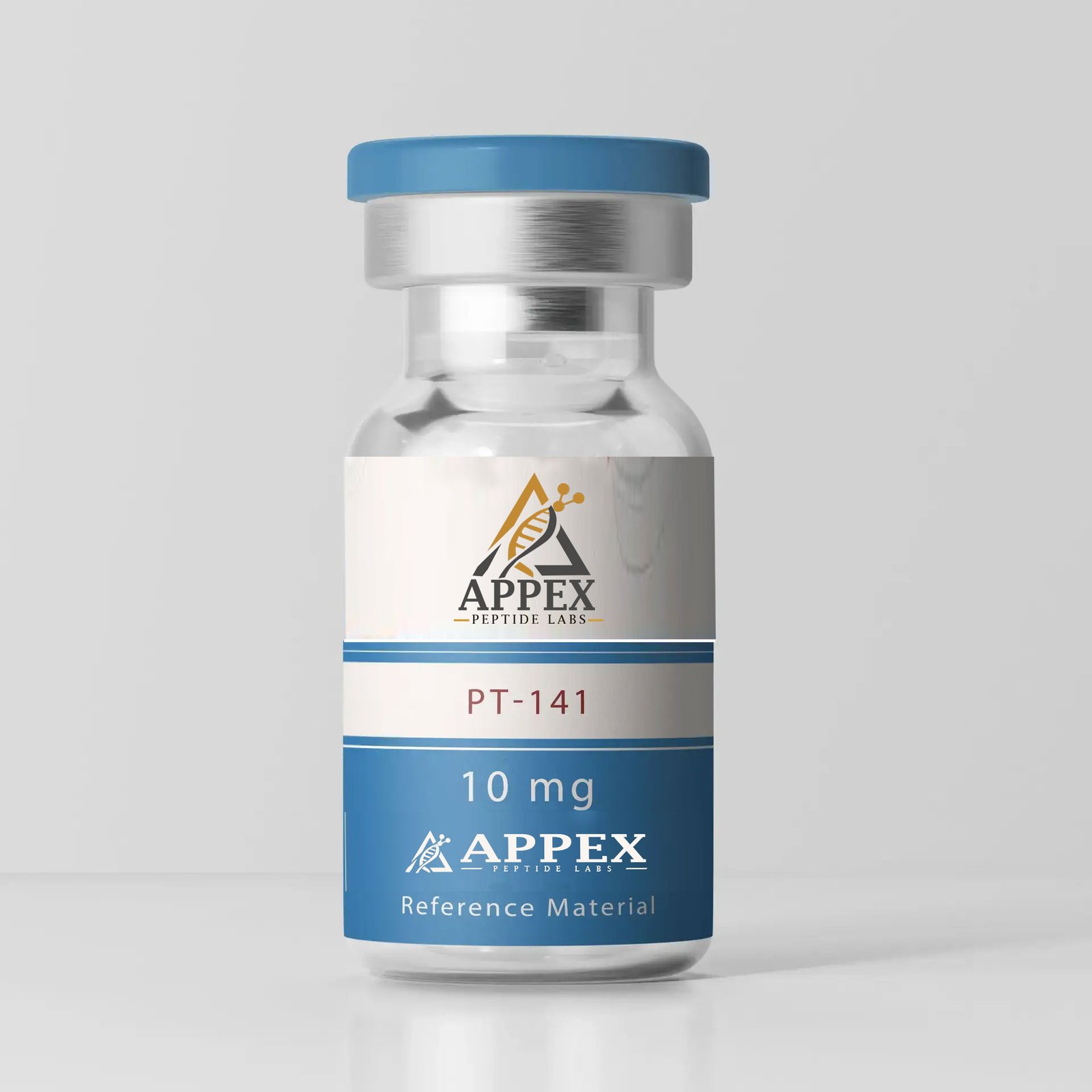
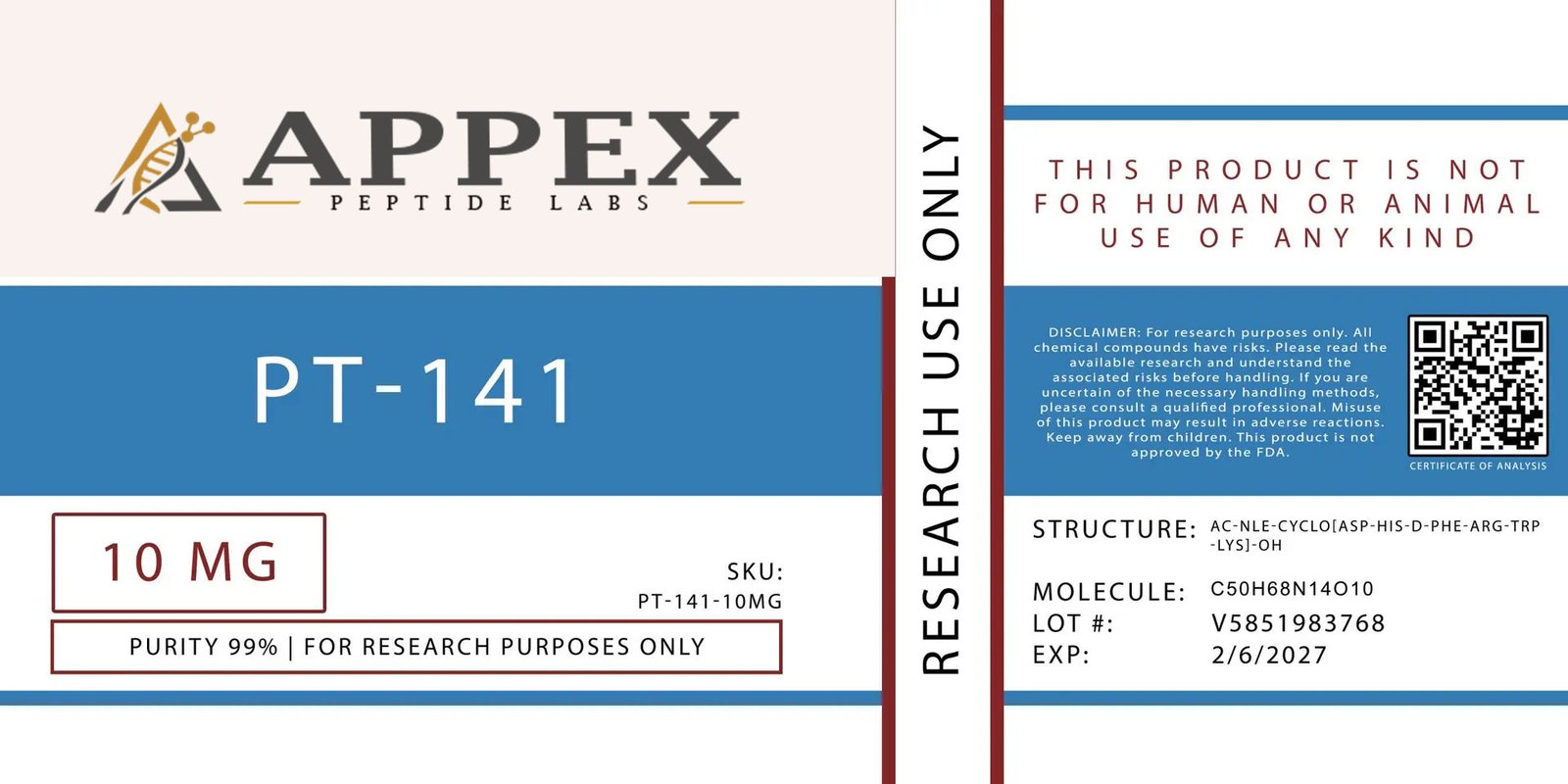

PT-141 (Bremelanotide) Peptide is a synthetic cyclic peptide derived from α-melanocyte-stimulating hormone (α-MSH) and is extensively investigated for its interaction with the melanocortin receptor family, particularly MC3R and MC4R. Its conformationally constrained cyclic structure enhances molecular stability and receptor affinity, making it a valuable research tool for studying central melanocortin signaling.
Researchers utilize PT-141 to investigate receptor activation kinetics, intracellular signaling cascades, ligand specificity, receptor trafficking, and neuroendocrine communication within controlled laboratory environments. Experimental models also examine downstream pathways involving cyclic AMP (cAMP), protein kinase activation, neuronal signaling, and GPCR-mediated molecular responses. Its well-characterized pharmacological profile has established PT-141 as an important peptide for receptor pharmacology, peptide chemistry, and molecular neuroscience research.
At Appex Peptide Lab, PT-141 (Bremelanotide) Peptide is synthesized under stringent quality-controlled manufacturing standards and independently verified using validated analytical methods to ensure exceptional purity, structural integrity, and batch reproducibility. Each lot is accompanied by comprehensive analytical documentation to support reliable scientific investigations.
Trusted by research institutions, biotechnology companies, universities, and pharmaceutical laboratories throughout the United States, Canada, and Australia, PT-141 provides dependable quality for advanced melanocortin receptor and neuroendocrine research.
Researchers investigating melanocortin receptor biology require peptide standards that deliver consistent analytical quality and dependable experimental performance.
Researchers choose this product because it offers:
Laboratory investigations examining MC3R and MC4R activation, ligand binding kinetics, receptor trafficking, and downstream intracellular signaling.
Experimental studies evaluating G protein-coupled receptor activation, ligand specificity, receptor desensitization, and pharmacodynamic responses.
Research involving hypothalamic signaling pathways, peptide-mediated neuronal communication, and endocrine regulation mechanisms.
Studies focused on peptide-receptor interactions, structure-activity relationships, ligand affinity, and receptor selectivity.
Experimental investigations examining cAMP production, protein kinase activation, intracellular second messengers, and signal transduction pathways.
Laboratory studies exploring neuronal receptor expression, peptide signaling networks, and central nervous system molecular biology.
Research involving cyclic peptide stability, conformational analysis, molecular optimization, and synthetic peptide characterization.
Suitable for in vitro receptor binding assays, molecular docking studies, peptide characterization, and pharmacological screening.
| Specification | Details |
|---|---|
| Product Name | PT-141 (Bremelanotide) Peptide |
| Purity | ≥98% (HPLC Verified) |
| Peptide Type | Synthetic Cyclic Melanocortin Receptor Agonist |
| Molecular Formula | C₅₀H₆₈N₁₄O₁₀ |
| Molecular Weight | 1025.16 g/mol |
| CAS Number | 189691-06-3 |
| Appearance | White to off-white lyophilized powder |
| Storage Conditions | Store unopened at -20°C. Protect from moisture, heat, direct light, and repeated freeze-thaw cycles. |
| Solubility | Soluble in laboratory-grade sterile water and appropriate aqueous research buffers |
| Sequence | Ac-Nle-cyclo[Asp-His-D-Phe-Arg-Trp-Lys]-OH |
| Available Sizes | 10 mg |

Within laboratory research, PT-141 (Bremelanotide) Peptide is investigated as a synthetic agonist of the melanocortin receptor family, with primary activity toward melanocortin-3 receptor (MC3R) and melanocortin-4 receptor (MC4R). These receptors belong to the Class A family of G protein-coupled receptors (GPCRs) and participate in numerous neuroendocrine signaling networks studied in experimental biology.
Upon receptor binding, PT-141 activates Gs protein-dependent signaling, resulting in stimulation of adenylyl cyclase and increased intracellular cyclic adenosine monophosphate (cAMP) production. Elevated cAMP activates downstream mediators including protein kinase A (PKA), which subsequently regulates phosphorylation events, transcription factor activity, and intracellular signaling cascades. Researchers frequently investigate these molecular responses to better understand melanocortin receptor pharmacology and GPCR-mediated cellular communication.
The cyclic lactam-bridged structure of PT-141 enhances conformational stability and receptor affinity relative to linear peptide analogs. This structural feature has made the peptide valuable for investigations involving receptor binding kinetics, ligand-receptor interactions, receptor internalization, β-arrestin recruitment, and receptor recycling. Laboratory studies also evaluate receptor selectivity between melanocortin receptor subtypes and characterize downstream signaling bias under controlled experimental conditions.
Experimental models further utilize PT-141 to investigate neuroendocrine communication, hypothalamic signaling pathways, intracellular second messenger systems, peptide pharmacokinetics, and structure-activity relationships. Cell-based assays continue to explore how receptor activation influences transcriptional regulation, neuronal signaling, and molecular responses associated with melanocortin biology.
Because of its well-defined pharmacological profile and sequence stability, PT-141 remains an important research tool for peptide chemistry, receptor biology, molecular pharmacology, neuroscience, and GPCR signaling investigations.
For research use only. Not intended for human consumption or clinical use.
| Size | 10mg |
|---|---|
| Dimensions | 9 × 7 × .5 in |
| Weight | .125 lbs |
PT-141 (Bremelanotide) Peptide is a synthetic cyclic peptide derived from α-melanocyte-stimulating hormone (α-MSH) and is extensively investigated for its interaction with the melanocortin receptor family, particularly MC3R and MC4R. Its conformationally constrained cyclic structure enhances molecular stability and receptor affinity, making it a valuable research tool for studying central melanocortin signaling.
Researchers utilize PT-141 to investigate receptor activation kinetics, intracellular signaling cascades, ligand specificity, receptor trafficking, and neuroendocrine communication within controlled laboratory environments. Experimental models also examine downstream pathways involving cyclic AMP (cAMP), protein kinase activation, neuronal signaling, and GPCR-mediated molecular responses. Its well-characterized pharmacological profile has established PT-141 as an important peptide for receptor pharmacology, peptide chemistry, and molecular neuroscience research.
At Appex Peptide Lab, PT-141 (Bremelanotide) Peptide is synthesized under stringent quality-controlled manufacturing standards and independently verified using validated analytical methods to ensure exceptional purity, structural integrity, and batch reproducibility. Each lot is accompanied by comprehensive analytical documentation to support reliable scientific investigations.
Trusted by research institutions, biotechnology companies, universities, and pharmaceutical laboratories throughout the United States, Canada, and Australia, PT-141 provides dependable quality for advanced melanocortin receptor and neuroendocrine research.
Researchers investigating melanocortin receptor biology require peptide standards that deliver consistent analytical quality and dependable experimental performance.
Researchers choose this product because it offers:
Laboratory investigations examining MC3R and MC4R activation, ligand binding kinetics, receptor trafficking, and downstream intracellular signaling.
Experimental studies evaluating G protein-coupled receptor activation, ligand specificity, receptor desensitization, and pharmacodynamic responses.
Research involving hypothalamic signaling pathways, peptide-mediated neuronal communication, and endocrine regulation mechanisms.
Studies focused on peptide-receptor interactions, structure-activity relationships, ligand affinity, and receptor selectivity.
Experimental investigations examining cAMP production, protein kinase activation, intracellular second messengers, and signal transduction pathways.
Laboratory studies exploring neuronal receptor expression, peptide signaling networks, and central nervous system molecular biology.
Research involving cyclic peptide stability, conformational analysis, molecular optimization, and synthetic peptide characterization.
Suitable for in vitro receptor binding assays, molecular docking studies, peptide characterization, and pharmacological screening.
| Specification | Details |
|---|---|
| Product Name | PT-141 (Bremelanotide) Peptide |
| Purity | ≥98% (HPLC Verified) |
| Peptide Type | Synthetic Cyclic Melanocortin Receptor Agonist |
| Molecular Formula | C₅₀H₆₈N₁₄O₁₀ |
| Molecular Weight | 1025.16 g/mol |
| CAS Number | 189691-06-3 |
| Appearance | White to off-white lyophilized powder |
| Storage Conditions | Store unopened at -20°C. Protect from moisture, heat, direct light, and repeated freeze-thaw cycles. |
| Solubility | Soluble in laboratory-grade sterile water and appropriate aqueous research buffers |
| Sequence | Ac-Nle-cyclo[Asp-His-D-Phe-Arg-Trp-Lys]-OH |
| Available Sizes | 10 mg |
Within laboratory research, PT-141 (Bremelanotide) Peptide is investigated as a synthetic agonist of the melanocortin receptor family, with primary activity toward melanocortin-3 receptor (MC3R) and melanocortin-4 receptor (MC4R). These receptors belong to the Class A family of G protein-coupled receptors (GPCRs) and participate in numerous neuroendocrine signaling networks studied in experimental biology.
Upon receptor binding, PT-141 activates Gs protein-dependent signaling, resulting in stimulation of adenylyl cyclase and increased intracellular cyclic adenosine monophosphate (cAMP) production. Elevated cAMP activates downstream mediators including protein kinase A (PKA), which subsequently regulates phosphorylation events, transcription factor activity, and intracellular signaling cascades. Researchers frequently investigate these molecular responses to better understand melanocortin receptor pharmacology and GPCR-mediated cellular communication.
The cyclic lactam-bridged structure of PT-141 enhances conformational stability and receptor affinity relative to linear peptide analogs. This structural feature has made the peptide valuable for investigations involving receptor binding kinetics, ligand-receptor interactions, receptor internalization, β-arrestin recruitment, and receptor recycling. Laboratory studies also evaluate receptor selectivity between melanocortin receptor subtypes and characterize downstream signaling bias under controlled experimental conditions.
Experimental models further utilize PT-141 to investigate neuroendocrine communication, hypothalamic signaling pathways, intracellular second messenger systems, peptide pharmacokinetics, and structure-activity relationships. Cell-based assays continue to explore how receptor activation influences transcriptional regulation, neuronal signaling, and molecular responses associated with melanocortin biology.
Because of its well-defined pharmacological profile and sequence stability, PT-141 remains an important research tool for peptide chemistry, receptor biology, molecular pharmacology, neuroscience, and GPCR signaling investigations.
For research use only. Not intended for human consumption or clinical use.
| Size | 10mg |
|---|---|
| Dimensions | 9 × 7 × .5 in |
| Weight | .125 lbs |