Bulk Orders. Better Value.
Research institutions, universities and clinical teams qualify for volume discounts. Contact our team to discuss custom formulations and bulk pricing.

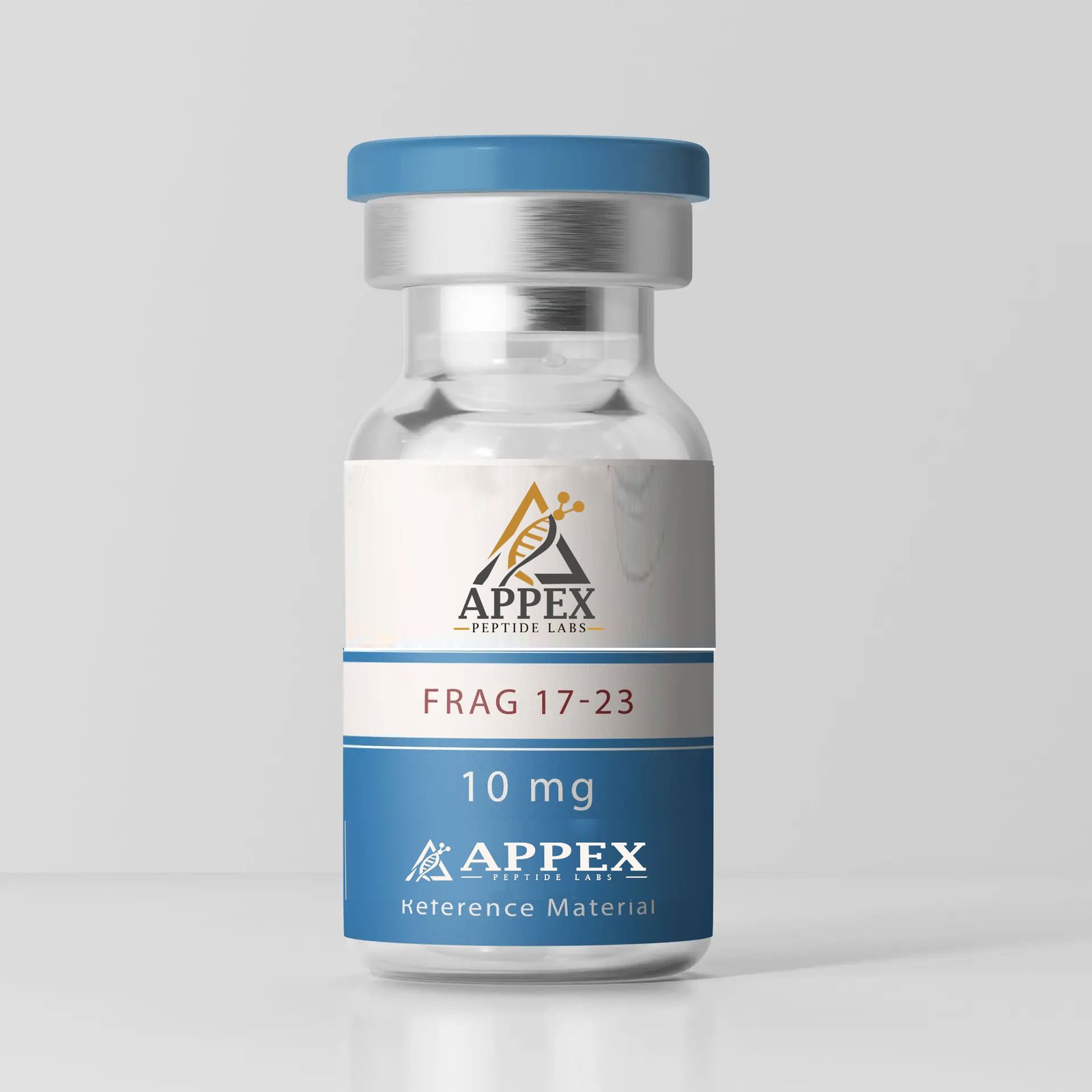
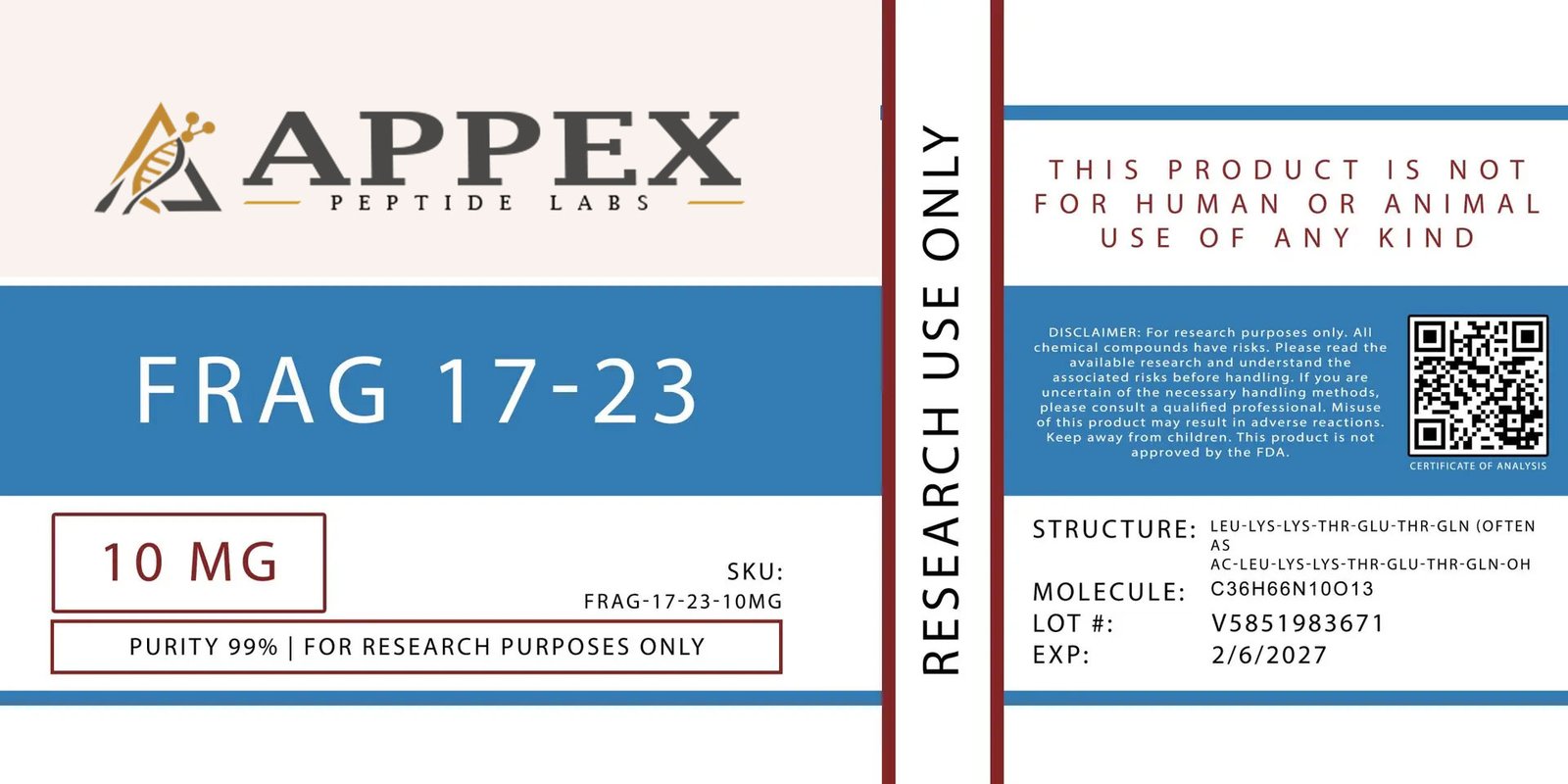

Frag 17-23 Peptide is a research-grade synthetic fragment derived from the highly conserved actin-binding region of thymosin beta-4 (TB-500). Comprising the amino acid sequence LKKTETQ, this minimal functional domain has attracted significant interest within cell biology and molecular research due to its central role in interactions with globular actin (G-actin) and regulation of cytoskeletal architecture.
Unlike the full-length thymosin beta-4 protein, Frag 17-23 Peptide enables researchers to investigate the specific contribution of the actin-binding domain without the influence of additional functional regions. This makes it particularly valuable for mechanistic studies examining cytoskeletal remodeling, actin polymerization, protein binding kinetics, cellular morphology, and intracellular transport.
Researchers employ Frag 17-23 Peptide across multiple scientific disciplines including cytoskeletal biology, regenerative biology, developmental biology, vascular biology, molecular pharmacology, and protein interaction research. Its well-defined sequence and established biochemical role provide an excellent experimental model for understanding actin-dependent cellular processes.
Appex Peptide Lab supplies high-purity research-grade Frag 17-23 Peptide manufactured under rigorous quality standards and verified through comprehensive analytical testing to ensure reliable and reproducible laboratory performance.
For research use only. Not intended for human consumption or clinical use.
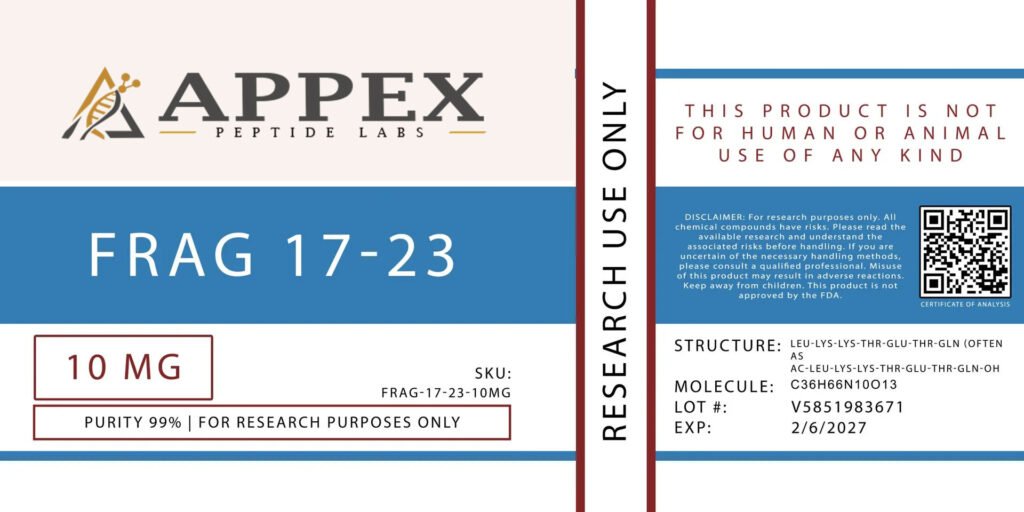
Frag 17-23 Peptide is widely employed to investigate actin filament dynamics, cytoskeletal organization, cellular architecture, and structural protein interactions under controlled laboratory conditions.
Researchers utilize Frag 17-23 Peptide to examine globular actin sequestration, filament assembly, polymerization kinetics, and regulation of intracellular actin remodeling.
The peptide supports investigations into cell motility, cytoskeletal rearrangement, focal adhesion dynamics, epithelial migration, and intracellular mechanical signaling.
Frag 17-23 Peptide serves as a molecular probe for studying interactions between actin-binding proteins, cytoskeletal regulators, and signaling complexes involved in cellular organization.
Experimental laboratories incorporate Frag 17-23 Peptide into studies evaluating tissue remodeling, extracellular matrix organization, vascular cell biology, and cellular regenerative signaling pathways.
Biotechnology and pharmaceutical researchers employ Frag 17-23 Peptide during assay development, peptide interaction studies, structure-function analyses, and biochemical pathway characterization.
| Specification | Details |
|---|---|
| Purity | ≥99% (HPLC verified) |
| Molecular Formula | C₃₄H₆₂N₁₀O₁₂* |
| Molecular Weight | Approximately 803.9 g/mol |
| CAS Number | Not assigned |
| Appearance | White to off-white lyophilized powder |
| Storage Conditions | Store at -20°C in a dry environment. After reconstitution, aliquot according to validated laboratory protocols and avoid repeated freeze-thaw cycles. |
| Solubility | Soluble in sterile laboratory-grade water or appropriate aqueous research buffers |
| Sequence | LKKTETQ |
| Available Sizes | Research quantities (availability may vary) |
*Calculated from the peptide sequence and may vary slightly depending on salt form.
Frag 17-23 Peptide is a synthetic heptapeptide derived from residues 17–23 of thymosin beta-4 (TB-500) and contains the highly conserved LKKTETQ motif responsible for the parent protein’s interaction with globular actin (G-actin). Within laboratory research, this peptide serves as a targeted molecular tool for investigating actin-binding mechanisms, cytoskeletal remodeling, intracellular protein interactions, and cell motility.
The biological activity of Frag 17-23 Peptide is primarily attributed to its ability to associate with G-actin monomers, influencing the equilibrium between monomeric and filamentous actin (F-actin). Regulation of this equilibrium is fundamental to numerous cellular processes including migration, intracellular trafficking, cytokinesis, membrane dynamics, and maintenance of cellular morphology. By isolating the actin-binding domain from the full-length thymosin beta-4 molecule, researchers can specifically evaluate the molecular contribution of this conserved sequence without interference from other functional domains.
Experimental investigations demonstrate that modulation of actin availability influences the assembly of cytoskeletal structures such as stress fibers, lamellipodia, filopodia, and cortical actin networks. These structural rearrangements regulate cellular mechanics and contribute to intracellular force generation, adhesion dynamics, and directional cell movement. Consequently, Frag 17-23 Peptide is frequently incorporated into studies examining actin polymerization kinetics, cytoskeletal architecture, and migration-associated signaling pathways.
Beyond direct actin interactions, cytoskeletal remodeling influences numerous intracellular signaling cascades including those mediated by Rho family GTPases (RhoA, Rac1, and Cdc42), focal adhesion kinase (FAK), integrins, and downstream MAPK signaling pathways. Researchers employ Frag 17-23 Peptide to investigate how localized changes in actin organization affect signal transduction, mechanotransduction, transcriptional regulation, and protein complex assembly within diverse cellular models.
The peptide is also valuable for studying interactions between actin-binding proteins, extracellular matrix signaling, epithelial cell biology, vascular biology, developmental processes, and regenerative cellular mechanisms. Because it represents a minimal functional actin-binding motif, Frag 17-23 Peptide provides a simplified and highly reproducible experimental system for dissecting cytoskeletal biology at the molecular level.
Its precise sequence, well-characterized biochemical properties, and compatibility with modern cell biology, proteomics, molecular pharmacology, and structural biology techniques make Frag 17-23 Peptide an important research reagent for laboratories investigating actin-dependent cellular function.
For research use only. Not intended for human consumption or clinical use.
| Size | 10mg |
|---|---|
| Weight | .125 lbs |
| Dimensions | 9 × 7 × .5 in |
Frag 17-23 Peptide is a research-grade synthetic fragment derived from the highly conserved actin-binding region of thymosin beta-4 (TB-500). Comprising the amino acid sequence LKKTETQ, this minimal functional domain has attracted significant interest within cell biology and molecular research due to its central role in interactions with globular actin (G-actin) and regulation of cytoskeletal architecture.
Unlike the full-length thymosin beta-4 protein, Frag 17-23 Peptide enables researchers to investigate the specific contribution of the actin-binding domain without the influence of additional functional regions. This makes it particularly valuable for mechanistic studies examining cytoskeletal remodeling, actin polymerization, protein binding kinetics, cellular morphology, and intracellular transport.
Researchers employ Frag 17-23 Peptide across multiple scientific disciplines including cytoskeletal biology, regenerative biology, developmental biology, vascular biology, molecular pharmacology, and protein interaction research. Its well-defined sequence and established biochemical role provide an excellent experimental model for understanding actin-dependent cellular processes.
Appex Peptide Lab supplies high-purity research-grade Frag 17-23 Peptide manufactured under rigorous quality standards and verified through comprehensive analytical testing to ensure reliable and reproducible laboratory performance.
For research use only. Not intended for human consumption or clinical use.
Frag 17-23 Peptide is widely employed to investigate actin filament dynamics, cytoskeletal organization, cellular architecture, and structural protein interactions under controlled laboratory conditions.
Researchers utilize Frag 17-23 Peptide to examine globular actin sequestration, filament assembly, polymerization kinetics, and regulation of intracellular actin remodeling.
The peptide supports investigations into cell motility, cytoskeletal rearrangement, focal adhesion dynamics, epithelial migration, and intracellular mechanical signaling.
Frag 17-23 Peptide serves as a molecular probe for studying interactions between actin-binding proteins, cytoskeletal regulators, and signaling complexes involved in cellular organization.
Experimental laboratories incorporate Frag 17-23 Peptide into studies evaluating tissue remodeling, extracellular matrix organization, vascular cell biology, and cellular regenerative signaling pathways.
Biotechnology and pharmaceutical researchers employ Frag 17-23 Peptide during assay development, peptide interaction studies, structure-function analyses, and biochemical pathway characterization.
| Specification | Details |
|---|---|
| Purity | ≥99% (HPLC verified) |
| Molecular Formula | C₃₄H₆₂N₁₀O₁₂* |
| Molecular Weight | Approximately 803.9 g/mol |
| CAS Number | Not assigned |
| Appearance | White to off-white lyophilized powder |
| Storage Conditions | Store at -20°C in a dry environment. After reconstitution, aliquot according to validated laboratory protocols and avoid repeated freeze-thaw cycles. |
| Solubility | Soluble in sterile laboratory-grade water or appropriate aqueous research buffers |
| Sequence | LKKTETQ |
| Available Sizes | Research quantities (availability may vary) |
*Calculated from the peptide sequence and may vary slightly depending on salt form.
Frag 17-23 Peptide is a synthetic heptapeptide derived from residues 17–23 of thymosin beta-4 (TB-500) and contains the highly conserved LKKTETQ motif responsible for the parent protein’s interaction with globular actin (G-actin). Within laboratory research, this peptide serves as a targeted molecular tool for investigating actin-binding mechanisms, cytoskeletal remodeling, intracellular protein interactions, and cell motility.
The biological activity of Frag 17-23 Peptide is primarily attributed to its ability to associate with G-actin monomers, influencing the equilibrium between monomeric and filamentous actin (F-actin). Regulation of this equilibrium is fundamental to numerous cellular processes including migration, intracellular trafficking, cytokinesis, membrane dynamics, and maintenance of cellular morphology. By isolating the actin-binding domain from the full-length thymosin beta-4 molecule, researchers can specifically evaluate the molecular contribution of this conserved sequence without interference from other functional domains.
Experimental investigations demonstrate that modulation of actin availability influences the assembly of cytoskeletal structures such as stress fibers, lamellipodia, filopodia, and cortical actin networks. These structural rearrangements regulate cellular mechanics and contribute to intracellular force generation, adhesion dynamics, and directional cell movement. Consequently, Frag 17-23 Peptide is frequently incorporated into studies examining actin polymerization kinetics, cytoskeletal architecture, and migration-associated signaling pathways.
Beyond direct actin interactions, cytoskeletal remodeling influences numerous intracellular signaling cascades including those mediated by Rho family GTPases (RhoA, Rac1, and Cdc42), focal adhesion kinase (FAK), integrins, and downstream MAPK signaling pathways. Researchers employ Frag 17-23 Peptide to investigate how localized changes in actin organization affect signal transduction, mechanotransduction, transcriptional regulation, and protein complex assembly within diverse cellular models.
The peptide is also valuable for studying interactions between actin-binding proteins, extracellular matrix signaling, epithelial cell biology, vascular biology, developmental processes, and regenerative cellular mechanisms. Because it represents a minimal functional actin-binding motif, Frag 17-23 Peptide provides a simplified and highly reproducible experimental system for dissecting cytoskeletal biology at the molecular level.
Its precise sequence, well-characterized biochemical properties, and compatibility with modern cell biology, proteomics, molecular pharmacology, and structural biology techniques make Frag 17-23 Peptide an important research reagent for laboratories investigating actin-dependent cellular function.
For research use only. Not intended for human consumption or clinical use.
| Size | 10mg |
|---|---|
| Weight | .125 lbs |
| Dimensions | 9 × 7 × .5 in |