Bulk Orders. Better Value.
Research institutions, universities and clinical teams qualify for volume discounts. Contact our team to discuss custom formulations and bulk pricing.

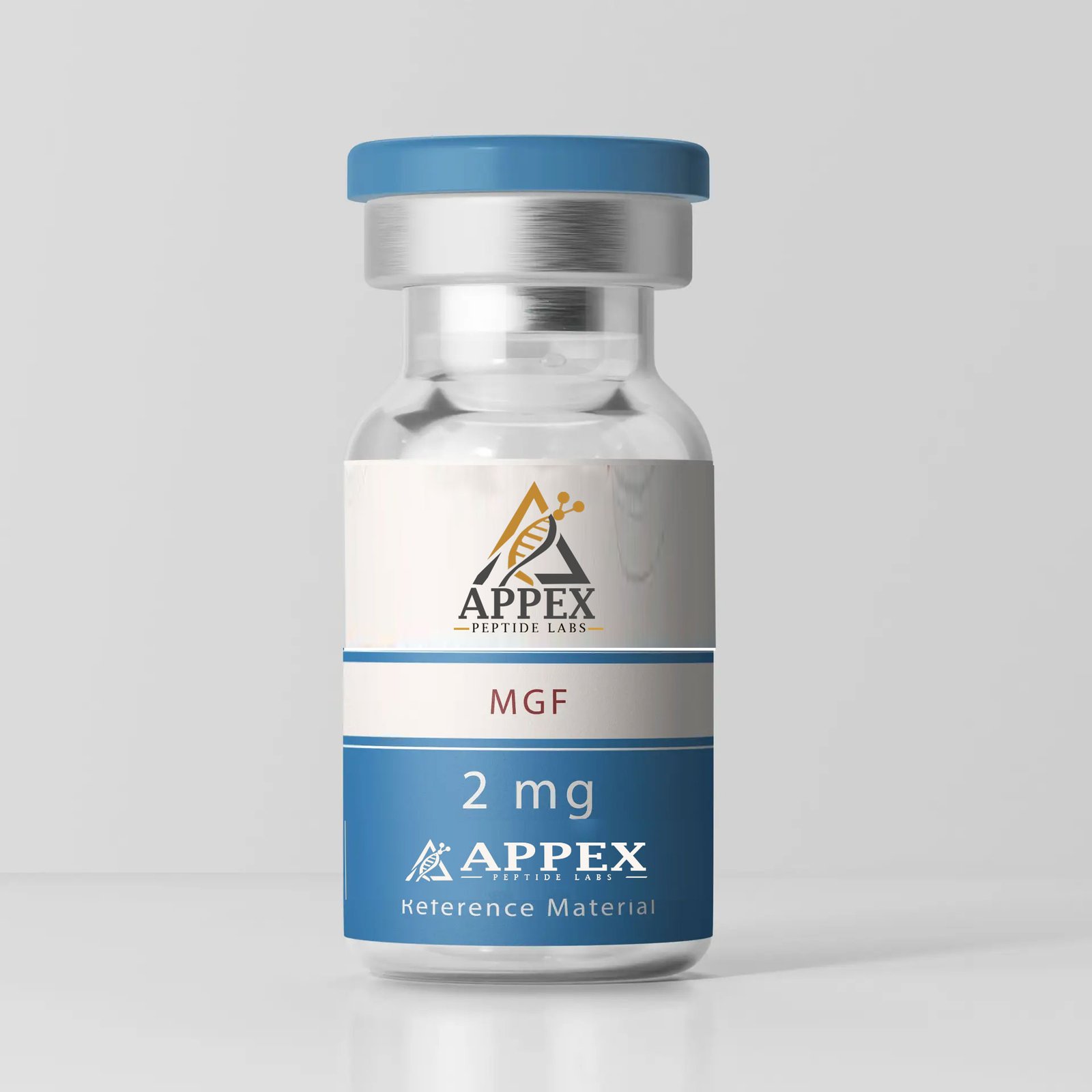



MGF (Mechano Growth Factor) Peptide, also known as IGF-1Ec, is a synthetic 24-amino-acid peptide corresponding to the unique C-terminal sequence generated through alternative splicing of the insulin-like growth factor-1 (IGF-1) gene. Unlike circulating IGF-1 isoforms, MGF is primarily expressed locally following mechanical stimulation, making it an important research tool for investigating tissue-specific molecular signaling and cellular adaptation.
Scientific interest in MGF has grown considerably within molecular biology, skeletal muscle physiology, regenerative biology, peptide pharmacology, and mechanobiology. Researchers utilize this peptide to investigate satellite cell activation, myoblast proliferation, intracellular signaling, mechanosensitive gene expression, and the biological consequences of alternative IGF-1 splicing in experimental systems.
Its defined amino acid sequence, reproducible synthesis, and high analytical purity make MGF particularly valuable for controlled laboratory investigations requiring standardized peptide preparations. Research laboratories employ MGF in studies examining cellular communication, transcriptional regulation, growth factor biology, and peptide-mediated molecular responses following mechanical loading.
Each batch is synthesized under stringent quality control procedures and undergoes analytical verification for identity and purity. Comprehensive documentation, including a Certificate of Analysis (COA), supports experimental consistency and reproducibility.
For research use only. Not intended for human consumption or clinical use.

MGF is extensively utilized to investigate molecular signaling initiated by mechanical stimulation, cellular stress responses, and mechanosensitive biochemical pathways under controlled laboratory conditions. MGF (Mechano Growth Factor) Peptide.
Researchers employ MGF to study molecular events associated with satellite cell activation, proliferation dynamics, cellular communication, and gene regulation in skeletal muscle research models.
Experimental studies investigate MGF as a model for understanding alternative mRNA splicing of the IGF-1 gene and the functional differences between tissue-specific IGF-1 isoforms.
MGF is incorporated into laboratory investigations examining kinase activation, intracellular signaling cascades, transcription factor regulation, and peptide-mediated molecular responses.
Scientists utilize MGF to explore cellular adaptation, tissue remodeling processes, extracellular matrix interactions, and molecular mechanisms associated with mechanical loading in experimental systems.
The peptide serves as a valuable research material for structure-function analysis, comparative peptide biology, receptor-independent signaling investigations, and growth factor research.
| Specification | Details |
|---|---|
| Product Name | MGF (Mechano Growth Factor) Peptide |
| Purity | ≥99% (HPLC Tested) |
| Molecular Formula | C₁₁₇H₂₀₀N₄₂O₃₅ |
| Molecular Weight | Approximately 2868.3 g/mol |
| CAS Number | Not officially assigned |
| Appearance | White to off-white lyophilized powder |
| Storage Conditions | Store at -20°C in a dry environment. Protect from moisture, repeated freeze-thaw cycles, and prolonged light exposure. |
| Solubility | Soluble in sterile laboratory-grade water and appropriate buffered aqueous solutions |
| Sequence | Tyr-Gln-Pro-Pro-Ser-Thr-Asn-Lys-Asn-Thr-Lys-Ser-Gln-Arg-Arg-Lys-Gly-Ser-Thr-Phe-Glu-Glu-His-Lys |
| Available Sizes | 5 mg |
MGF (Mechano Growth Factor), also designated IGF-1Ec, is a splice variant of the insulin-like growth factor-1 (IGF-1) gene generated through alternative messenger RNA processing. Unlike systemic IGF-1 isoforms that circulate throughout the body, MGF is primarily expressed locally within mechanically stimulated tissues, making it an important molecular target for investigating tissue-specific responses to mechanical loading in laboratory research.
Following mechanical stress or experimental stimulation, transcriptional regulation of the IGF1 gene produces multiple splice variants through alternative exon selection. MGF contains a distinctive C-terminal peptide sequence that differentiates it structurally and functionally from mature IGF-1. This unique sequence has become the focus of molecular biology research examining localized growth factor signaling independent of endocrine IGF-1 activity.
Experimental investigations indicate that MGF participates in early cellular responses following mechanical stimulation by influencing molecular pathways associated with satellite cell activation, myoblast proliferation, and cellular adaptation. Researchers commonly evaluate alterations in gene expression using transcriptomic analysis, quantitative PCR, and protein phosphorylation assays to characterize downstream signaling events initiated after MGF exposure.
Laboratory studies also examine interactions between MGF-associated signaling and intracellular pathways involving PI3K/Akt, MAPK/ERK, focal adhesion kinase (FAK), and mechanosensitive signaling proteins. These pathways regulate diverse cellular processes including proliferation, differentiation timing, protein synthesis, cytoskeletal remodeling, and transcriptional activity. Scientists continue investigating how MGF-mediated signaling differs from canonical IGF-1 receptor activation and whether its biological effects involve receptor-dependent or receptor-independent mechanisms under varying experimental conditions.
At the cellular level, MGF serves as a valuable research model for understanding communication between mechanical stimuli and molecular responses. Investigators employ advanced techniques including phosphoproteomics, RNA sequencing, immunoblotting, fluorescence microscopy, and single-cell transcriptomics to characterize changes in signaling networks, transcription factor activation, extracellular matrix interactions, and cellular adaptation following peptide exposure.
From a peptide chemistry perspective, the defined 24-amino-acid sequence provides a reproducible experimental model for studying alternative splice variants of IGF-1 and their biochemical properties. Its standardized synthesis, analytical characterization, and high purity make MGF a dependable research material for biotechnology, pharmaceutical, and academic laboratories investigating mechanobiology, peptide signaling, molecular endocrinology, and growth factor biology.
For research use only. Not intended for human consumption or clinical use.
| Size | 2mg |
|---|---|
| Dimensions | 9 × 7 × .5 in |
| Weight | .125 lbs |




MGF (Mechano Growth Factor) Peptide, also known as IGF-1Ec, is a synthetic 24-amino-acid peptide corresponding to the unique C-terminal sequence generated through alternative splicing of the insulin-like growth factor-1 (IGF-1) gene. Unlike circulating IGF-1 isoforms, MGF is primarily expressed locally following mechanical stimulation, making it an important research tool for investigating tissue-specific molecular signaling and cellular adaptation.
Scientific interest in MGF has grown considerably within molecular biology, skeletal muscle physiology, regenerative biology, peptide pharmacology, and mechanobiology. Researchers utilize this peptide to investigate satellite cell activation, myoblast proliferation, intracellular signaling, mechanosensitive gene expression, and the biological consequences of alternative IGF-1 splicing in experimental systems.
Its defined amino acid sequence, reproducible synthesis, and high analytical purity make MGF particularly valuable for controlled laboratory investigations requiring standardized peptide preparations. Research laboratories employ MGF in studies examining cellular communication, transcriptional regulation, growth factor biology, and peptide-mediated molecular responses following mechanical loading.
Each batch is synthesized under stringent quality control procedures and undergoes analytical verification for identity and purity. Comprehensive documentation, including a Certificate of Analysis (COA), supports experimental consistency and reproducibility.
For research use only. Not intended for human consumption or clinical use.
MGF is extensively utilized to investigate molecular signaling initiated by mechanical stimulation, cellular stress responses, and mechanosensitive biochemical pathways under controlled laboratory conditions. MGF (Mechano Growth Factor) Peptide.
Researchers employ MGF to study molecular events associated with satellite cell activation, proliferation dynamics, cellular communication, and gene regulation in skeletal muscle research models.
Experimental studies investigate MGF as a model for understanding alternative mRNA splicing of the IGF-1 gene and the functional differences between tissue-specific IGF-1 isoforms.
MGF is incorporated into laboratory investigations examining kinase activation, intracellular signaling cascades, transcription factor regulation, and peptide-mediated molecular responses.
Scientists utilize MGF to explore cellular adaptation, tissue remodeling processes, extracellular matrix interactions, and molecular mechanisms associated with mechanical loading in experimental systems.
The peptide serves as a valuable research material for structure-function analysis, comparative peptide biology, receptor-independent signaling investigations, and growth factor research.
| Specification | Details |
|---|---|
| Product Name | MGF (Mechano Growth Factor) Peptide |
| Purity | ≥99% (HPLC Tested) |
| Molecular Formula | C₁₁₇H₂₀₀N₄₂O₃₅ |
| Molecular Weight | Approximately 2868.3 g/mol |
| CAS Number | Not officially assigned |
| Appearance | White to off-white lyophilized powder |
| Storage Conditions | Store at -20°C in a dry environment. Protect from moisture, repeated freeze-thaw cycles, and prolonged light exposure. |
| Solubility | Soluble in sterile laboratory-grade water and appropriate buffered aqueous solutions |
| Sequence | Tyr-Gln-Pro-Pro-Ser-Thr-Asn-Lys-Asn-Thr-Lys-Ser-Gln-Arg-Arg-Lys-Gly-Ser-Thr-Phe-Glu-Glu-His-Lys |
| Available Sizes | 5 mg |
MGF (Mechano Growth Factor), also designated IGF-1Ec, is a splice variant of the insulin-like growth factor-1 (IGF-1) gene generated through alternative messenger RNA processing. Unlike systemic IGF-1 isoforms that circulate throughout the body, MGF is primarily expressed locally within mechanically stimulated tissues, making it an important molecular target for investigating tissue-specific responses to mechanical loading in laboratory research.
Following mechanical stress or experimental stimulation, transcriptional regulation of the IGF1 gene produces multiple splice variants through alternative exon selection. MGF contains a distinctive C-terminal peptide sequence that differentiates it structurally and functionally from mature IGF-1. This unique sequence has become the focus of molecular biology research examining localized growth factor signaling independent of endocrine IGF-1 activity.
Experimental investigations indicate that MGF participates in early cellular responses following mechanical stimulation by influencing molecular pathways associated with satellite cell activation, myoblast proliferation, and cellular adaptation. Researchers commonly evaluate alterations in gene expression using transcriptomic analysis, quantitative PCR, and protein phosphorylation assays to characterize downstream signaling events initiated after MGF exposure.
Laboratory studies also examine interactions between MGF-associated signaling and intracellular pathways involving PI3K/Akt, MAPK/ERK, focal adhesion kinase (FAK), and mechanosensitive signaling proteins. These pathways regulate diverse cellular processes including proliferation, differentiation timing, protein synthesis, cytoskeletal remodeling, and transcriptional activity. Scientists continue investigating how MGF-mediated signaling differs from canonical IGF-1 receptor activation and whether its biological effects involve receptor-dependent or receptor-independent mechanisms under varying experimental conditions.
At the cellular level, MGF serves as a valuable research model for understanding communication between mechanical stimuli and molecular responses. Investigators employ advanced techniques including phosphoproteomics, RNA sequencing, immunoblotting, fluorescence microscopy, and single-cell transcriptomics to characterize changes in signaling networks, transcription factor activation, extracellular matrix interactions, and cellular adaptation following peptide exposure.
From a peptide chemistry perspective, the defined 24-amino-acid sequence provides a reproducible experimental model for studying alternative splice variants of IGF-1 and their biochemical properties. Its standardized synthesis, analytical characterization, and high purity make MGF a dependable research material for biotechnology, pharmaceutical, and academic laboratories investigating mechanobiology, peptide signaling, molecular endocrinology, and growth factor biology.
For research use only. Not intended for human consumption or clinical use.
| Size | 2mg |
|---|---|
| Dimensions | 9 × 7 × .5 in |
| Weight | .125 lbs |