Bulk Orders. Better Value.
Research institutions, universities and clinical teams qualify for volume discounts. Contact our team to discuss custom formulations and bulk pricing.

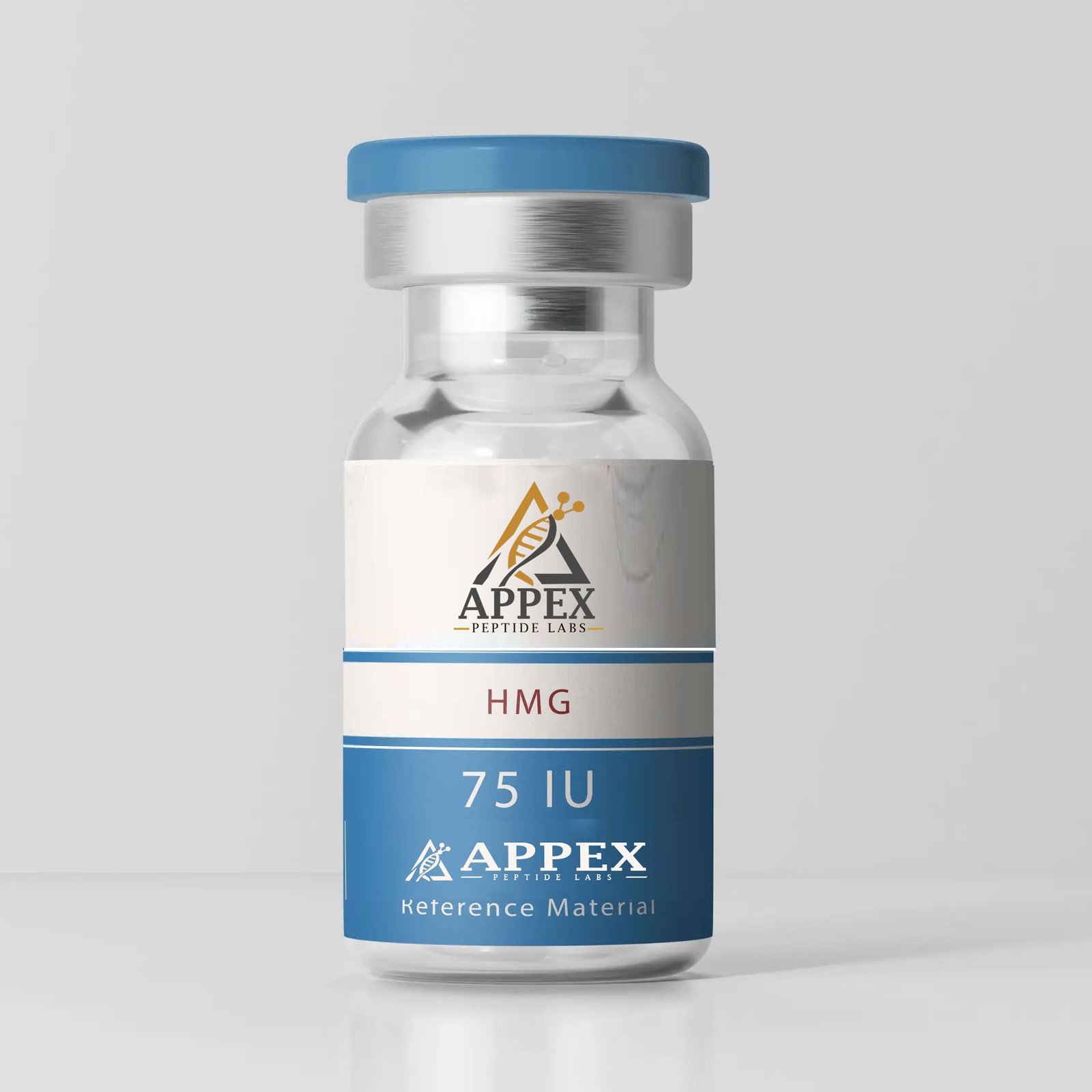
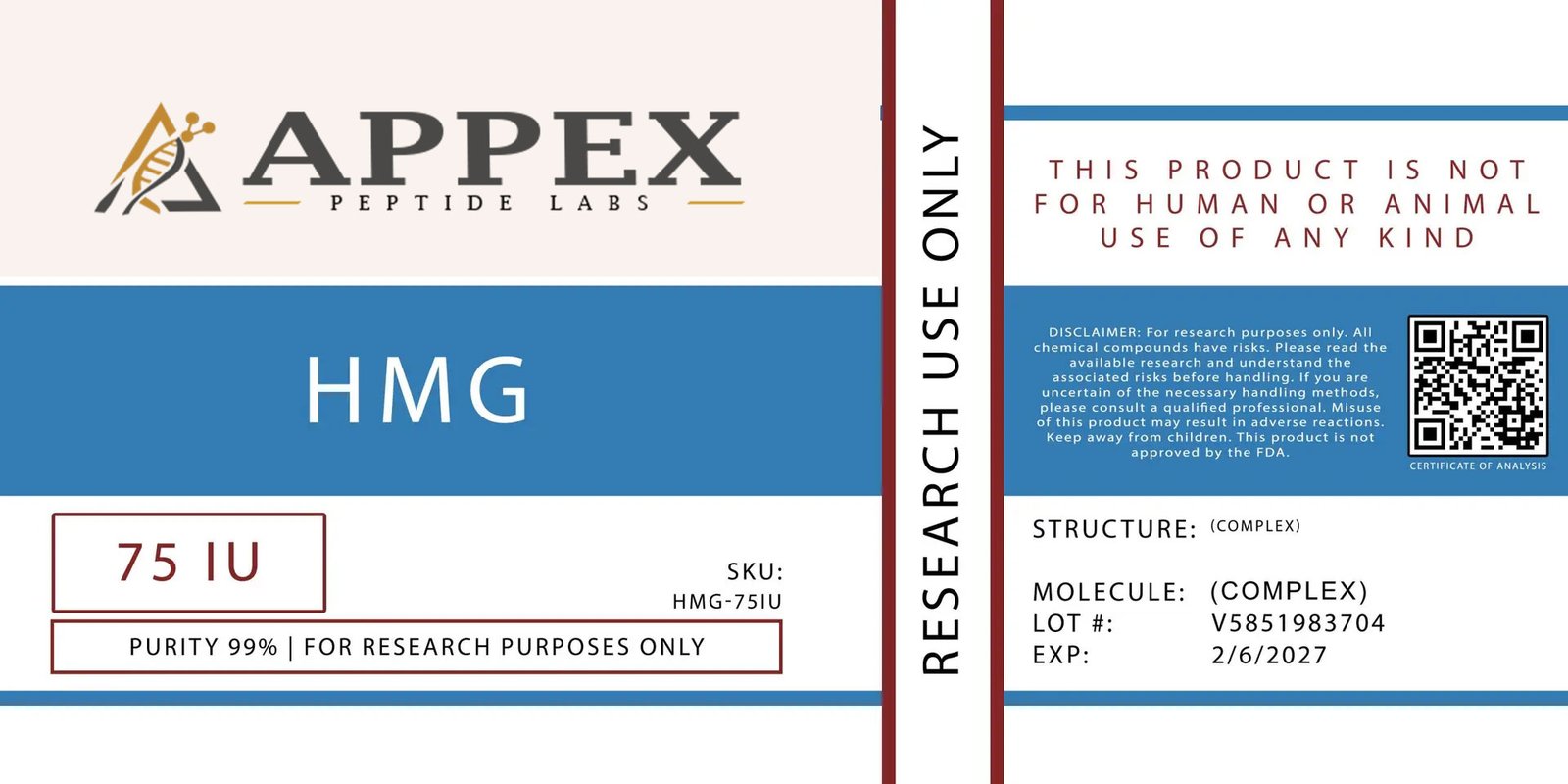

HMG Peptide (Human Menopausal Gonadotropin) is a highly purified glycoprotein hormone preparation composed of both follicle-stimulating hormone (FSH) and luteinizing hormone (LH) bioactivity. These naturally occurring pituitary hormones play central roles in regulating reproductive endocrinology, making HMG Peptide an essential reagent for laboratory investigations involving gonadal physiology, steroidogenesis, gametogenesis, receptor pharmacology, and hypothalamic-pituitary-gonadal (HPG) axis signaling.
Within research environments, HMG Peptide enables scientists to investigate the coordinated activation of FSH and LH receptors, downstream intracellular signaling cascades, hormone-responsive gene expression, and endocrine feedback mechanisms. Because both hormones are present within a single preparation, researchers can evaluate complex physiological interactions that more closely resemble endogenous gonadotropin activity than isolated hormone models.
Appex Peptide Lab supplies research-grade HMG Peptide manufactured according to stringent quality standards with high analytical purity and batch consistency. Comprehensive quality testing supports reproducible experimental outcomes across academic, pharmaceutical, and biotechnology laboratories.
For research use only. Not intended for human consumption or clinical use.
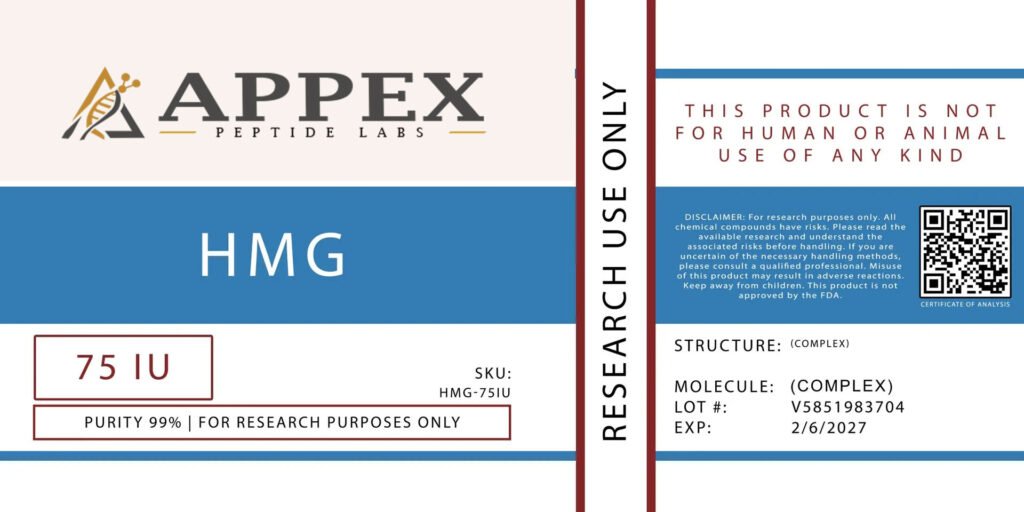
HMG Peptide is extensively used to investigate endocrine regulation of reproductive physiology, hormone secretion, follicular development, and gonadal function under controlled laboratory conditions.
Researchers employ HMG Peptide to evaluate activation of follicle-stimulating hormone receptors (FSHR) and luteinizing hormone/choriogonadotropin receptors (LHCGR), enabling studies of receptor pharmacodynamics and intracellular signaling.
HMG Peptide serves as an experimental reagent for investigating hormone-regulated steroid biosynthesis pathways, including cellular mechanisms governing steroidogenic enzyme expression.
Laboratories utilize HMG Peptide to study cAMP-mediated signaling, protein kinase activation, transcription factor regulation, and downstream molecular responses initiated by gonadotropin receptor stimulation.
Suitable for experiments involving granulosa cells, Sertoli cells, Leydig cells, and other gonadal cell systems used to evaluate hormone-responsive biological processes.
Biotechnology and pharmaceutical researchers incorporate HMG Peptide into assay development, receptor characterization, and preclinical laboratory models investigating endocrine signaling pathways.
| Specification | Details |
|---|---|
| Purity | ≥98% (HPLC verified or equivalent analytical testing) |
| Molecular Formula | Variable glycoprotein hormone complex |
| Molecular Weight | Variable (heterodimeric glycoprotein) |
| CAS Number | Not assigned for HMG mixture |
| Appearance | White to off-white lyophilized powder |
| Storage Conditions | Store at 2–8°C before reconstitution. Store reconstituted material according to laboratory protocol. Protect from repeated freeze-thaw cycles. |
| Solubility | Soluble in sterile laboratory-grade water or appropriate research buffer |
| Sequence | Naturally occurring heterodimeric glycoprotein consisting of FSH and LH subunits |
| Available Sizes | 75 IU, 150 IU, 300 IU (availability may vary) |
HMG Peptide functions as a dual gonadotropin preparation containing both follicle-stimulating hormone (FSH) and luteinizing hormone (LH) biological activity. These glycoprotein hormones belong to the cystine-knot family of heterodimeric proteins and exert their biological effects through highly selective interactions with G protein-coupled receptors expressed on gonadal cells. In laboratory investigations, HMG Peptide provides a valuable model for studying coordinated endocrine signaling across multiple receptor systems.
The FSH component selectively binds to the follicle-stimulating hormone receptor (FSHR), a Gs protein-coupled receptor primarily expressed on granulosa cells in ovarian models and Sertoli cells in testicular research systems. Ligand binding activates adenylate cyclase, resulting in increased intracellular cyclic adenosine monophosphate (cAMP) production. Elevated cAMP subsequently activates protein kinase A (PKA), which phosphorylates transcriptional regulators including cAMP response element-binding protein (CREB). These signaling events influence gene expression involved in cellular differentiation, proliferation, metabolic regulation, and hormone-responsive biological processes.
The LH component interacts with the luteinizing hormone/choriogonadotropin receptor (LHCGR), another G protein-coupled receptor that activates multiple intracellular signaling pathways. In addition to cAMP-PKA signaling, receptor stimulation may engage phospholipase C (PLC), protein kinase C (PKC), extracellular signal-regulated kinase (ERK), phosphoinositide 3-kinase (PI3K)/Akt, and mitogen-activated protein kinase (MAPK) pathways depending on experimental conditions and cellular context. These interconnected signaling networks regulate transcriptional activity, steroidogenic enzyme expression, intracellular calcium mobilization, and cellular metabolic responses.
Because HMG Peptide contains both FSH and LH activity, researchers can investigate synchronized receptor activation within integrated endocrine models. This dual-hormone approach enables evaluation of receptor crosstalk, coordinated intracellular signaling, feedback regulation, and hormone-dependent gene networks that may not be fully represented when studying isolated gonadotropins individually.
Modern laboratory investigations also employ HMG Peptide to characterize receptor kinetics, ligand-receptor affinity, signal transduction efficiency, glycoprotein hormone structure-function relationships, post-translational glycosylation patterns, and endocrine regulatory mechanisms using molecular biology, pharmacology, proteomics, and cell culture platforms. These applications contribute to a broader understanding of gonadotropin biology while supporting reproducible experimental research.
For research use only. Not intended for human consumption or clinical use.
| Size | 75 IU |
|---|---|
| Dimensions | 9 × 7 × .5 in |
| Weight | .125 lbs |
HMG Peptide (Human Menopausal Gonadotropin) is a highly purified glycoprotein hormone preparation composed of both follicle-stimulating hormone (FSH) and luteinizing hormone (LH) bioactivity. These naturally occurring pituitary hormones play central roles in regulating reproductive endocrinology, making HMG Peptide an essential reagent for laboratory investigations involving gonadal physiology, steroidogenesis, gametogenesis, receptor pharmacology, and hypothalamic-pituitary-gonadal (HPG) axis signaling.
Within research environments, HMG Peptide enables scientists to investigate the coordinated activation of FSH and LH receptors, downstream intracellular signaling cascades, hormone-responsive gene expression, and endocrine feedback mechanisms. Because both hormones are present within a single preparation, researchers can evaluate complex physiological interactions that more closely resemble endogenous gonadotropin activity than isolated hormone models.
Appex Peptide Lab supplies research-grade HMG Peptide manufactured according to stringent quality standards with high analytical purity and batch consistency. Comprehensive quality testing supports reproducible experimental outcomes across academic, pharmaceutical, and biotechnology laboratories.
For research use only. Not intended for human consumption or clinical use.
HMG Peptide is extensively used to investigate endocrine regulation of reproductive physiology, hormone secretion, follicular development, and gonadal function under controlled laboratory conditions.
Researchers employ HMG Peptide to evaluate activation of follicle-stimulating hormone receptors (FSHR) and luteinizing hormone/choriogonadotropin receptors (LHCGR), enabling studies of receptor pharmacodynamics and intracellular signaling.
HMG Peptide serves as an experimental reagent for investigating hormone-regulated steroid biosynthesis pathways, including cellular mechanisms governing steroidogenic enzyme expression.
Laboratories utilize HMG Peptide to study cAMP-mediated signaling, protein kinase activation, transcription factor regulation, and downstream molecular responses initiated by gonadotropin receptor stimulation.
Suitable for experiments involving granulosa cells, Sertoli cells, Leydig cells, and other gonadal cell systems used to evaluate hormone-responsive biological processes.
Biotechnology and pharmaceutical researchers incorporate HMG Peptide into assay development, receptor characterization, and preclinical laboratory models investigating endocrine signaling pathways.
| Specification | Details |
|---|---|
| Purity | ≥98% (HPLC verified or equivalent analytical testing) |
| Molecular Formula | Variable glycoprotein hormone complex |
| Molecular Weight | Variable (heterodimeric glycoprotein) |
| CAS Number | Not assigned for HMG mixture |
| Appearance | White to off-white lyophilized powder |
| Storage Conditions | Store at 2–8°C before reconstitution. Store reconstituted material according to laboratory protocol. Protect from repeated freeze-thaw cycles. |
| Solubility | Soluble in sterile laboratory-grade water or appropriate research buffer |
| Sequence | Naturally occurring heterodimeric glycoprotein consisting of FSH and LH subunits |
| Available Sizes | 75 IU, 150 IU, 300 IU (availability may vary) |
HMG Peptide functions as a dual gonadotropin preparation containing both follicle-stimulating hormone (FSH) and luteinizing hormone (LH) biological activity. These glycoprotein hormones belong to the cystine-knot family of heterodimeric proteins and exert their biological effects through highly selective interactions with G protein-coupled receptors expressed on gonadal cells. In laboratory investigations, HMG Peptide provides a valuable model for studying coordinated endocrine signaling across multiple receptor systems.
The FSH component selectively binds to the follicle-stimulating hormone receptor (FSHR), a Gs protein-coupled receptor primarily expressed on granulosa cells in ovarian models and Sertoli cells in testicular research systems. Ligand binding activates adenylate cyclase, resulting in increased intracellular cyclic adenosine monophosphate (cAMP) production. Elevated cAMP subsequently activates protein kinase A (PKA), which phosphorylates transcriptional regulators including cAMP response element-binding protein (CREB). These signaling events influence gene expression involved in cellular differentiation, proliferation, metabolic regulation, and hormone-responsive biological processes.
The LH component interacts with the luteinizing hormone/choriogonadotropin receptor (LHCGR), another G protein-coupled receptor that activates multiple intracellular signaling pathways. In addition to cAMP-PKA signaling, receptor stimulation may engage phospholipase C (PLC), protein kinase C (PKC), extracellular signal-regulated kinase (ERK), phosphoinositide 3-kinase (PI3K)/Akt, and mitogen-activated protein kinase (MAPK) pathways depending on experimental conditions and cellular context. These interconnected signaling networks regulate transcriptional activity, steroidogenic enzyme expression, intracellular calcium mobilization, and cellular metabolic responses.
Because HMG Peptide contains both FSH and LH activity, researchers can investigate synchronized receptor activation within integrated endocrine models. This dual-hormone approach enables evaluation of receptor crosstalk, coordinated intracellular signaling, feedback regulation, and hormone-dependent gene networks that may not be fully represented when studying isolated gonadotropins individually.
Modern laboratory investigations also employ HMG Peptide to characterize receptor kinetics, ligand-receptor affinity, signal transduction efficiency, glycoprotein hormone structure-function relationships, post-translational glycosylation patterns, and endocrine regulatory mechanisms using molecular biology, pharmacology, proteomics, and cell culture platforms. These applications contribute to a broader understanding of gonadotropin biology while supporting reproducible experimental research.
For research use only. Not intended for human consumption or clinical use.
| Size | 75 IU |
|---|---|
| Dimensions | 9 × 7 × .5 in |
| Weight | .125 lbs |