Bulk Orders. Better Value.
Research institutions, universities and clinical teams qualify for volume discounts. Contact our team to discuss custom formulations and bulk pricing.

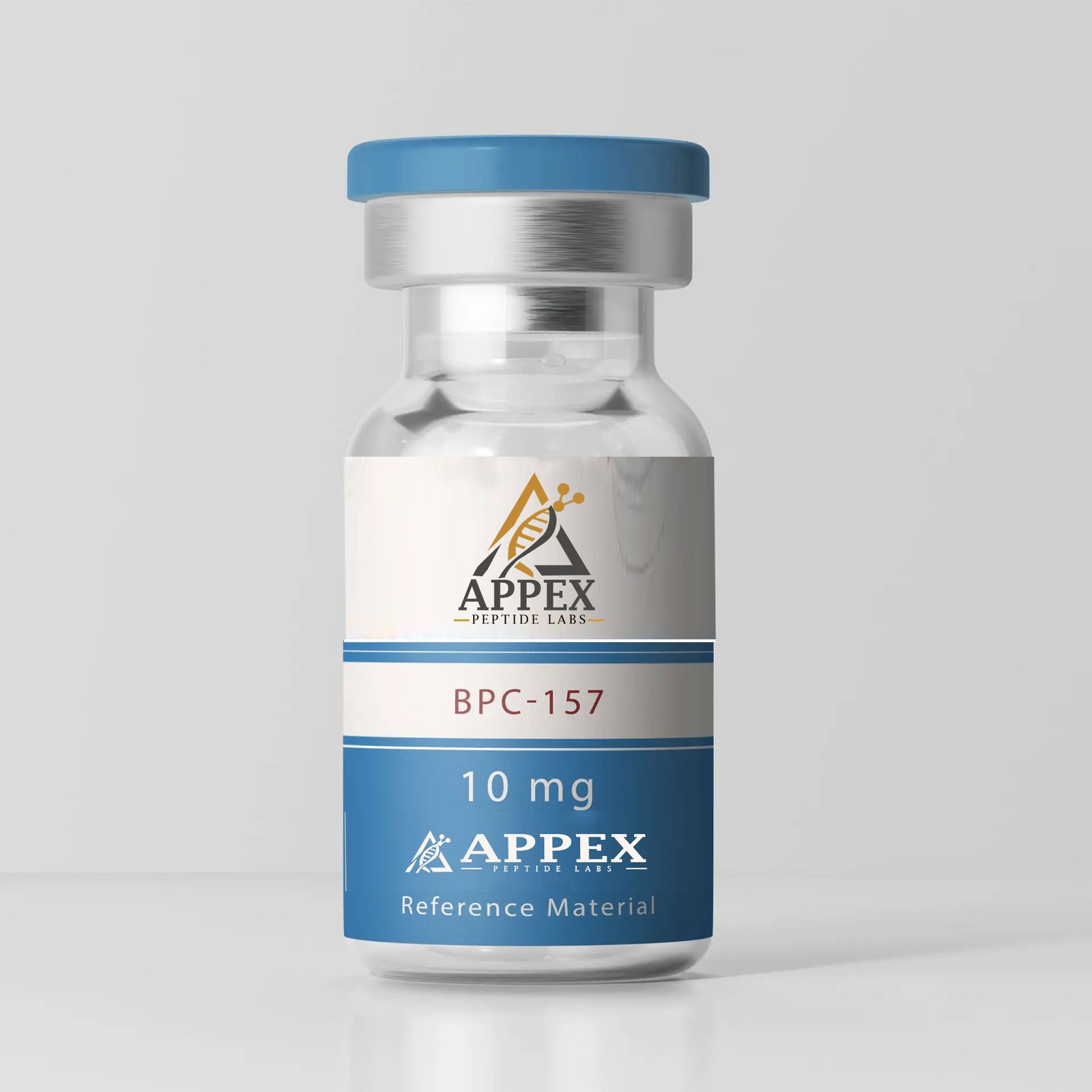
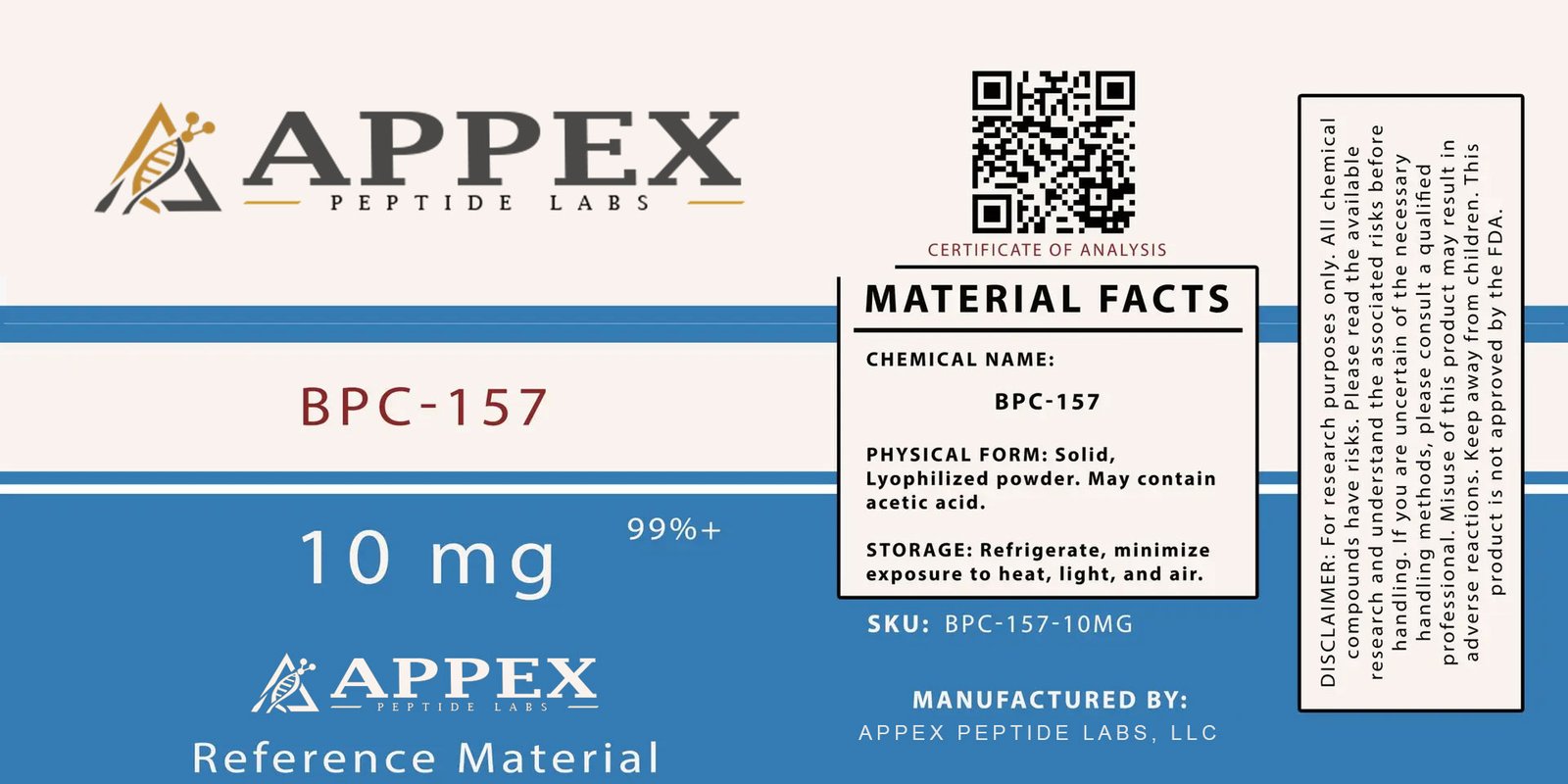
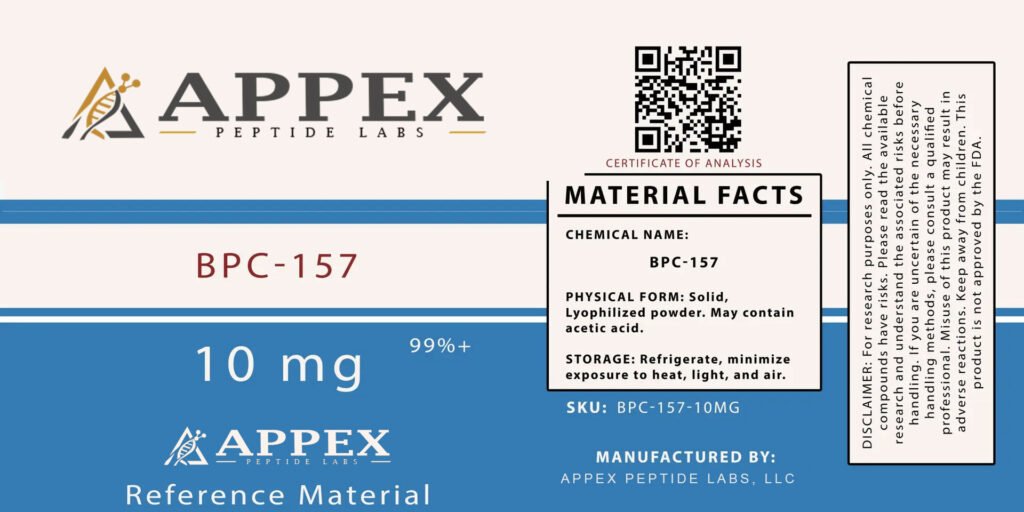
BPC-157 Peptide is a synthetic pentadecapeptide extensively investigated in laboratory research for its involvement in cellular communication, extracellular matrix regulation, angiogenic signaling, and tissue remodeling. Derived from a peptide sequence associated with gastric proteins, BPC-157 has become one of the most widely studied experimental peptides in regenerative biology due to its broad range of molecular interactions observed under controlled research conditions.
Current scientific literature continues to explore BPC-157 across numerous experimental models involving connective tissue biology, vascular signaling, gastrointestinal physiology, fibroblast activity, collagen organization, and intracellular communication. Researchers also investigate its influence on molecular pathways associated with nitric oxide signaling, angiogenic factors, extracellular matrix proteins, and cellular migration.
At Appex Peptide Lab, BPC-157 Peptide is manufactured using carefully controlled peptide synthesis and purification processes to ensure exceptional purity and batch-to-batch reproducibility. Every production lot undergoes independent analytical verification before release, providing researchers with confidence in product quality and structural integrity.
Trusted by universities, biotechnology companies, pharmaceutical organizations, and life science laboratories throughout the United States, Canada, and Australia, BPC-157 Peptide supports advanced scientific investigations requiring reliable research-grade peptide materials.
Researchers require peptide standards that provide exceptional analytical quality and reproducible experimental performance. BPC-157 Peptide from Appex Peptide Lab is manufactured to rigorous scientific standards for demanding laboratory applications.
Researchers choose this product because it offers:
Laboratory investigations involving cellular repair mechanisms, extracellular matrix organization, and tissue remodeling pathways.
Studies examining molecular pathways associated with vascular development, endothelial signaling, and microvascular biology.
Experimental investigations involving epithelial biology, mucosal integrity, and gastrointestinal cellular signaling.
Research evaluating fibroblast biology, collagen organization, extracellular matrix proteins, and connective tissue physiology.
Studies involving intracellular signaling pathways, peptide-mediated gene regulation, and protein expression.
Laboratory investigations examining cellular movement, adhesion molecules, and tissue organization under experimental conditions.
Experimental models exploring molecular responses associated with oxidative stress and cellular homeostasis.
Research focused on peptide stability, structure-activity relationships, receptor interactions, and molecular pharmacology.
| Specification | Details |
|---|---|
| Product Name | BPC-157 Peptide |
| Alternative Name | Body Protection Compound-157 |
| Available Sizes | 5 mg, 10 mg |
| Purity | ≥99% (HPLC Verified) |
| Peptide Type | Synthetic Pentadecapeptide |
| Molecular Formula | C₆₂H₉₈N₁₆O₂₂ |
| Molecular Weight | Approximately 1,419.5 g/mol |
| CAS Number | 137525-51-0 |
| Appearance | White to off-white lyophilized powder |
| Solubility | Soluble in appropriate laboratory-grade aqueous research solvents |
| Storage Conditions | Store unopened at -20°C. Protect from moisture, excessive heat, direct light, and repeated freeze-thaw cycles. |
| Sequence | Gly-Glu-Pro-Pro-Pro-Gly-Lys-Pro-Ala-Asp-Asp-Ala-Gly-Leu-Val |
Within laboratory research, BPC-157 Peptide is investigated for its participation in multiple molecular pathways involved in cellular signaling, extracellular matrix regulation, and tissue organization. Unlike receptor-selective peptides that primarily target a single signaling pathway, BPC-157 has been examined across numerous experimental systems because of its broad interactions with cellular communication networks associated with connective tissue biology and vascular physiology.
Published laboratory studies have investigated BPC-157 in relation to angiogenic signaling, including pathways involving vascular endothelial growth factor (VEGF), endothelial cell migration, and microvascular remodeling. Researchers also examine its interaction with nitric oxide (NO) signaling, an important regulator of vascular homeostasis and intracellular communication within experimental models.
Additional investigations have explored how BPC-157 influences fibroblast activity, extracellular matrix protein synthesis, collagen organization, and matrix remodeling. Molecular studies continue to evaluate peptide-mediated regulation of growth factors, cytokine signaling, cell adhesion molecules, and intracellular kinase pathways associated with cellular adaptation and tissue organization.
Researchers have also examined BPC-157 in studies involving oxidative stress responses, inflammatory signaling, epithelial biology, gastrointestinal physiology, tendon-derived cell cultures, and musculoskeletal tissue models. These investigations focus on understanding peptide-mediated molecular mechanisms rather than evaluating therapeutic applications.
Ongoing scientific research continues to expand knowledge of BPC-157 across peptide pharmacology, regenerative biology, molecular endocrinology, and cellular physiology. Its diverse biochemical interactions make it a valuable experimental tool for laboratories investigating peptide signaling, extracellular matrix dynamics, and cellular communication within controlled research environments.
For research use only. Not intended for human consumption or clinical use.
| Size | 10mg, 5mg |
|---|---|
| Dimensions | 9 × 7 × .5 in |
| Weight | .125 lbs |
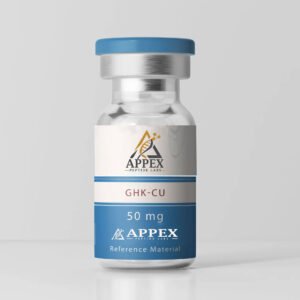
BPC-157 Peptide is a synthetic pentadecapeptide extensively investigated in laboratory research for its involvement in cellular communication, extracellular matrix regulation, angiogenic signaling, and tissue remodeling. Derived from a peptide sequence associated with gastric proteins, BPC-157 has become one of the most widely studied experimental peptides in regenerative biology due to its broad range of molecular interactions observed under controlled research conditions.
Current scientific literature continues to explore BPC-157 across numerous experimental models involving connective tissue biology, vascular signaling, gastrointestinal physiology, fibroblast activity, collagen organization, and intracellular communication. Researchers also investigate its influence on molecular pathways associated with nitric oxide signaling, angiogenic factors, extracellular matrix proteins, and cellular migration.
At Appex Peptide Lab, BPC-157 Peptide is manufactured using carefully controlled peptide synthesis and purification processes to ensure exceptional purity and batch-to-batch reproducibility. Every production lot undergoes independent analytical verification before release, providing researchers with confidence in product quality and structural integrity.
Trusted by universities, biotechnology companies, pharmaceutical organizations, and life science laboratories throughout the United States, Canada, and Australia, BPC-157 Peptide supports advanced scientific investigations requiring reliable research-grade peptide materials.
Researchers require peptide standards that provide exceptional analytical quality and reproducible experimental performance. BPC-157 Peptide from Appex Peptide Lab is manufactured to rigorous scientific standards for demanding laboratory applications.
Researchers choose this product because it offers:
Laboratory investigations involving cellular repair mechanisms, extracellular matrix organization, and tissue remodeling pathways.
Studies examining molecular pathways associated with vascular development, endothelial signaling, and microvascular biology.
Experimental investigations involving epithelial biology, mucosal integrity, and gastrointestinal cellular signaling.
Research evaluating fibroblast biology, collagen organization, extracellular matrix proteins, and connective tissue physiology.
Studies involving intracellular signaling pathways, peptide-mediated gene regulation, and protein expression.
Laboratory investigations examining cellular movement, adhesion molecules, and tissue organization under experimental conditions.
Experimental models exploring molecular responses associated with oxidative stress and cellular homeostasis.
Research focused on peptide stability, structure-activity relationships, receptor interactions, and molecular pharmacology.
| Specification | Details |
|---|---|
| Product Name | BPC-157 Peptide |
| Alternative Name | Body Protection Compound-157 |
| Available Sizes | 5 mg, 10 mg |
| Purity | ≥99% (HPLC Verified) |
| Peptide Type | Synthetic Pentadecapeptide |
| Molecular Formula | C₆₂H₉₈N₁₆O₂₂ |
| Molecular Weight | Approximately 1,419.5 g/mol |
| CAS Number | 137525-51-0 |
| Appearance | White to off-white lyophilized powder |
| Solubility | Soluble in appropriate laboratory-grade aqueous research solvents |
| Storage Conditions | Store unopened at -20°C. Protect from moisture, excessive heat, direct light, and repeated freeze-thaw cycles. |
| Sequence | Gly-Glu-Pro-Pro-Pro-Gly-Lys-Pro-Ala-Asp-Asp-Ala-Gly-Leu-Val |
Within laboratory research, BPC-157 Peptide is investigated for its participation in multiple molecular pathways involved in cellular signaling, extracellular matrix regulation, and tissue organization. Unlike receptor-selective peptides that primarily target a single signaling pathway, BPC-157 has been examined across numerous experimental systems because of its broad interactions with cellular communication networks associated with connective tissue biology and vascular physiology.
Published laboratory studies have investigated BPC-157 in relation to angiogenic signaling, including pathways involving vascular endothelial growth factor (VEGF), endothelial cell migration, and microvascular remodeling. Researchers also examine its interaction with nitric oxide (NO) signaling, an important regulator of vascular homeostasis and intracellular communication within experimental models.
Additional investigations have explored how BPC-157 influences fibroblast activity, extracellular matrix protein synthesis, collagen organization, and matrix remodeling. Molecular studies continue to evaluate peptide-mediated regulation of growth factors, cytokine signaling, cell adhesion molecules, and intracellular kinase pathways associated with cellular adaptation and tissue organization.
Researchers have also examined BPC-157 in studies involving oxidative stress responses, inflammatory signaling, epithelial biology, gastrointestinal physiology, tendon-derived cell cultures, and musculoskeletal tissue models. These investigations focus on understanding peptide-mediated molecular mechanisms rather than evaluating therapeutic applications.
Ongoing scientific research continues to expand knowledge of BPC-157 across peptide pharmacology, regenerative biology, molecular endocrinology, and cellular physiology. Its diverse biochemical interactions make it a valuable experimental tool for laboratories investigating peptide signaling, extracellular matrix dynamics, and cellular communication within controlled research environments.
For research use only. Not intended for human consumption or clinical use.
| Size | 10mg, 5mg |
|---|---|
| Dimensions | 9 × 7 × .5 in |
| Weight | .125 lbs |