Bulk Orders. Better Value.
Research institutions, universities and clinical teams qualify for volume discounts. Contact our team to discuss custom formulations and bulk pricing.

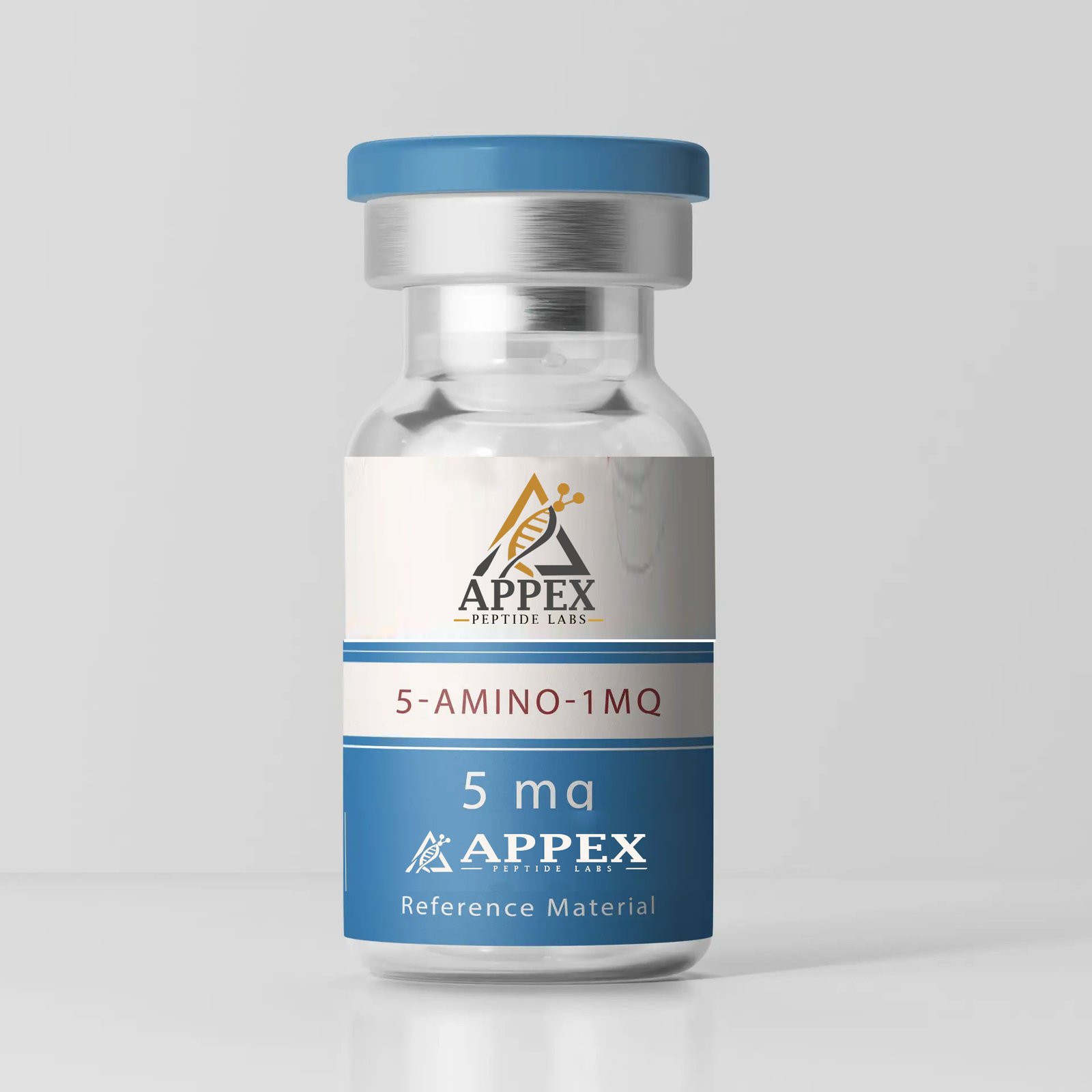
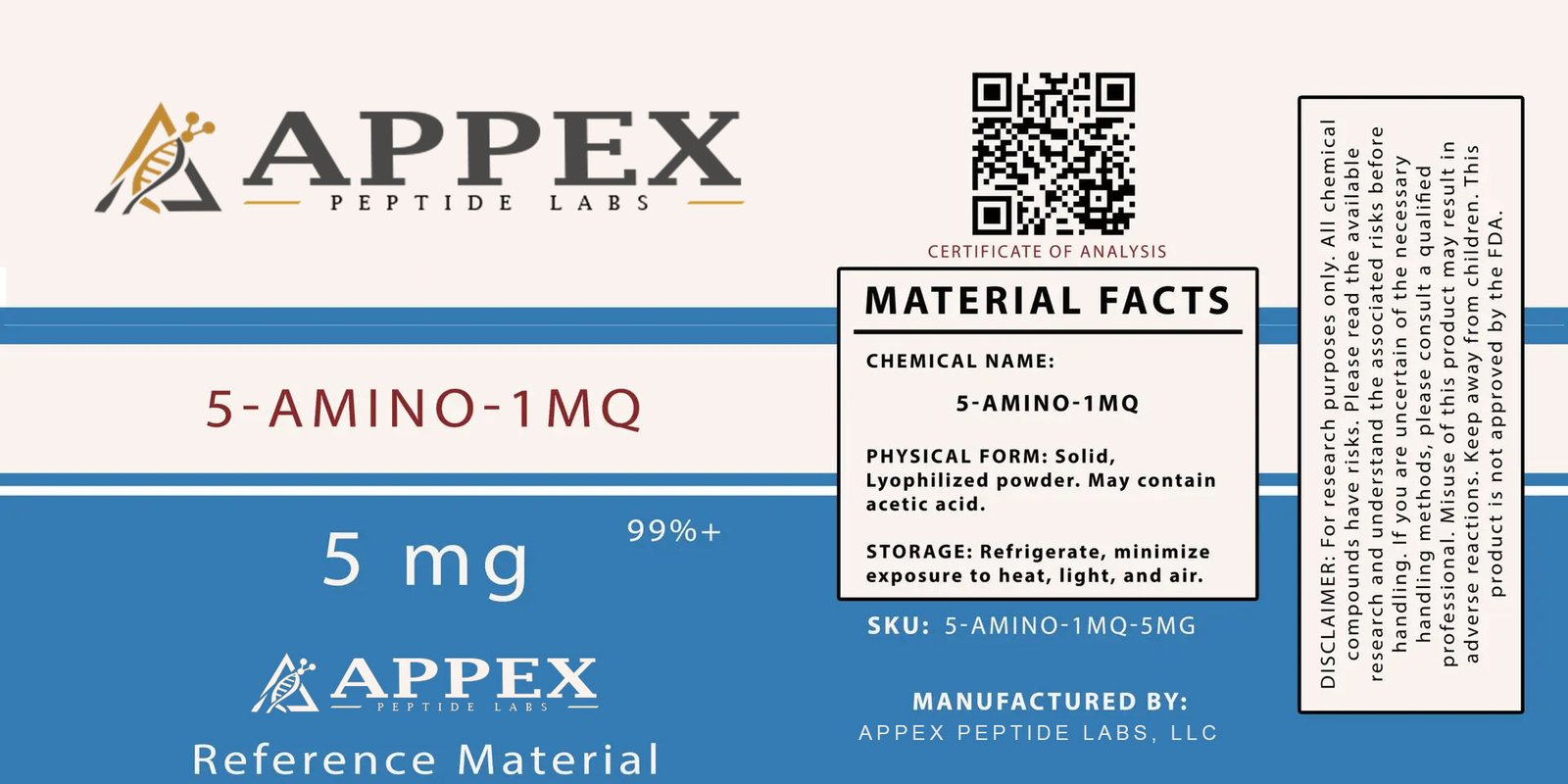

5-Amino-1MQ is a synthetic quinolinium-based small molecule developed as a potent and selective inhibitor of nicotinamide N-methyltransferase (NNMT), a cytosolic enzyme responsible for transferring methyl groups from S-adenosyl-L-methionine (SAM) to nicotinamide, producing 1-methylnicotinamide (1-MNA). Because NNMT plays a significant role in cellular methylation balance and nicotinamide metabolism, 5-Amino-1MQ has become an important research reagent in metabolic biology and enzymology.
Published laboratory studies utilize 5-Amino-1MQ to investigate the relationship between NNMT activity, intracellular NAD⁺ availability, methyl donor metabolism, mitochondrial bioenergetics, and cellular metabolic adaptation. Researchers continue to examine how selective NNMT inhibition influences one-carbon metabolism, energy homeostasis, epigenetic regulation, and metabolic signaling across various experimental systems.
Beyond metabolic research, 5-Amino-1MQ has become valuable in molecular pharmacology, systems biology, and biochemical pathway analysis because of its high selectivity, favorable cellular permeability, and reproducible biochemical activity.
Each batch is manufactured under rigorous quality-controlled conditions, analytically verified for purity and structural identity, and supplied as a stable crystalline powder with a comprehensive Certificate of Analysis to support reliable scientific research.
For research use only. Not intended for human consumption or clinical use.
Researchers utilize 5-Amino-1MQ to investigate catalytic activity, substrate specificity, inhibitor selectivity, and kinetic regulation of nicotinamide N-methyltransferase.
Experimental systems employ 5-Amino-1MQ to examine nicotinamide recycling, NAD⁺ biosynthesis, salvage pathway regulation, and intracellular cofactor homeostasis.
Scientists investigate mitochondrial respiration, ATP production, oxidative metabolism, and energy utilization following selective NNMT inhibition.
Laboratory studies evaluate methyl donor utilization, SAM-dependent methylation reactions, epigenetic regulation, and cellular methylation balance.
Researchers investigate compound selectivity, intracellular uptake, enzyme inhibition kinetics, pharmacodynamics, and structure-activity relationships.
5-Amino-1MQ is incorporated into metabolomic profiling, pathway analysis, biomarker discovery, and systems biology investigations focused on metabolic regulation.
| Specification | Details |
|---|---|
| Product Name | 5-Amino-1MQ |
| Chemical Name | 5-Amino-1-methylquinolinium |
| Purity | ≥99% (HPLC Verified) |
| Molecular Formula | C₁₀H₁₁N₂⁺ |
| Molecular Weight | 159.21 g/mol (cation) |
| CAS Number | Not universally assigned for all research-grade forms |
| Appearance | Yellow to yellow-brown crystalline powder |
| Solubility | Soluble in water, DMSO, and other appropriate laboratory solvents |
| Storage Conditions | Store in a tightly sealed container at 2–8°C in a dry, light-protected environment. |
| Structure | Quinolinium-based small-molecule NNMT inhibitor |
| Available Sizes | 5 mg, 10 mg, 50 mg |
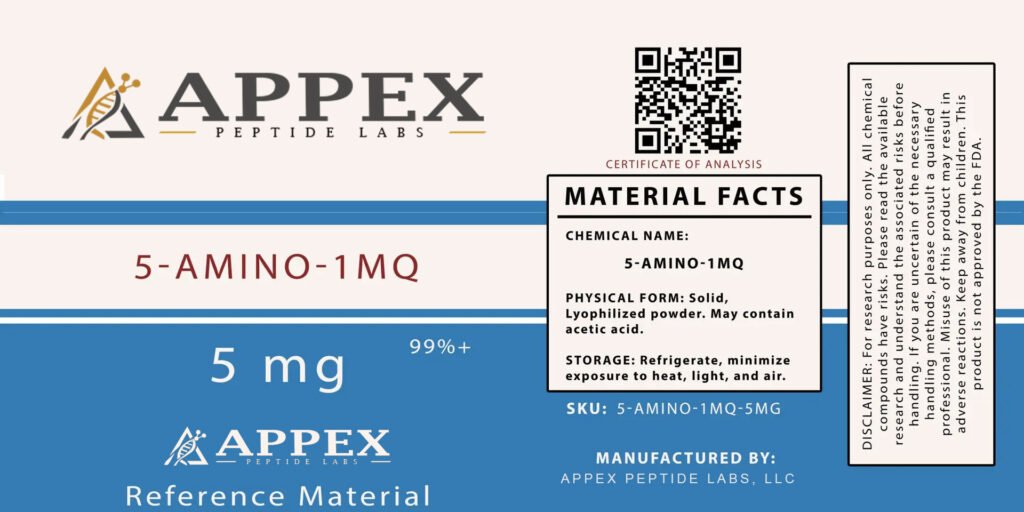
5-Amino-1MQ is a selective, cell-permeable small-molecule inhibitor of nicotinamide N-methyltransferase (NNMT), a cytosolic methyltransferase that catalyzes the transfer of a methyl group from S-adenosyl-L-methionine (SAM) to nicotinamide, producing 1-methylnicotinamide (1-MNA) and S-adenosyl-L-homocysteine (SAH). In laboratory research, inhibition of this enzyme provides a valuable model for investigating the relationship between methyl donor utilization, NAD⁺ metabolism, and cellular energy homeostasis.
Biochemical studies indicate that 5-Amino-1MQ binds selectively to the catalytic region of NNMT, reducing enzymatic methyl transfer activity. This decreases the conversion of nicotinamide into 1-MNA, allowing researchers to evaluate how intracellular nicotinamide availability influences the NAD⁺ salvage pathway, a critical metabolic route responsible for maintaining cellular NAD⁺ pools.
Changes in NAD⁺ availability can affect the activity of multiple NAD⁺-dependent enzymes, including sirtuins (SIRT1–SIRT7) and poly(ADP-ribose) polymerases (PARPs). These enzyme families regulate transcription, chromatin remodeling, DNA damage responses, mitochondrial function, and cellular metabolic adaptation. Consequently, 5-Amino-1MQ is frequently incorporated into studies exploring the molecular relationship between NNMT activity and global metabolic regulation.
Published laboratory investigations have also examined the compound’s influence on one-carbon metabolism, intracellular methyl donor balance, SAM/SAH ratios, mitochondrial respiration, lipid metabolism, and broader metabolomic profiles. Because NNMT serves as an interface between methylation reactions and energy metabolism, selective inhibition with 5-Amino-1MQ enables researchers to study coordinated metabolic network responses using transcriptomic, proteomic, and metabolomic approaches.
Its high selectivity, favorable cellular permeability, and reproducible biochemical activity make 5-Amino-1MQ an important research tool for enzymology, metabolic biology, molecular pharmacology, systems biology, and biotechnology laboratories investigating the regulation of cellular metabolism.
For research use only. Not intended for human consumption or clinical use.
| Size | 10mg, 50mg, 5mg |
|---|---|
| Dimensions | 9 × 7 × .5 in |
| Weight | .125 lbs |
5-Amino-1MQ is a synthetic quinolinium-based small molecule developed as a potent and selective inhibitor of nicotinamide N-methyltransferase (NNMT), a cytosolic enzyme responsible for transferring methyl groups from S-adenosyl-L-methionine (SAM) to nicotinamide, producing 1-methylnicotinamide (1-MNA). Because NNMT plays a significant role in cellular methylation balance and nicotinamide metabolism, 5-Amino-1MQ has become an important research reagent in metabolic biology and enzymology.
Published laboratory studies utilize 5-Amino-1MQ to investigate the relationship between NNMT activity, intracellular NAD⁺ availability, methyl donor metabolism, mitochondrial bioenergetics, and cellular metabolic adaptation. Researchers continue to examine how selective NNMT inhibition influences one-carbon metabolism, energy homeostasis, epigenetic regulation, and metabolic signaling across various experimental systems.
Beyond metabolic research, 5-Amino-1MQ has become valuable in molecular pharmacology, systems biology, and biochemical pathway analysis because of its high selectivity, favorable cellular permeability, and reproducible biochemical activity.
Each batch is manufactured under rigorous quality-controlled conditions, analytically verified for purity and structural identity, and supplied as a stable crystalline powder with a comprehensive Certificate of Analysis to support reliable scientific research.
For research use only. Not intended for human consumption or clinical use.
Researchers utilize 5-Amino-1MQ to investigate catalytic activity, substrate specificity, inhibitor selectivity, and kinetic regulation of nicotinamide N-methyltransferase.
Experimental systems employ 5-Amino-1MQ to examine nicotinamide recycling, NAD⁺ biosynthesis, salvage pathway regulation, and intracellular cofactor homeostasis.
Scientists investigate mitochondrial respiration, ATP production, oxidative metabolism, and energy utilization following selective NNMT inhibition.
Laboratory studies evaluate methyl donor utilization, SAM-dependent methylation reactions, epigenetic regulation, and cellular methylation balance.
Researchers investigate compound selectivity, intracellular uptake, enzyme inhibition kinetics, pharmacodynamics, and structure-activity relationships.
5-Amino-1MQ is incorporated into metabolomic profiling, pathway analysis, biomarker discovery, and systems biology investigations focused on metabolic regulation.
| Specification | Details |
|---|---|
| Product Name | 5-Amino-1MQ |
| Chemical Name | 5-Amino-1-methylquinolinium |
| Purity | ≥99% (HPLC Verified) |
| Molecular Formula | C₁₀H₁₁N₂⁺ |
| Molecular Weight | 159.21 g/mol (cation) |
| CAS Number | Not universally assigned for all research-grade forms |
| Appearance | Yellow to yellow-brown crystalline powder |
| Solubility | Soluble in water, DMSO, and other appropriate laboratory solvents |
| Storage Conditions | Store in a tightly sealed container at 2–8°C in a dry, light-protected environment. |
| Structure | Quinolinium-based small-molecule NNMT inhibitor |
| Available Sizes | 5 mg, 10 mg, 50 mg |
5-Amino-1MQ is a selective, cell-permeable small-molecule inhibitor of nicotinamide N-methyltransferase (NNMT), a cytosolic methyltransferase that catalyzes the transfer of a methyl group from S-adenosyl-L-methionine (SAM) to nicotinamide, producing 1-methylnicotinamide (1-MNA) and S-adenosyl-L-homocysteine (SAH). In laboratory research, inhibition of this enzyme provides a valuable model for investigating the relationship between methyl donor utilization, NAD⁺ metabolism, and cellular energy homeostasis.
Biochemical studies indicate that 5-Amino-1MQ binds selectively to the catalytic region of NNMT, reducing enzymatic methyl transfer activity. This decreases the conversion of nicotinamide into 1-MNA, allowing researchers to evaluate how intracellular nicotinamide availability influences the NAD⁺ salvage pathway, a critical metabolic route responsible for maintaining cellular NAD⁺ pools.
Changes in NAD⁺ availability can affect the activity of multiple NAD⁺-dependent enzymes, including sirtuins (SIRT1–SIRT7) and poly(ADP-ribose) polymerases (PARPs). These enzyme families regulate transcription, chromatin remodeling, DNA damage responses, mitochondrial function, and cellular metabolic adaptation. Consequently, 5-Amino-1MQ is frequently incorporated into studies exploring the molecular relationship between NNMT activity and global metabolic regulation.
Published laboratory investigations have also examined the compound’s influence on one-carbon metabolism, intracellular methyl donor balance, SAM/SAH ratios, mitochondrial respiration, lipid metabolism, and broader metabolomic profiles. Because NNMT serves as an interface between methylation reactions and energy metabolism, selective inhibition with 5-Amino-1MQ enables researchers to study coordinated metabolic network responses using transcriptomic, proteomic, and metabolomic approaches.
Its high selectivity, favorable cellular permeability, and reproducible biochemical activity make 5-Amino-1MQ an important research tool for enzymology, metabolic biology, molecular pharmacology, systems biology, and biotechnology laboratories investigating the regulation of cellular metabolism.
For research use only. Not intended for human consumption or clinical use.
| Size | 10mg, 50mg, 5mg |
|---|---|
| Dimensions | 9 × 7 × .5 in |
| Weight | .125 lbs |