Bulk Orders. Better Value.
Research institutions, universities and clinical teams qualify for volume discounts. Contact our team to discuss custom formulations and bulk pricing.

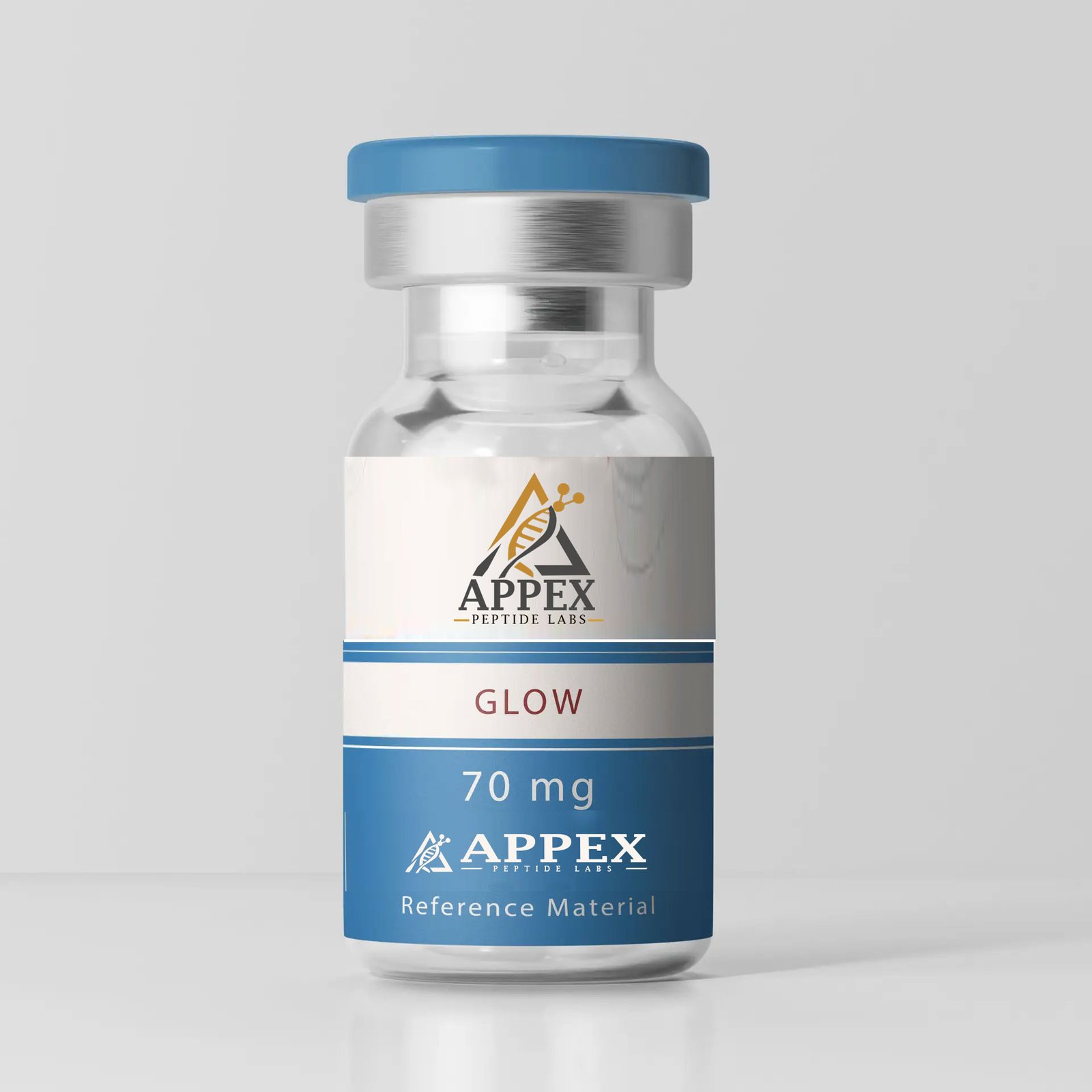
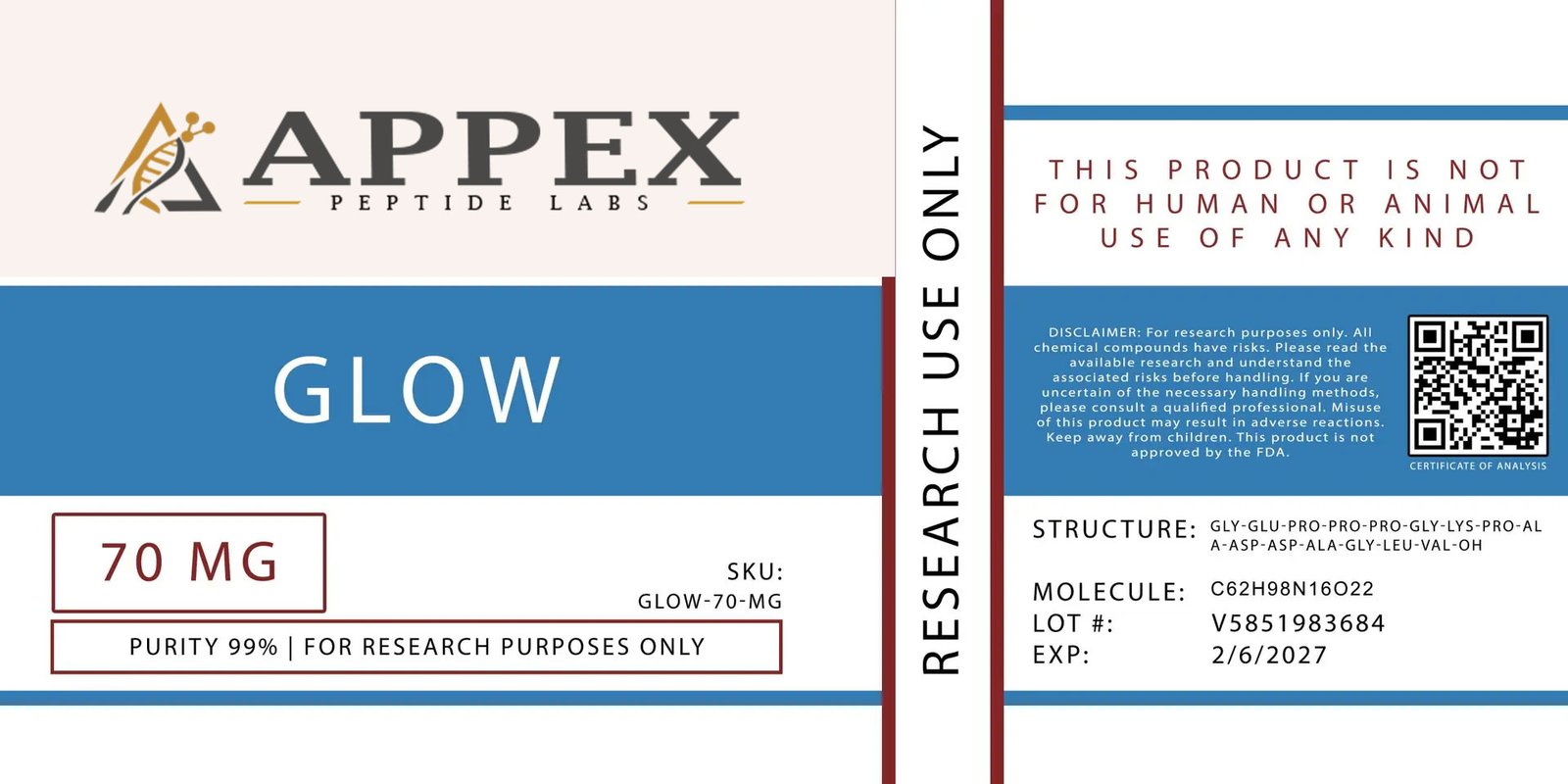
Glow | GHK-Cu + TB-500 + BPC-157 Blend brings together three extensively investigated research peptides into a single formulation designed for sophisticated laboratory applications. Each component has been independently studied for its unique molecular interactions, while the combined blend enables researchers to examine overlapping biological pathways within integrated experimental systems.
GHK-Cu is widely investigated for its interaction with extracellular matrix regulation, metalloproteinase activity, copper-dependent biological processes, and cellular signaling networks. TB-500, a synthetic fragment derived from thymosin beta-4, has attracted significant scientific interest because of its relationship with actin dynamics, cellular migration, and cytoskeletal remodeling. BPC-157 has been explored in laboratory settings for its involvement in nitric oxide signaling, growth factor modulation, cellular communication, and tissue-associated molecular pathways.
By combining these peptides, researchers can investigate coordinated molecular responses that may not be readily observed when each peptide is evaluated independently. This formulation supports experimental designs involving cell culture, molecular biology, peptide interaction studies, regenerative biology models, extracellular matrix investigations, and systems biology research.
Each vial is manufactured using stringent quality standards, verified through analytical testing, and supplied with supporting documentation to promote consistency across laboratory workflows.
For research use only. Not intended for human consumption or clinical use.
Researchers utilize this peptide blend to investigate extracellular matrix organization, matrix remodeling processes, collagen-associated signaling, and fibroblast-mediated cellular communication within controlled laboratory models.
The formulation supports investigations examining cytoskeletal organization, actin filament dynamics, integrin-mediated signaling, and mechanisms governing cellular movement during experimental research.
Laboratories studying vascular biology employ peptide-based models to explore signaling pathways associated with angiogenic regulation, endothelial cell communication, and growth factor interactions.
Combining GHK-Cu, TB-500, and BPC-157 enables researchers to evaluate coordinated peptide signaling, pathway cross-talk, and molecular network interactions that may influence complex biological systems.
Suitable for controlled in vitro experiments investigating fibroblast behavior, epithelial cell responses, peptide-mediated signaling cascades, and molecular communication between diverse cell populations.
Researchers may incorporate this formulation into studies evaluating receptor signaling, transcriptional regulation, intracellular messenger systems, protein expression, and peptide-associated biological mechanisms.
| Specification | Details |
|---|---|
| Product Name | Glow | GHK-Cu + TB-500 + BPC-157 Blend |
| Purity | GHK-Cu ≥99%; TB-500 ≥98%; BPC-157 ≥98% (HPLC verified) |
| Molecular Formula | Blend containing GHK-Cu, TB-500, and BPC-157 |
| Molecular Weight | Composite peptide formulation |
| CAS Number | Not applicable (blend formulation) |
| Appearance | Blue lyophilized peptide powder |
| Storage Conditions | Store refrigerated at 2–8°C. Protect from heat, moisture, and direct light. Long-term storage at -20°C is recommended before reconstitution. |
| Solubility | Soluble in sterile laboratory-grade water or appropriate research buffers |
| Sequence | GHK-Cu (Glycyl-L-Histidyl-L-Lysine-Copper); TB-500 (Ac-LKKTETQ); BPC-157 (15-amino acid synthetic peptide) |
| Available Sizes | 70 mg per vial (50 mg GHK-Cu + 10 mg TB-500 + 10 mg BPC-157) |
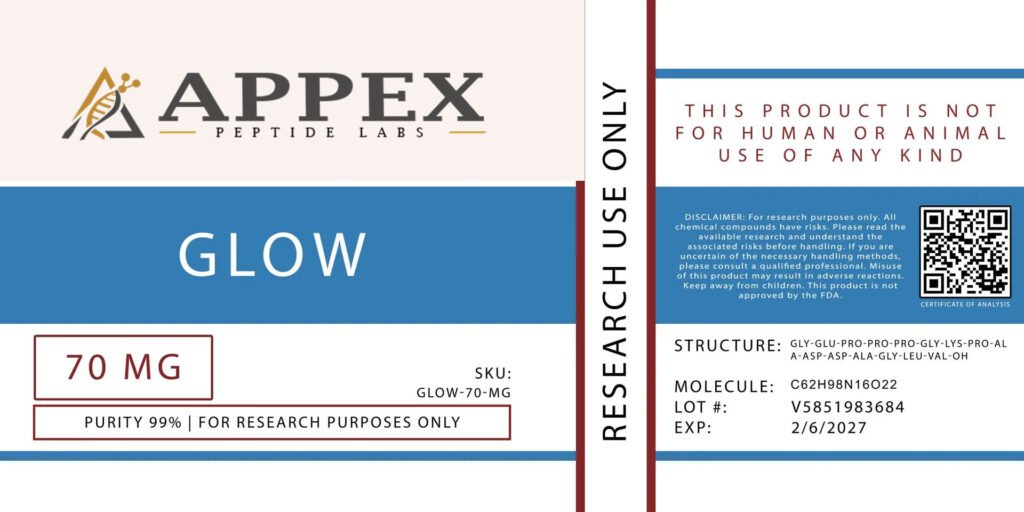
The Glow | GHK-Cu + TB-500 + BPC-157 Blend combines three peptides that have been independently investigated for their distinct molecular activities across multiple biological systems. Although each peptide exhibits unique biochemical characteristics, their inclusion within a single research formulation allows investigators to evaluate interconnected signaling pathways under standardized laboratory conditions.
GHK-Cu is a naturally occurring copper-binding tripeptide recognized for its affinity for copper ions and its participation in extracellular matrix biology. Laboratory investigations have demonstrated that GHK-Cu can influence gene expression profiles associated with extracellular matrix turnover, matrix metalloproteinase regulation, collagen-associated proteins, and cellular communication networks. Researchers have also explored its interaction with transforming growth factor signaling, oxidative stress responses, and copper-dependent enzymatic processes that contribute to cellular homeostasis. Glow | GHK-Cu + TB-500 + BPC-157 Blend
TB-500 is a synthetic peptide derived from the active region of thymosin beta-4. Experimental research has focused on its ability to regulate actin dynamics by influencing globular actin sequestration and cytoskeletal remodeling. These molecular interactions contribute to investigations involving cellular migration, adhesion, intracellular architecture, and tissue organization. TB-500 has also been studied within experimental models evaluating integrin-mediated signaling, focal adhesion complexes, and vascular-associated cellular responses.
BPC-157 is a synthetic pentadecapeptide investigated for its involvement in several intracellular signaling mechanisms, including nitric oxide-associated pathways, focal adhesion kinase (FAK) activation, vascular endothelial growth factor (VEGF)-related signaling, and downstream kinase cascades. Research models have examined how these molecular interactions influence cellular communication, migration, and protein regulation during controlled laboratory experiments. Ongoing studies continue to explore additional receptor-independent mechanisms associated with peptide-mediated signal transduction.
When investigated together, GHK-Cu, TB-500, and BPC-157 provide researchers with an opportunity to evaluate complementary molecular processes involving extracellular matrix regulation, cytoskeletal organization, peptide signaling networks, angiogenic pathway modulation, and cellular communication. Rather than functioning through a single receptor or isolated mechanism, the formulation supports investigation of multiple interconnected biochemical pathways that contribute to complex experimental models in molecular biology, peptide chemistry, and cell-based research. Glow | GHK-Cu + TB-500 + BPC-157 Blend
For research use only. Not intended for human consumption or clinical use.
| Size | 70mg |
|---|---|
| Dimensions | 9 × 7 × .5 in |
| Weight | .125 lbs |
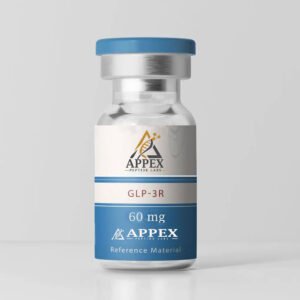
Glow | GHK-Cu + TB-500 + BPC-157 Blend brings together three extensively investigated research peptides into a single formulation designed for sophisticated laboratory applications. Each component has been independently studied for its unique molecular interactions, while the combined blend enables researchers to examine overlapping biological pathways within integrated experimental systems.
GHK-Cu is widely investigated for its interaction with extracellular matrix regulation, metalloproteinase activity, copper-dependent biological processes, and cellular signaling networks. TB-500, a synthetic fragment derived from thymosin beta-4, has attracted significant scientific interest because of its relationship with actin dynamics, cellular migration, and cytoskeletal remodeling. BPC-157 has been explored in laboratory settings for its involvement in nitric oxide signaling, growth factor modulation, cellular communication, and tissue-associated molecular pathways.
By combining these peptides, researchers can investigate coordinated molecular responses that may not be readily observed when each peptide is evaluated independently. This formulation supports experimental designs involving cell culture, molecular biology, peptide interaction studies, regenerative biology models, extracellular matrix investigations, and systems biology research.
Each vial is manufactured using stringent quality standards, verified through analytical testing, and supplied with supporting documentation to promote consistency across laboratory workflows.
For research use only. Not intended for human consumption or clinical use.
Researchers utilize this peptide blend to investigate extracellular matrix organization, matrix remodeling processes, collagen-associated signaling, and fibroblast-mediated cellular communication within controlled laboratory models.
The formulation supports investigations examining cytoskeletal organization, actin filament dynamics, integrin-mediated signaling, and mechanisms governing cellular movement during experimental research.
Laboratories studying vascular biology employ peptide-based models to explore signaling pathways associated with angiogenic regulation, endothelial cell communication, and growth factor interactions.
Combining GHK-Cu, TB-500, and BPC-157 enables researchers to evaluate coordinated peptide signaling, pathway cross-talk, and molecular network interactions that may influence complex biological systems.
Suitable for controlled in vitro experiments investigating fibroblast behavior, epithelial cell responses, peptide-mediated signaling cascades, and molecular communication between diverse cell populations.
Researchers may incorporate this formulation into studies evaluating receptor signaling, transcriptional regulation, intracellular messenger systems, protein expression, and peptide-associated biological mechanisms.
| Specification | Details |
|---|---|
| Product Name | Glow | GHK-Cu + TB-500 + BPC-157 Blend |
| Purity | GHK-Cu ≥99%; TB-500 ≥98%; BPC-157 ≥98% (HPLC verified) |
| Molecular Formula | Blend containing GHK-Cu, TB-500, and BPC-157 |
| Molecular Weight | Composite peptide formulation |
| CAS Number | Not applicable (blend formulation) |
| Appearance | Blue lyophilized peptide powder |
| Storage Conditions | Store refrigerated at 2–8°C. Protect from heat, moisture, and direct light. Long-term storage at -20°C is recommended before reconstitution. |
| Solubility | Soluble in sterile laboratory-grade water or appropriate research buffers |
| Sequence | GHK-Cu (Glycyl-L-Histidyl-L-Lysine-Copper); TB-500 (Ac-LKKTETQ); BPC-157 (15-amino acid synthetic peptide) |
| Available Sizes | 70 mg per vial (50 mg GHK-Cu + 10 mg TB-500 + 10 mg BPC-157) |
The Glow | GHK-Cu + TB-500 + BPC-157 Blend combines three peptides that have been independently investigated for their distinct molecular activities across multiple biological systems. Although each peptide exhibits unique biochemical characteristics, their inclusion within a single research formulation allows investigators to evaluate interconnected signaling pathways under standardized laboratory conditions.
GHK-Cu is a naturally occurring copper-binding tripeptide recognized for its affinity for copper ions and its participation in extracellular matrix biology. Laboratory investigations have demonstrated that GHK-Cu can influence gene expression profiles associated with extracellular matrix turnover, matrix metalloproteinase regulation, collagen-associated proteins, and cellular communication networks. Researchers have also explored its interaction with transforming growth factor signaling, oxidative stress responses, and copper-dependent enzymatic processes that contribute to cellular homeostasis. Glow | GHK-Cu + TB-500 + BPC-157 Blend
TB-500 is a synthetic peptide derived from the active region of thymosin beta-4. Experimental research has focused on its ability to regulate actin dynamics by influencing globular actin sequestration and cytoskeletal remodeling. These molecular interactions contribute to investigations involving cellular migration, adhesion, intracellular architecture, and tissue organization. TB-500 has also been studied within experimental models evaluating integrin-mediated signaling, focal adhesion complexes, and vascular-associated cellular responses.
BPC-157 is a synthetic pentadecapeptide investigated for its involvement in several intracellular signaling mechanisms, including nitric oxide-associated pathways, focal adhesion kinase (FAK) activation, vascular endothelial growth factor (VEGF)-related signaling, and downstream kinase cascades. Research models have examined how these molecular interactions influence cellular communication, migration, and protein regulation during controlled laboratory experiments. Ongoing studies continue to explore additional receptor-independent mechanisms associated with peptide-mediated signal transduction.
When investigated together, GHK-Cu, TB-500, and BPC-157 provide researchers with an opportunity to evaluate complementary molecular processes involving extracellular matrix regulation, cytoskeletal organization, peptide signaling networks, angiogenic pathway modulation, and cellular communication. Rather than functioning through a single receptor or isolated mechanism, the formulation supports investigation of multiple interconnected biochemical pathways that contribute to complex experimental models in molecular biology, peptide chemistry, and cell-based research. Glow | GHK-Cu + TB-500 + BPC-157 Blend
For research use only. Not intended for human consumption or clinical use.
| Size | 70mg |
|---|---|
| Dimensions | 9 × 7 × .5 in |
| Weight | .125 lbs |