Bulk Orders. Better Value.
Research institutions, universities and clinical teams qualify for volume discounts. Contact our team to discuss custom formulations and bulk pricing.

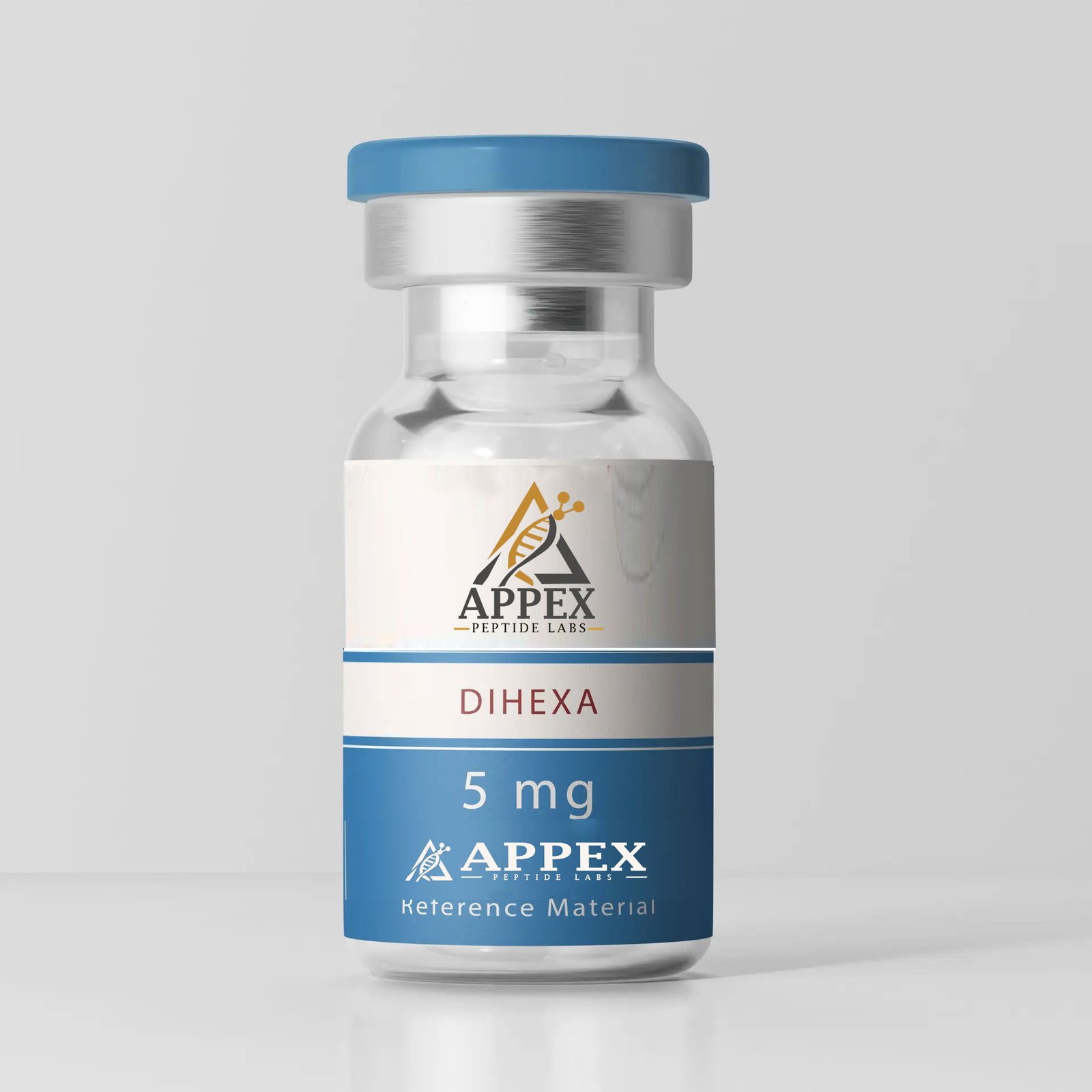


Dihexa Peptide is a synthetic, metabolically stabilized oligopeptide engineered as an analog of angiotensin IV (Ang IV) to investigate molecular mechanisms involved in neuronal signaling and synaptic development. Unlike classical angiotensin receptor ligands, Dihexa primarily functions by interacting with hepatocyte growth factor (HGF) and enhancing activation of the c-Met receptor, making it a valuable experimental tool for studying growth factor-mediated intracellular signaling.
Within laboratory research, Dihexa Peptide is widely employed to investigate neuronal differentiation, dendritic spine formation, synaptic protein regulation, receptor pharmacology, and intracellular signaling pathways governing cellular communication. The peptide has also become increasingly relevant in studies examining growth factor biology, protein-protein interactions, and molecular mechanisms regulating neuronal network formation.
Researchers utilize Dihexa Peptide across neuroscience, molecular biology, developmental biology, regenerative biology, and pharmaceutical discovery to evaluate HGF-dependent signaling, receptor activation kinetics, downstream kinase pathways, and transcriptional regulation. Its unique mechanism provides opportunities to study cellular processes that are distinct from traditional peptide receptor agonists.
Appex Peptide Lab supplies high-purity research-grade Dihexa Peptide manufactured under rigorous quality control standards and verified through comprehensive analytical testing for dependable laboratory performance.
For research use only. Not intended for human consumption or clinical use.

Dihexa Peptide is widely employed to investigate hepatocyte growth factor-mediated activation of the c-Met receptor, receptor phosphorylation, intracellular signaling cascades, and growth factor biology.
Researchers utilize Dihexa Peptide to examine molecular mechanisms governing synapse formation, dendritic spine development, neuronal connectivity, and synaptic protein regulation.
The peptide supports investigations into neuronal communication, intracellular signaling, neurodevelopmental pathways, and protein interaction networks involved in nervous system biology.
Dihexa Peptide is incorporated into laboratory studies evaluating PI3K/Akt signaling, ERK/MAPK activation, receptor-mediated kinase pathways, and transcription factor regulation.
Suitable for in vitro experiments using neuronal cell lines, primary neuronal cultures, and recombinant cellular systems to evaluate HGF-dependent molecular responses.
Biotechnology and pharmaceutical laboratories employ Dihexa Peptide for receptor pharmacology, assay development, compound screening, ligand characterization, and mechanistic molecular biology studies.
| Specification | Details |
|---|---|
| Purity | ≥99% (HPLC verified) |
| Molecular Formula | C₂₇H₄₄N₄O₅ |
| Molecular Weight | 504.66 g/mol |
| CAS Number | 1401708-83-5 |
| Appearance | White to off-white lyophilized powder |
| Storage Conditions | Store at -20°C in a dry environment. Following reconstitution, aliquot according to validated laboratory protocols and avoid repeated freeze-thaw cycles. |
| Solubility | Soluble in DMSO and appropriate laboratory-grade aqueous buffers according to experimental protocols |
| Sequence | N-Hexanoic-Tyr-Ile-(6-aminohexanoic acid)-amide |
| Available Sizes | 5 mg, 10 mg |
Dihexa Peptide is a synthetic oligopeptide derived from angiotensin IV (Ang IV) that functions through a mechanism distinct from classical renin-angiotensin system ligands. Rather than directly activating angiotensin receptors, Dihexa has been shown in experimental research to bind with high affinity to hepatocyte growth factor (HGF), enhancing its interaction with the c-Met receptor, a receptor tyrosine kinase that regulates diverse cellular signaling pathways. This unique mechanism has established Dihexa Peptide as an important research tool for investigating growth factor biology, receptor pharmacology, and intracellular signaling.
Upon potentiation of HGF activity, ligand engagement with the c-Met receptor induces receptor dimerization and autophosphorylation of intracellular tyrosine residues. These phosphorylation events recruit adaptor proteins including Gab1, Grb2, and Shc, initiating several downstream signaling cascades. Researchers commonly investigate activation of the PI3K/Akt, Ras/Raf/MEK/ERK (MAPK), STAT3, PLCγ, and mTOR pathways, all of which regulate cellular proliferation, differentiation, cytoskeletal organization, protein synthesis, and intracellular communication.
In neuronal laboratory models, Dihexa Peptide has been extensively utilized to study molecular events associated with synaptogenesis, dendritic spine formation, and neuronal network development. Experimental investigations examine how enhanced HGF/c-Met signaling influences synaptic protein expression, dendritic branching, cytoskeletal remodeling, and intracellular trafficking. These studies contribute to a broader understanding of neuronal connectivity and growth factor-mediated signaling under controlled research conditions.
The peptide is also employed in studies evaluating receptor phosphorylation kinetics, protein-protein interactions, signal amplification, transcriptional regulation, and growth factor-dependent cellular responses. Because c-Met signaling intersects with multiple intracellular kinase networks, Dihexa Peptide enables researchers to investigate pathway crosstalk, feedback regulation, and coordinated molecular signaling within complex cellular systems.
Current molecular biology and pharmaceutical research incorporates Dihexa Peptide into investigations involving receptor activation dynamics, ligand-binding affinity, neurobiology, developmental signaling, proteomics, and systems biology. Its distinctive mechanism of potentiating endogenous HGF activity rather than directly acting as a receptor agonist provides researchers with a highly specialized experimental platform for exploring c-Met-dependent signaling and growth factor-mediated cellular regulation.
For research use only. Not intended for human consumption or clinical use.
| Size | 5mg |
|---|---|
| Dimensions | 9 × 7 × .5 in |
| Weight | .125 lbs |
Dihexa Peptide is a synthetic, metabolically stabilized oligopeptide engineered as an analog of angiotensin IV (Ang IV) to investigate molecular mechanisms involved in neuronal signaling and synaptic development. Unlike classical angiotensin receptor ligands, Dihexa primarily functions by interacting with hepatocyte growth factor (HGF) and enhancing activation of the c-Met receptor, making it a valuable experimental tool for studying growth factor-mediated intracellular signaling.
Within laboratory research, Dihexa Peptide is widely employed to investigate neuronal differentiation, dendritic spine formation, synaptic protein regulation, receptor pharmacology, and intracellular signaling pathways governing cellular communication. The peptide has also become increasingly relevant in studies examining growth factor biology, protein-protein interactions, and molecular mechanisms regulating neuronal network formation.
Researchers utilize Dihexa Peptide across neuroscience, molecular biology, developmental biology, regenerative biology, and pharmaceutical discovery to evaluate HGF-dependent signaling, receptor activation kinetics, downstream kinase pathways, and transcriptional regulation. Its unique mechanism provides opportunities to study cellular processes that are distinct from traditional peptide receptor agonists.
Appex Peptide Lab supplies high-purity research-grade Dihexa Peptide manufactured under rigorous quality control standards and verified through comprehensive analytical testing for dependable laboratory performance.
For research use only. Not intended for human consumption or clinical use.
Dihexa Peptide is widely employed to investigate hepatocyte growth factor-mediated activation of the c-Met receptor, receptor phosphorylation, intracellular signaling cascades, and growth factor biology.
Researchers utilize Dihexa Peptide to examine molecular mechanisms governing synapse formation, dendritic spine development, neuronal connectivity, and synaptic protein regulation.
The peptide supports investigations into neuronal communication, intracellular signaling, neurodevelopmental pathways, and protein interaction networks involved in nervous system biology.
Dihexa Peptide is incorporated into laboratory studies evaluating PI3K/Akt signaling, ERK/MAPK activation, receptor-mediated kinase pathways, and transcription factor regulation.
Suitable for in vitro experiments using neuronal cell lines, primary neuronal cultures, and recombinant cellular systems to evaluate HGF-dependent molecular responses.
Biotechnology and pharmaceutical laboratories employ Dihexa Peptide for receptor pharmacology, assay development, compound screening, ligand characterization, and mechanistic molecular biology studies.
| Specification | Details |
|---|---|
| Purity | ≥99% (HPLC verified) |
| Molecular Formula | C₂₇H₄₄N₄O₅ |
| Molecular Weight | 504.66 g/mol |
| CAS Number | 1401708-83-5 |
| Appearance | White to off-white lyophilized powder |
| Storage Conditions | Store at -20°C in a dry environment. Following reconstitution, aliquot according to validated laboratory protocols and avoid repeated freeze-thaw cycles. |
| Solubility | Soluble in DMSO and appropriate laboratory-grade aqueous buffers according to experimental protocols |
| Sequence | N-Hexanoic-Tyr-Ile-(6-aminohexanoic acid)-amide |
| Available Sizes | 5 mg, 10 mg |
Dihexa Peptide is a synthetic oligopeptide derived from angiotensin IV (Ang IV) that functions through a mechanism distinct from classical renin-angiotensin system ligands. Rather than directly activating angiotensin receptors, Dihexa has been shown in experimental research to bind with high affinity to hepatocyte growth factor (HGF), enhancing its interaction with the c-Met receptor, a receptor tyrosine kinase that regulates diverse cellular signaling pathways. This unique mechanism has established Dihexa Peptide as an important research tool for investigating growth factor biology, receptor pharmacology, and intracellular signaling.
Upon potentiation of HGF activity, ligand engagement with the c-Met receptor induces receptor dimerization and autophosphorylation of intracellular tyrosine residues. These phosphorylation events recruit adaptor proteins including Gab1, Grb2, and Shc, initiating several downstream signaling cascades. Researchers commonly investigate activation of the PI3K/Akt, Ras/Raf/MEK/ERK (MAPK), STAT3, PLCγ, and mTOR pathways, all of which regulate cellular proliferation, differentiation, cytoskeletal organization, protein synthesis, and intracellular communication.
In neuronal laboratory models, Dihexa Peptide has been extensively utilized to study molecular events associated with synaptogenesis, dendritic spine formation, and neuronal network development. Experimental investigations examine how enhanced HGF/c-Met signaling influences synaptic protein expression, dendritic branching, cytoskeletal remodeling, and intracellular trafficking. These studies contribute to a broader understanding of neuronal connectivity and growth factor-mediated signaling under controlled research conditions.
The peptide is also employed in studies evaluating receptor phosphorylation kinetics, protein-protein interactions, signal amplification, transcriptional regulation, and growth factor-dependent cellular responses. Because c-Met signaling intersects with multiple intracellular kinase networks, Dihexa Peptide enables researchers to investigate pathway crosstalk, feedback regulation, and coordinated molecular signaling within complex cellular systems.
Current molecular biology and pharmaceutical research incorporates Dihexa Peptide into investigations involving receptor activation dynamics, ligand-binding affinity, neurobiology, developmental signaling, proteomics, and systems biology. Its distinctive mechanism of potentiating endogenous HGF activity rather than directly acting as a receptor agonist provides researchers with a highly specialized experimental platform for exploring c-Met-dependent signaling and growth factor-mediated cellular regulation.
For research use only. Not intended for human consumption or clinical use.
| Size | 5mg |
|---|---|
| Dimensions | 9 × 7 × .5 in |
| Weight | .125 lbs |