Bulk Orders. Better Value.
Research institutions, universities and clinical teams qualify for volume discounts. Contact our team to discuss custom formulations and bulk pricing.

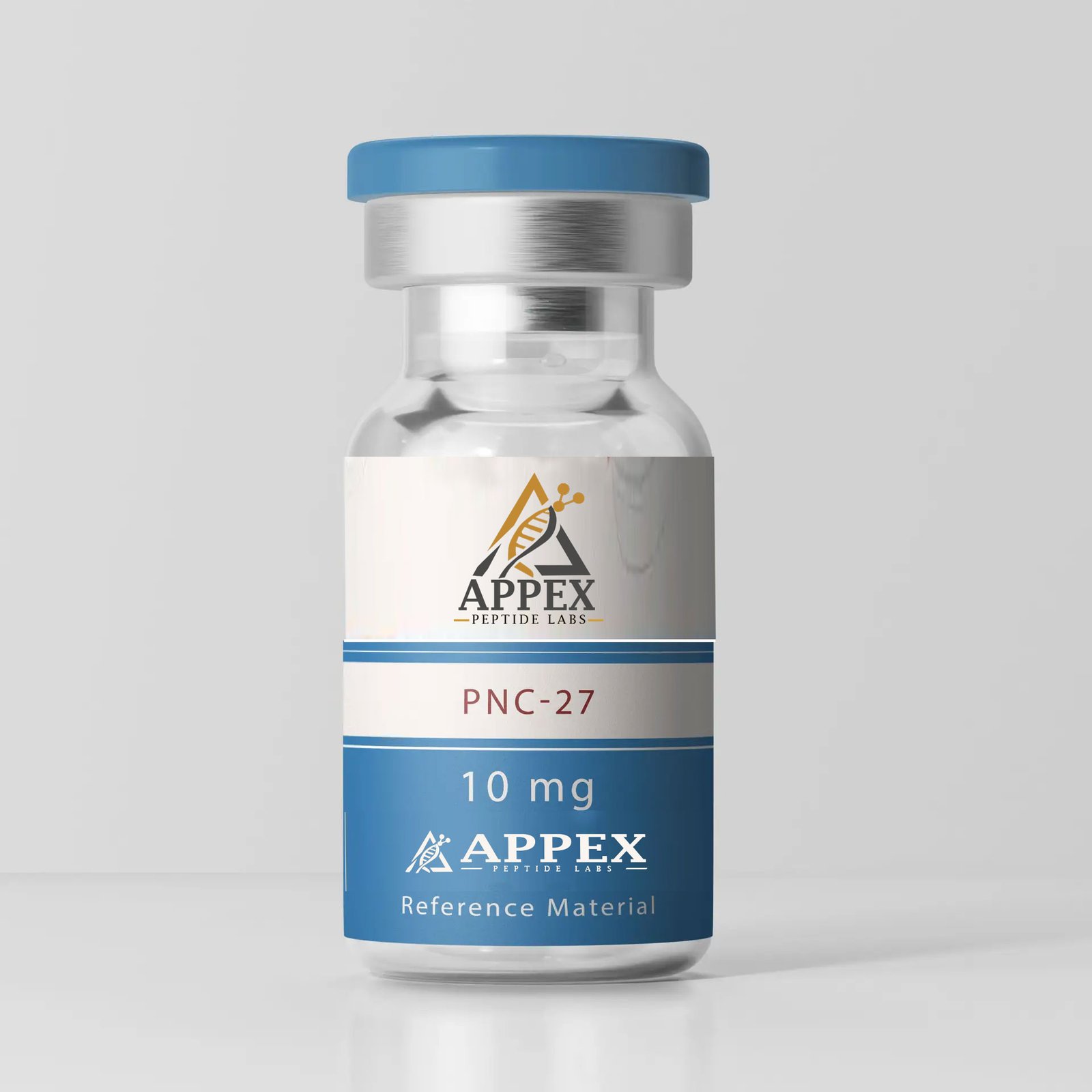


PNC-27 Peptide is a synthetic chimeric peptide engineered by combining amino acids 12-26 of the human p53 tumor suppressor protein with a membrane residency peptide (MRP). This unique molecular design enables researchers to investigate membrane-associated HDM-2 interactions independently of endogenous p53 signaling while providing a highly characterized experimental model for membrane biology and peptide pharmacology.
Published laboratory research has explored PNC-27 Peptide in studies examining HDM-2 localization, membrane receptor interactions, peptide-mediated pore formation, cellular membrane permeability, and intracellular signaling. Scientists continue to investigate the molecular mechanisms governing selective membrane interactions, protein binding, cellular stress responses, and downstream signaling pathways using both in vitro and preclinical experimental systems.
Beyond membrane biology, PNC-27 has become an important research reagent in oncology, molecular pharmacology, structural biology, peptide engineering, and protein interaction studies. Its defined amino acid sequence and reproducible physicochemical characteristics make it valuable for universities, biotechnology companies, pharmaceutical laboratories, and life science research institutions investigating protein-protein interactions and membrane-associated signaling.
Each batch is synthesized using rigorous quality-controlled manufacturing procedures, analytically verified for purity and identity, and supplied as a stable lyophilized peptide accompanied by a comprehensive Certificate of Analysis to support reproducible scientific investigations.
For research use only. Not intended for human consumption or clinical use.
PNC-27 Peptide is extensively utilized in laboratory investigations examining interactions between the p53-derived binding domain and membrane-associated HDM-2 protein within experimental cellular systems.
Researchers employ PNC-27 to investigate peptide-membrane interactions, membrane protein localization, pore formation mechanisms, membrane permeability, and structural membrane biology.
Experimental models utilize PNC-27 to study protein-protein interactions, intracellular signaling pathways, membrane-associated molecular mechanisms, and cellular responses in transformed cell models.
Scientists investigate intracellular signaling networks involving MAPK/ERK, PI3K/Akt, stress-response pathways, apoptosis-associated proteins, and transcriptional regulation following peptide interaction.
PNC-27 serves as an experimental model for studying peptide design, fusion peptide engineering, protein domain interactions, and structure-function relationships.
Researchers utilize PNC-27 to evaluate peptide stability, molecular transport, analytical characterization, formulation development, and biochemical interaction kinetics.
| Specification | Details |
|---|---|
| Product Name | PNC-27 Peptide |
| Synonyms | PNC-27, p53(12-26)-MRP Fusion Peptide |
| Purity | ≥99% (HPLC Verified) |
| Molecular Formula | Sequence-specific peptide |
| Molecular Weight | Approximately 3.7 kDa |
| CAS Number | Not assigned |
| Sequence | 32-amino-acid p53(12-26)-MRP fusion peptide |
| Appearance | White to off-white lyophilized powder |
| Solubility | Soluble in sterile bacteriostatic water and laboratory-grade aqueous buffers |
| Storage Conditions | Store lyophilized peptide at 2–8°C. For long-term storage, maintain at −20°C in a dry, light-protected environment. Avoid repeated freeze-thaw cycles following reconstitution. |
| Available Sizes | 5 mg, 10 mg |

PNC-27 Peptide is a synthetic fusion peptide composed of the HDM-2-binding domain of the human tumor suppressor protein p53 (residues 12-26) linked to a membrane residency peptide (MRP). Unlike native p53, which functions primarily as a nuclear transcription factor, PNC-27 is engineered to facilitate investigation of membrane-associated HDM-2 interactions within controlled laboratory environments.
Published laboratory studies indicate that the p53-derived region of PNC-27 retains high affinity for HDM-2 (human double minute-2 protein, MDM2), a key regulator of p53 signaling. Experimental evidence suggests that when HDM-2 is localized at the plasma membrane in certain transformed cell models, PNC-27 binds selectively to membrane-associated HDM-2, providing researchers with an experimental platform for investigating protein localization, receptor accessibility, and membrane-associated signaling mechanisms.
Following membrane association, laboratory investigations have reported peptide-mediated formation of transmembrane pores in selected experimental systems. Researchers continue to study the structural basis of pore assembly, membrane permeability changes, ion flux, and alterations in membrane integrity using biochemical assays, live-cell imaging, and electrophysiological techniques. The precise molecular sequence of pore formation remains an active area of investigation.
Additional studies explore downstream signaling events following HDM-2 interaction, including modulation of intracellular calcium homeostasis, mitochondrial membrane dynamics, oxidative stress responses, stress-activated protein kinases, and protein interaction networks associated with cellular adaptation. Researchers also investigate interactions with MAPK/ERK, PI3K/Akt, and other signaling pathways that regulate cellular communication and membrane-associated molecular processes.
Because of its unique chimeric structure, defined amino acid sequence, and selective HDM-2-binding properties, PNC-27 Peptide remains a valuable experimental reagent for molecular oncology, membrane biology, structural biochemistry, peptide pharmacology, and biotechnology laboratories investigating protein-protein interactions, membrane dynamics, and peptide engineering.
For research use only. Not intended for human consumption or clinical use.
| Size | 10mg, 5mg |
|---|---|
| Dimensions | 9 × 7 × .5 in |
| Weight | .125 lbs |
PNC-27 Peptide is a synthetic chimeric peptide engineered by combining amino acids 12-26 of the human p53 tumor suppressor protein with a membrane residency peptide (MRP). This unique molecular design enables researchers to investigate membrane-associated HDM-2 interactions independently of endogenous p53 signaling while providing a highly characterized experimental model for membrane biology and peptide pharmacology.
Published laboratory research has explored PNC-27 Peptide in studies examining HDM-2 localization, membrane receptor interactions, peptide-mediated pore formation, cellular membrane permeability, and intracellular signaling. Scientists continue to investigate the molecular mechanisms governing selective membrane interactions, protein binding, cellular stress responses, and downstream signaling pathways using both in vitro and preclinical experimental systems.
Beyond membrane biology, PNC-27 has become an important research reagent in oncology, molecular pharmacology, structural biology, peptide engineering, and protein interaction studies. Its defined amino acid sequence and reproducible physicochemical characteristics make it valuable for universities, biotechnology companies, pharmaceutical laboratories, and life science research institutions investigating protein-protein interactions and membrane-associated signaling.
Each batch is synthesized using rigorous quality-controlled manufacturing procedures, analytically verified for purity and identity, and supplied as a stable lyophilized peptide accompanied by a comprehensive Certificate of Analysis to support reproducible scientific investigations.
For research use only. Not intended for human consumption or clinical use.
PNC-27 Peptide is extensively utilized in laboratory investigations examining interactions between the p53-derived binding domain and membrane-associated HDM-2 protein within experimental cellular systems.
Researchers employ PNC-27 to investigate peptide-membrane interactions, membrane protein localization, pore formation mechanisms, membrane permeability, and structural membrane biology.
Experimental models utilize PNC-27 to study protein-protein interactions, intracellular signaling pathways, membrane-associated molecular mechanisms, and cellular responses in transformed cell models.
Scientists investigate intracellular signaling networks involving MAPK/ERK, PI3K/Akt, stress-response pathways, apoptosis-associated proteins, and transcriptional regulation following peptide interaction.
PNC-27 serves as an experimental model for studying peptide design, fusion peptide engineering, protein domain interactions, and structure-function relationships.
Researchers utilize PNC-27 to evaluate peptide stability, molecular transport, analytical characterization, formulation development, and biochemical interaction kinetics.
| Specification | Details |
|---|---|
| Product Name | PNC-27 Peptide |
| Synonyms | PNC-27, p53(12-26)-MRP Fusion Peptide |
| Purity | ≥99% (HPLC Verified) |
| Molecular Formula | Sequence-specific peptide |
| Molecular Weight | Approximately 3.7 kDa |
| CAS Number | Not assigned |
| Sequence | 32-amino-acid p53(12-26)-MRP fusion peptide |
| Appearance | White to off-white lyophilized powder |
| Solubility | Soluble in sterile bacteriostatic water and laboratory-grade aqueous buffers |
| Storage Conditions | Store lyophilized peptide at 2–8°C. For long-term storage, maintain at −20°C in a dry, light-protected environment. Avoid repeated freeze-thaw cycles following reconstitution. |
| Available Sizes | 5 mg, 10 mg |
PNC-27 Peptide is a synthetic fusion peptide composed of the HDM-2-binding domain of the human tumor suppressor protein p53 (residues 12-26) linked to a membrane residency peptide (MRP). Unlike native p53, which functions primarily as a nuclear transcription factor, PNC-27 is engineered to facilitate investigation of membrane-associated HDM-2 interactions within controlled laboratory environments.
Published laboratory studies indicate that the p53-derived region of PNC-27 retains high affinity for HDM-2 (human double minute-2 protein, MDM2), a key regulator of p53 signaling. Experimental evidence suggests that when HDM-2 is localized at the plasma membrane in certain transformed cell models, PNC-27 binds selectively to membrane-associated HDM-2, providing researchers with an experimental platform for investigating protein localization, receptor accessibility, and membrane-associated signaling mechanisms.
Following membrane association, laboratory investigations have reported peptide-mediated formation of transmembrane pores in selected experimental systems. Researchers continue to study the structural basis of pore assembly, membrane permeability changes, ion flux, and alterations in membrane integrity using biochemical assays, live-cell imaging, and electrophysiological techniques. The precise molecular sequence of pore formation remains an active area of investigation.
Additional studies explore downstream signaling events following HDM-2 interaction, including modulation of intracellular calcium homeostasis, mitochondrial membrane dynamics, oxidative stress responses, stress-activated protein kinases, and protein interaction networks associated with cellular adaptation. Researchers also investigate interactions with MAPK/ERK, PI3K/Akt, and other signaling pathways that regulate cellular communication and membrane-associated molecular processes.
Because of its unique chimeric structure, defined amino acid sequence, and selective HDM-2-binding properties, PNC-27 Peptide remains a valuable experimental reagent for molecular oncology, membrane biology, structural biochemistry, peptide pharmacology, and biotechnology laboratories investigating protein-protein interactions, membrane dynamics, and peptide engineering.
For research use only. Not intended for human consumption or clinical use.
| Size | 10mg, 5mg |
|---|---|
| Dimensions | 9 × 7 × .5 in |
| Weight | .125 lbs |