Bulk Orders. Better Value.
Research institutions, universities and clinical teams qualify for volume discounts. Contact our team to discuss custom formulations and bulk pricing.

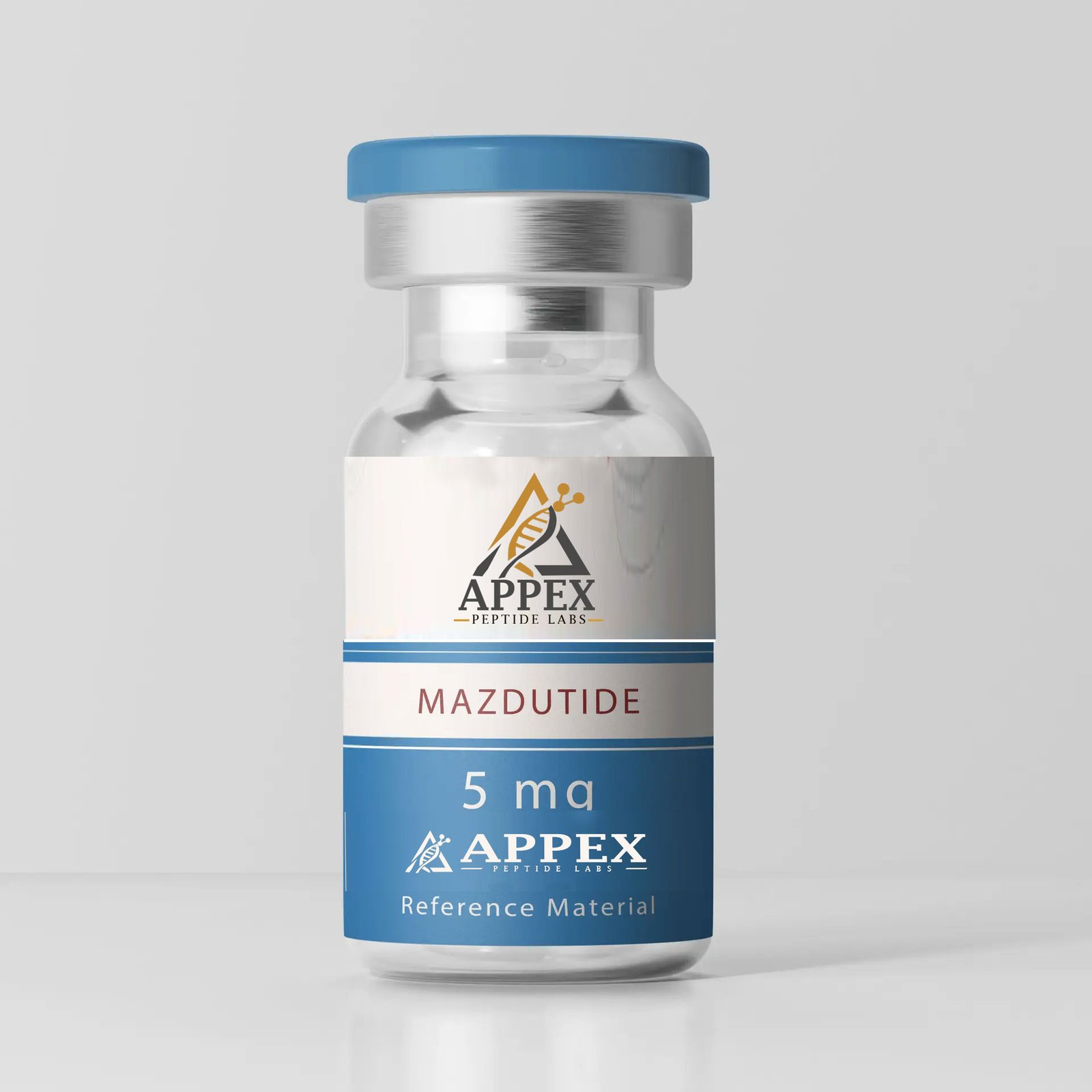


Mazdutide Peptide (IBI362/LY3305677) is an investigational dual agonist designed to activate both the GLP-1 receptor (GLP-1R) and the glucagon receptor (GCGR) through a single peptide molecule. Derived from the endogenous hormone oxyntomodulin, Mazdutide incorporates strategic amino acid substitutions that enhance enzymatic stability while maintaining balanced activity across both receptor systems, making it an important research tool for studying dual incretin biology.
Scientific investigations utilize Mazdutide Peptide in endocrinology, molecular pharmacology, metabolism, receptor biology, and peptide chemistry to examine receptor binding kinetics, intracellular signaling pathways, metabolic regulation, mitochondrial function, peptide pharmacokinetics, and endocrine communication. Researchers also investigate downstream signaling involving cyclic AMP (cAMP), protein kinase A (PKA), AMP-activated protein kinase (AMPK), lipid metabolism, glucose homeostasis, and energy regulation under controlled laboratory conditions.
Its dual receptor activity enables simultaneous investigation of complementary signaling pathways while supporting comparative studies with selective GLP-1 receptor agonists, glucagon receptor agonists, and other multi-receptor peptide analogs. Universities, biotechnology companies, pharmaceutical organizations, and life science laboratories utilize Mazdutide Peptide as a reference compound for receptor pharmacology, translational biology, and molecular signaling research.
Each batch is synthesized under stringent quality-controlled manufacturing procedures, analytically verified for purity and structural integrity, and supplied as a stable lyophilized peptide accompanied by a comprehensive Certificate of Analysis to ensure reproducible laboratory investigations.
For research use only. Not intended for human consumption or clinical use.

Mazdutide Peptide is extensively utilized in laboratory investigations examining coordinated activation of GLP-1R and GCGR, receptor pharmacology, ligand binding, receptor trafficking, and downstream intracellular signaling.
Researchers employ Mazdutide to investigate glucose metabolism, lipid metabolism, cellular bioenergetics, substrate utilization, mitochondrial function, and endocrine regulation in controlled experimental systems.
Experimental models utilize Mazdutide Peptide to study cyclic AMP signaling, protein kinase activation, endocrine communication, transcriptional regulation, and receptor-mediated cellular responses.
Scientists investigate receptor selectivity, agonist efficacy, signal amplification, ligand-receptor kinetics, receptor internalization, and comparative pharmacological profiles.
Laboratory investigations examine peptide stability, enzymatic degradation resistance, molecular persistence, formulation characteristics, and analytical performance.
Researchers utilize Mazdutide Peptide for analytical characterization, formulation development, structure-activity relationship studies, medicinal chemistry, and quality control validation.
| Specification | Details |
|---|---|
| Product Name | Mazdutide Peptide |
| Synonyms | IBI362, LY3305677 |
| Purity | ≥98% (HPLC Verified) |
| Molecular Formula | Proprietary modified 39-amino-acid peptide |
| Molecular Weight | Approximately 4.6 kDa |
| CAS Number | Not publicly assigned |
| Sequence | Modified oxyntomodulin-derived 39-amino-acid dual GLP-1R/GCGR agonist |
| Appearance | White to off-white lyophilized powder |
| Solubility | Soluble in sterile bacteriostatic water and laboratory-grade aqueous buffers |
| Storage Conditions | Store lyophilized peptide at 2–8°C. For long-term storage, maintain at −20°C in a dry, light-protected environment. Avoid repeated freeze-thaw cycles after reconstitution. |
| Available Sizes | 5 mg, 10 mg |
Mazdutide Peptide is a synthetic dual agonist engineered to activate both the glucagon-like peptide-1 receptor (GLP-1R) and the glucagon receptor (GCGR). Structurally derived from the endogenous peptide oxyntomodulin, Mazdutide incorporates sequence modifications that enhance enzymatic stability while preserving balanced receptor affinity, allowing researchers to investigate coordinated activation of two closely related Class B G protein-coupled receptors (GPCRs).
Upon binding to GLP-1R, Mazdutide activates Gs proteins, stimulating adenylyl cyclase and increasing intracellular cyclic adenosine monophosphate (cAMP) concentrations. Elevated cAMP activates protein kinase A (PKA) and exchange proteins directly activated by cAMP (EPAC), initiating signaling cascades that regulate transcriptional activity, intracellular calcium handling, vesicle trafficking, and endocrine cell communication in experimental models.
Simultaneously, activation of GCGR initiates complementary Gs-mediated signaling pathways that also elevate intracellular cAMP while influencing additional transcriptional programs associated with cellular energy metabolism, mitochondrial function, oxidative phosphorylation, and substrate utilization. Researchers frequently investigate interactions between GLP-1R and GCGR signaling because coordinated receptor activation produces distinct molecular responses compared with selective agonism of either receptor alone.
Published laboratory investigations have demonstrated downstream modulation of signaling pathways involving AMP-activated protein kinase (AMPK), PI3K/Akt, MAPK/ERK, CREB, and PGC-1α, providing valuable experimental models for studying receptor cross-talk, intracellular signaling integration, mitochondrial biology, and metabolic pathway regulation. Researchers also utilize Mazdutide to evaluate receptor internalization, ligand bias, signal duration, pharmacodynamic characteristics, and comparative receptor pharmacology.
Its defined molecular architecture, reproducible biochemical properties, and dual receptor activation profile have established Mazdutide Peptide as an important experimental reagent for endocrinology, molecular pharmacology, receptor biology, peptide chemistry, biotechnology, and life science laboratories investigating incretin signaling and integrated metabolic regulatory networks.
For research use only. Not intended for human consumption or clinical use.
| Size | 10mg, 5mg |
|---|---|
| Dimensions | 9 × 7 × .5 in |
| Weight | .125 lbs |
Mazdutide Peptide (IBI362/LY3305677) is an investigational dual agonist designed to activate both the GLP-1 receptor (GLP-1R) and the glucagon receptor (GCGR) through a single peptide molecule. Derived from the endogenous hormone oxyntomodulin, Mazdutide incorporates strategic amino acid substitutions that enhance enzymatic stability while maintaining balanced activity across both receptor systems, making it an important research tool for studying dual incretin biology.
Scientific investigations utilize Mazdutide Peptide in endocrinology, molecular pharmacology, metabolism, receptor biology, and peptide chemistry to examine receptor binding kinetics, intracellular signaling pathways, metabolic regulation, mitochondrial function, peptide pharmacokinetics, and endocrine communication. Researchers also investigate downstream signaling involving cyclic AMP (cAMP), protein kinase A (PKA), AMP-activated protein kinase (AMPK), lipid metabolism, glucose homeostasis, and energy regulation under controlled laboratory conditions.
Its dual receptor activity enables simultaneous investigation of complementary signaling pathways while supporting comparative studies with selective GLP-1 receptor agonists, glucagon receptor agonists, and other multi-receptor peptide analogs. Universities, biotechnology companies, pharmaceutical organizations, and life science laboratories utilize Mazdutide Peptide as a reference compound for receptor pharmacology, translational biology, and molecular signaling research.
Each batch is synthesized under stringent quality-controlled manufacturing procedures, analytically verified for purity and structural integrity, and supplied as a stable lyophilized peptide accompanied by a comprehensive Certificate of Analysis to ensure reproducible laboratory investigations.
For research use only. Not intended for human consumption or clinical use.
Mazdutide Peptide is extensively utilized in laboratory investigations examining coordinated activation of GLP-1R and GCGR, receptor pharmacology, ligand binding, receptor trafficking, and downstream intracellular signaling.
Researchers employ Mazdutide to investigate glucose metabolism, lipid metabolism, cellular bioenergetics, substrate utilization, mitochondrial function, and endocrine regulation in controlled experimental systems.
Experimental models utilize Mazdutide Peptide to study cyclic AMP signaling, protein kinase activation, endocrine communication, transcriptional regulation, and receptor-mediated cellular responses.
Scientists investigate receptor selectivity, agonist efficacy, signal amplification, ligand-receptor kinetics, receptor internalization, and comparative pharmacological profiles.
Laboratory investigations examine peptide stability, enzymatic degradation resistance, molecular persistence, formulation characteristics, and analytical performance.
Researchers utilize Mazdutide Peptide for analytical characterization, formulation development, structure-activity relationship studies, medicinal chemistry, and quality control validation.
| Specification | Details |
|---|---|
| Product Name | Mazdutide Peptide |
| Synonyms | IBI362, LY3305677 |
| Purity | ≥98% (HPLC Verified) |
| Molecular Formula | Proprietary modified 39-amino-acid peptide |
| Molecular Weight | Approximately 4.6 kDa |
| CAS Number | Not publicly assigned |
| Sequence | Modified oxyntomodulin-derived 39-amino-acid dual GLP-1R/GCGR agonist |
| Appearance | White to off-white lyophilized powder |
| Solubility | Soluble in sterile bacteriostatic water and laboratory-grade aqueous buffers |
| Storage Conditions | Store lyophilized peptide at 2–8°C. For long-term storage, maintain at −20°C in a dry, light-protected environment. Avoid repeated freeze-thaw cycles after reconstitution. |
| Available Sizes | 5 mg, 10 mg |
Mazdutide Peptide is a synthetic dual agonist engineered to activate both the glucagon-like peptide-1 receptor (GLP-1R) and the glucagon receptor (GCGR). Structurally derived from the endogenous peptide oxyntomodulin, Mazdutide incorporates sequence modifications that enhance enzymatic stability while preserving balanced receptor affinity, allowing researchers to investigate coordinated activation of two closely related Class B G protein-coupled receptors (GPCRs).
Upon binding to GLP-1R, Mazdutide activates Gs proteins, stimulating adenylyl cyclase and increasing intracellular cyclic adenosine monophosphate (cAMP) concentrations. Elevated cAMP activates protein kinase A (PKA) and exchange proteins directly activated by cAMP (EPAC), initiating signaling cascades that regulate transcriptional activity, intracellular calcium handling, vesicle trafficking, and endocrine cell communication in experimental models.
Simultaneously, activation of GCGR initiates complementary Gs-mediated signaling pathways that also elevate intracellular cAMP while influencing additional transcriptional programs associated with cellular energy metabolism, mitochondrial function, oxidative phosphorylation, and substrate utilization. Researchers frequently investigate interactions between GLP-1R and GCGR signaling because coordinated receptor activation produces distinct molecular responses compared with selective agonism of either receptor alone.
Published laboratory investigations have demonstrated downstream modulation of signaling pathways involving AMP-activated protein kinase (AMPK), PI3K/Akt, MAPK/ERK, CREB, and PGC-1α, providing valuable experimental models for studying receptor cross-talk, intracellular signaling integration, mitochondrial biology, and metabolic pathway regulation. Researchers also utilize Mazdutide to evaluate receptor internalization, ligand bias, signal duration, pharmacodynamic characteristics, and comparative receptor pharmacology.
Its defined molecular architecture, reproducible biochemical properties, and dual receptor activation profile have established Mazdutide Peptide as an important experimental reagent for endocrinology, molecular pharmacology, receptor biology, peptide chemistry, biotechnology, and life science laboratories investigating incretin signaling and integrated metabolic regulatory networks.
For research use only. Not intended for human consumption or clinical use.
| Size | 10mg, 5mg |
|---|---|
| Dimensions | 9 × 7 × .5 in |
| Weight | .125 lbs |