Bulk Orders. Better Value.
Research institutions, universities and clinical teams qualify for volume discounts. Contact our team to discuss custom formulations and bulk pricing.

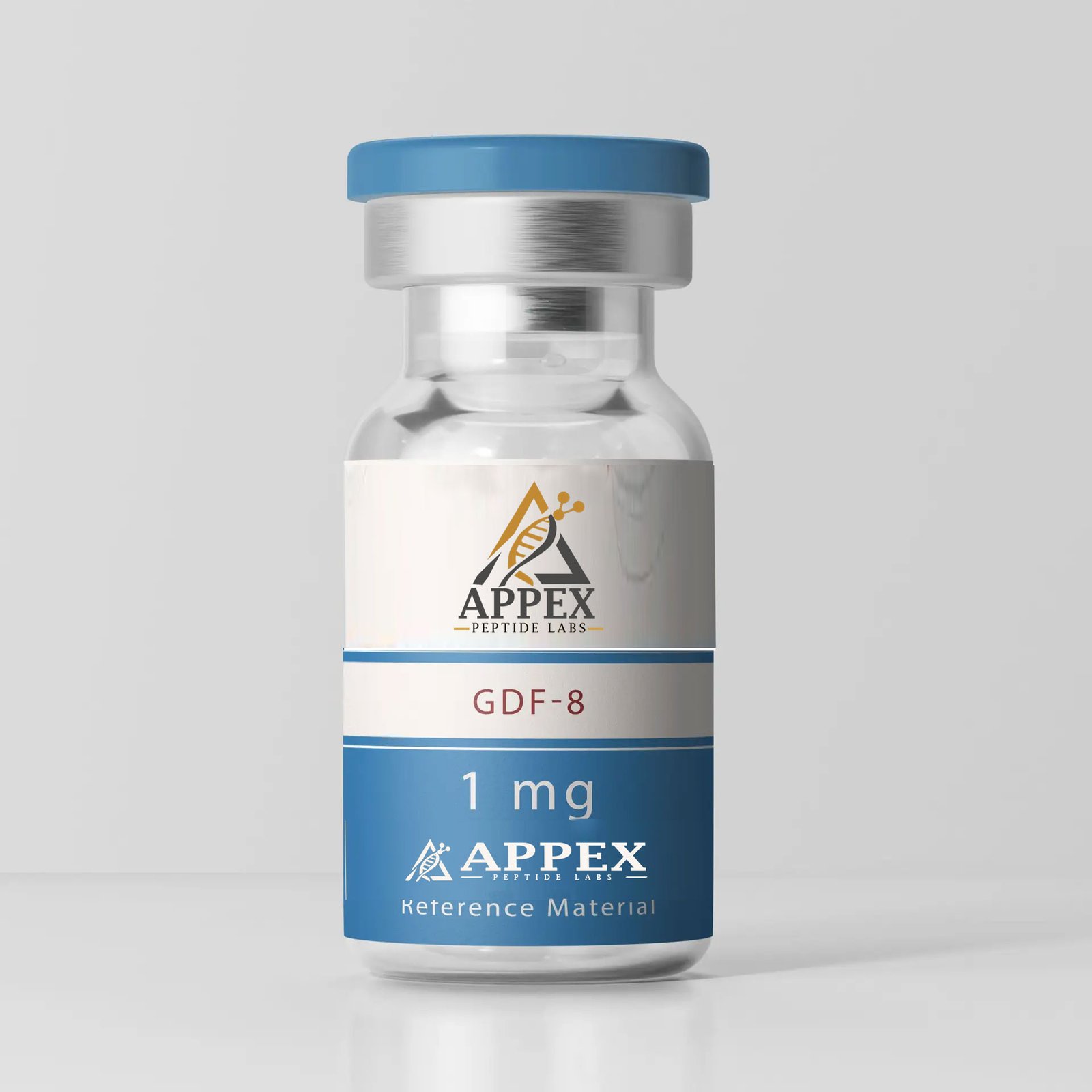
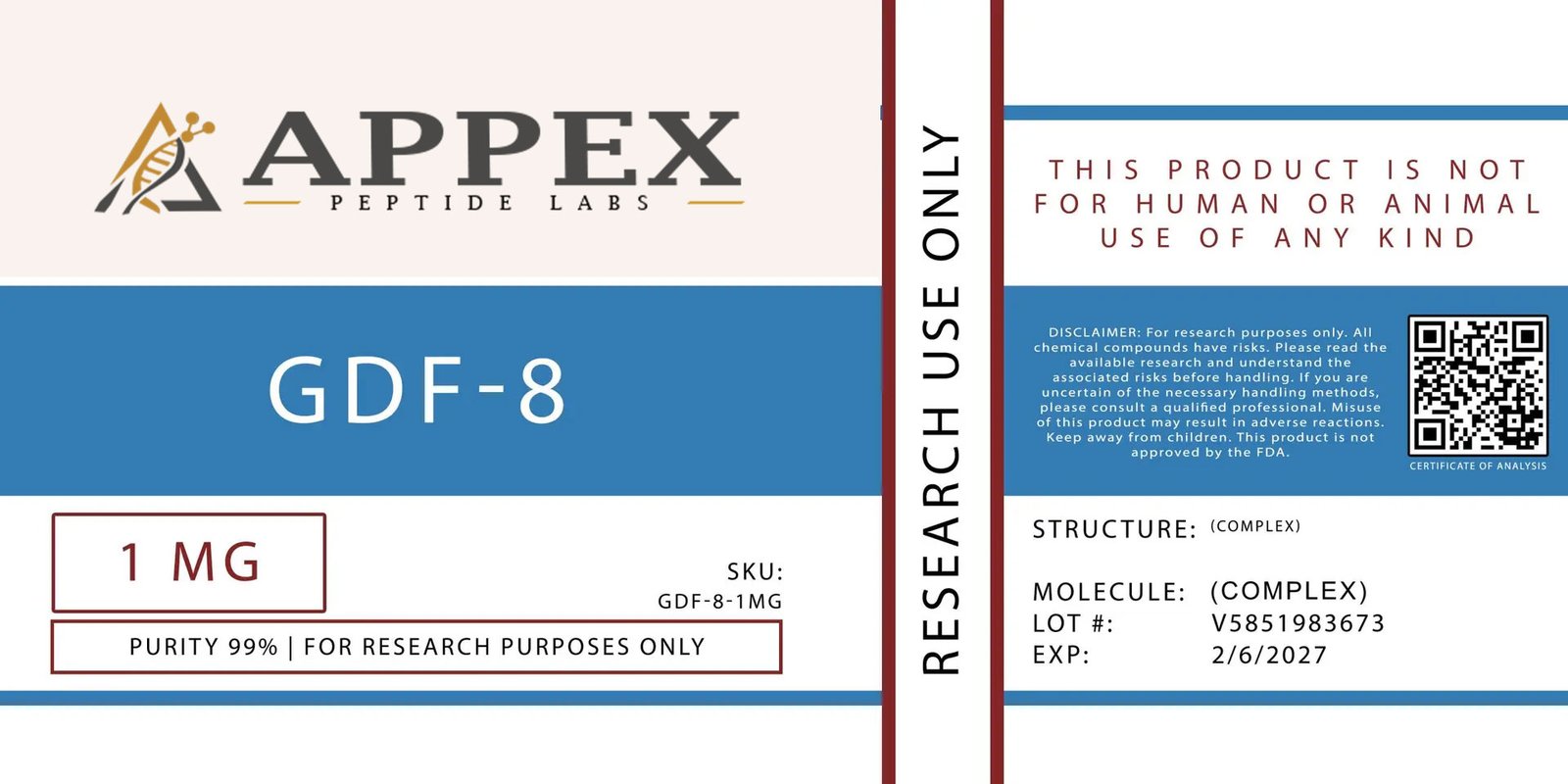

GDF-8 Peptide is a research-grade recombinant form of Growth Differentiation Factor-8 (GDF-8), more commonly known as myostatin, a secreted signaling protein belonging to the transforming growth factor-beta (TGF-β) superfamily. Since its discovery, GDF-8 has become one of the most extensively investigated regulators of skeletal muscle development, cellular differentiation, and musculoskeletal signaling.
Within laboratory research, GDF-8 Peptide is widely employed to examine signaling through Activin type II receptors (ActRIIA and ActRIIB), activation of Smad2/3 transcription factors, regulation of myogenic differentiation, extracellular matrix remodeling, and communication between skeletal muscle, bone, and connective tissues. Its highly conserved biological function makes it an essential reagent for molecular biology, developmental biology, regenerative medicine research, and pharmacological investigations.
Researchers also utilize GDF-8 Peptide to evaluate receptor-ligand interactions, intracellular signal transduction, transcriptional regulation, and interactions with endogenous binding proteins including follistatin, GDF-associated serum proteins, and myostatin propeptides. These studies contribute to a deeper understanding of tissue homeostasis and TGF-β pathway biology across diverse experimental models.
Appex Peptide Lab supplies high-purity research-grade GDF-8 Peptide manufactured under rigorous quality standards with comprehensive analytical verification to ensure reproducible laboratory performance.
For research use only. Not intended for human consumption or clinical use.
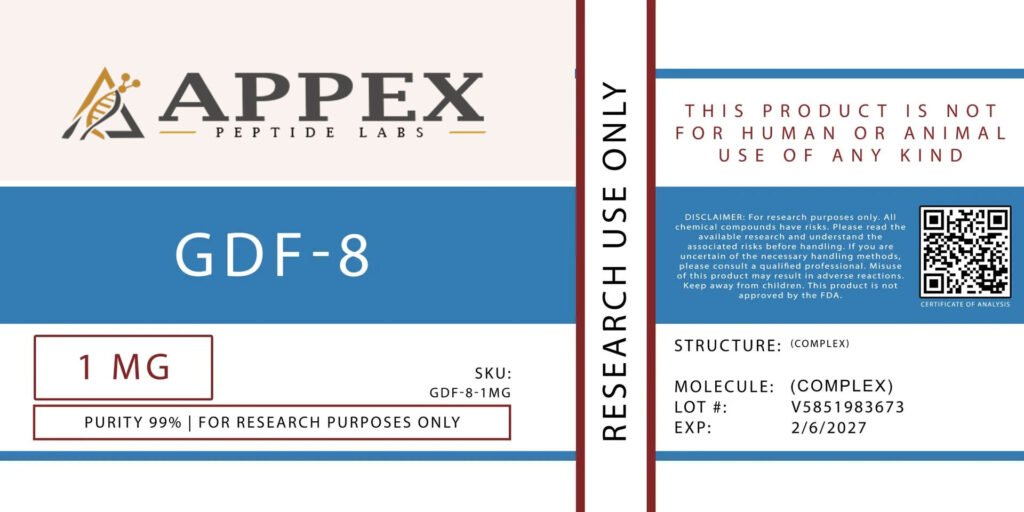
GDF-8 Peptide is widely used to investigate myostatin-mediated signaling, receptor activation, transcriptional regulation, and downstream molecular responses in skeletal muscle research.
Researchers utilize GDF-8 Peptide to study canonical and non-canonical signaling pathways associated with TGF-β family ligands, receptor complexes, and intracellular signaling networks.
The protein supports investigations into myoblast proliferation, satellite cell regulation, myogenic differentiation, muscle fiber development, and cellular communication within musculoskeletal systems.
GDF-8 Peptide is incorporated into laboratory studies examining mesenchymal stem cell differentiation, lineage specification, extracellular matrix interactions, and developmental signaling.
Experimental models utilize GDF-8 Peptide to investigate signaling interactions between muscle, bone, connective tissue, and extracellular matrix remodeling under controlled laboratory conditions.
Biotechnology and pharmaceutical laboratories employ GDF-8 Peptide for receptor-binding assays, antagonist screening, ligand characterization, pharmacological profiling, and signal transduction studies.
| Specification | Details |
|---|---|
| Purity | ≥99% (HPLC verified) |
| Molecular Formula | Recombinant protein (sequence dependent) |
| Molecular Weight | Approximately 25 kDa (mature dimeric protein; preparation dependent) |
| CAS Number | Not assigned |
| Appearance | White to off-white lyophilized powder |
| Storage Conditions | Store at -20°C or below. Following reconstitution, aliquot according to validated laboratory protocols and avoid repeated freeze-thaw cycles. |
| Solubility | Soluble in sterile laboratory-grade aqueous buffers according to experimental protocol |
| Sequence | Recombinant Growth Differentiation Factor-8 (Myostatin) protein |
| Available Sizes | Research quantities (availability may vary) |
GDF-8 Peptide, also known as Growth Differentiation Factor-8 (Myostatin), is a secreted cytokine belonging to the transforming growth factor-beta (TGF-β) superfamily. In laboratory research, GDF-8 serves as a key regulator of skeletal muscle development and cellular differentiation through activation of highly conserved receptor-mediated signaling pathways. Its extensively characterized molecular biology makes it an important research reagent for investigations involving musculoskeletal physiology, stem cell biology, developmental signaling, and receptor pharmacology.
The mature GDF-8 ligand exists as a disulfide-linked homodimer that initially binds with high affinity to Activin type II receptors (ActRIIA and ActRIIB) located on the cell surface. Ligand binding promotes recruitment of type I receptors, primarily ALK4 and ALK5, resulting in formation of an active heteromeric receptor complex possessing serine/threonine kinase activity.
Activation of this receptor complex initiates phosphorylation of the intracellular signaling proteins Smad2 and Smad3. These receptor-regulated Smads subsequently associate with the common mediator Smad4, forming transcriptional complexes that translocate into the nucleus. Within the nucleus, Smad complexes regulate expression of genes involved in myogenic differentiation, extracellular matrix organization, cellular proliferation, developmental signaling, and tissue homeostasis.
Beyond canonical Smad signaling, experimental studies have demonstrated that GDF-8 Peptide may also influence multiple non-canonical signaling pathways including ERK1/2, p38 MAPK, JNK, PI3K/Akt, and additional kinase-dependent regulatory networks. Researchers investigate these pathways to better understand receptor crosstalk, transcriptional regulation, cytoskeletal remodeling, cellular metabolism, and extracellular signaling integration.
An important aspect of GDF-8 biology involves its regulation by endogenous antagonists including follistatin, follistatin-like proteins, GDF-8 propeptide, decorin, and additional extracellular binding proteins that modulate receptor accessibility and ligand bioavailability. These regulatory interactions provide valuable experimental models for investigating ligand sequestration, receptor competition, and feedback regulation within the TGF-β signaling network.
Modern molecular biology laboratories employ GDF-8 Peptide to investigate receptor-ligand affinity, signal transduction kinetics, transcriptional control, developmental biology, stem cell signaling, musculoskeletal communication, extracellular matrix regulation, and protein-protein interaction networks. Its central role within TGF-β superfamily signaling continues to make GDF-8 one of the most important experimental proteins for advancing research in cellular and molecular biology.
For research use only. Not intended for human consumption or clinical use.
| Size | 1mg |
|---|---|
| Dimensions | 9 × 7 × .5 in |
| Weight | .125 lbs |
GDF-8 Peptide is a research-grade recombinant form of Growth Differentiation Factor-8 (GDF-8), more commonly known as myostatin, a secreted signaling protein belonging to the transforming growth factor-beta (TGF-β) superfamily. Since its discovery, GDF-8 has become one of the most extensively investigated regulators of skeletal muscle development, cellular differentiation, and musculoskeletal signaling.
Within laboratory research, GDF-8 Peptide is widely employed to examine signaling through Activin type II receptors (ActRIIA and ActRIIB), activation of Smad2/3 transcription factors, regulation of myogenic differentiation, extracellular matrix remodeling, and communication between skeletal muscle, bone, and connective tissues. Its highly conserved biological function makes it an essential reagent for molecular biology, developmental biology, regenerative medicine research, and pharmacological investigations.
Researchers also utilize GDF-8 Peptide to evaluate receptor-ligand interactions, intracellular signal transduction, transcriptional regulation, and interactions with endogenous binding proteins including follistatin, GDF-associated serum proteins, and myostatin propeptides. These studies contribute to a deeper understanding of tissue homeostasis and TGF-β pathway biology across diverse experimental models.
Appex Peptide Lab supplies high-purity research-grade GDF-8 Peptide manufactured under rigorous quality standards with comprehensive analytical verification to ensure reproducible laboratory performance.
For research use only. Not intended for human consumption or clinical use.
GDF-8 Peptide is widely used to investigate myostatin-mediated signaling, receptor activation, transcriptional regulation, and downstream molecular responses in skeletal muscle research.
Researchers utilize GDF-8 Peptide to study canonical and non-canonical signaling pathways associated with TGF-β family ligands, receptor complexes, and intracellular signaling networks.
The protein supports investigations into myoblast proliferation, satellite cell regulation, myogenic differentiation, muscle fiber development, and cellular communication within musculoskeletal systems.
GDF-8 Peptide is incorporated into laboratory studies examining mesenchymal stem cell differentiation, lineage specification, extracellular matrix interactions, and developmental signaling.
Experimental models utilize GDF-8 Peptide to investigate signaling interactions between muscle, bone, connective tissue, and extracellular matrix remodeling under controlled laboratory conditions.
Biotechnology and pharmaceutical laboratories employ GDF-8 Peptide for receptor-binding assays, antagonist screening, ligand characterization, pharmacological profiling, and signal transduction studies.
| Specification | Details |
|---|---|
| Purity | ≥99% (HPLC verified) |
| Molecular Formula | Recombinant protein (sequence dependent) |
| Molecular Weight | Approximately 25 kDa (mature dimeric protein; preparation dependent) |
| CAS Number | Not assigned |
| Appearance | White to off-white lyophilized powder |
| Storage Conditions | Store at -20°C or below. Following reconstitution, aliquot according to validated laboratory protocols and avoid repeated freeze-thaw cycles. |
| Solubility | Soluble in sterile laboratory-grade aqueous buffers according to experimental protocol |
| Sequence | Recombinant Growth Differentiation Factor-8 (Myostatin) protein |
| Available Sizes | Research quantities (availability may vary) |
GDF-8 Peptide, also known as Growth Differentiation Factor-8 (Myostatin), is a secreted cytokine belonging to the transforming growth factor-beta (TGF-β) superfamily. In laboratory research, GDF-8 serves as a key regulator of skeletal muscle development and cellular differentiation through activation of highly conserved receptor-mediated signaling pathways. Its extensively characterized molecular biology makes it an important research reagent for investigations involving musculoskeletal physiology, stem cell biology, developmental signaling, and receptor pharmacology.
The mature GDF-8 ligand exists as a disulfide-linked homodimer that initially binds with high affinity to Activin type II receptors (ActRIIA and ActRIIB) located on the cell surface. Ligand binding promotes recruitment of type I receptors, primarily ALK4 and ALK5, resulting in formation of an active heteromeric receptor complex possessing serine/threonine kinase activity.
Activation of this receptor complex initiates phosphorylation of the intracellular signaling proteins Smad2 and Smad3. These receptor-regulated Smads subsequently associate with the common mediator Smad4, forming transcriptional complexes that translocate into the nucleus. Within the nucleus, Smad complexes regulate expression of genes involved in myogenic differentiation, extracellular matrix organization, cellular proliferation, developmental signaling, and tissue homeostasis.
Beyond canonical Smad signaling, experimental studies have demonstrated that GDF-8 Peptide may also influence multiple non-canonical signaling pathways including ERK1/2, p38 MAPK, JNK, PI3K/Akt, and additional kinase-dependent regulatory networks. Researchers investigate these pathways to better understand receptor crosstalk, transcriptional regulation, cytoskeletal remodeling, cellular metabolism, and extracellular signaling integration.
An important aspect of GDF-8 biology involves its regulation by endogenous antagonists including follistatin, follistatin-like proteins, GDF-8 propeptide, decorin, and additional extracellular binding proteins that modulate receptor accessibility and ligand bioavailability. These regulatory interactions provide valuable experimental models for investigating ligand sequestration, receptor competition, and feedback regulation within the TGF-β signaling network.
Modern molecular biology laboratories employ GDF-8 Peptide to investigate receptor-ligand affinity, signal transduction kinetics, transcriptional control, developmental biology, stem cell signaling, musculoskeletal communication, extracellular matrix regulation, and protein-protein interaction networks. Its central role within TGF-β superfamily signaling continues to make GDF-8 one of the most important experimental proteins for advancing research in cellular and molecular biology.
For research use only. Not intended for human consumption or clinical use.
| Size | 1mg |
|---|---|
| Dimensions | 9 × 7 × .5 in |
| Weight | .125 lbs |