Bulk Orders. Better Value.
Research institutions, universities and clinical teams qualify for volume discounts. Contact our team to discuss custom formulations and bulk pricing.

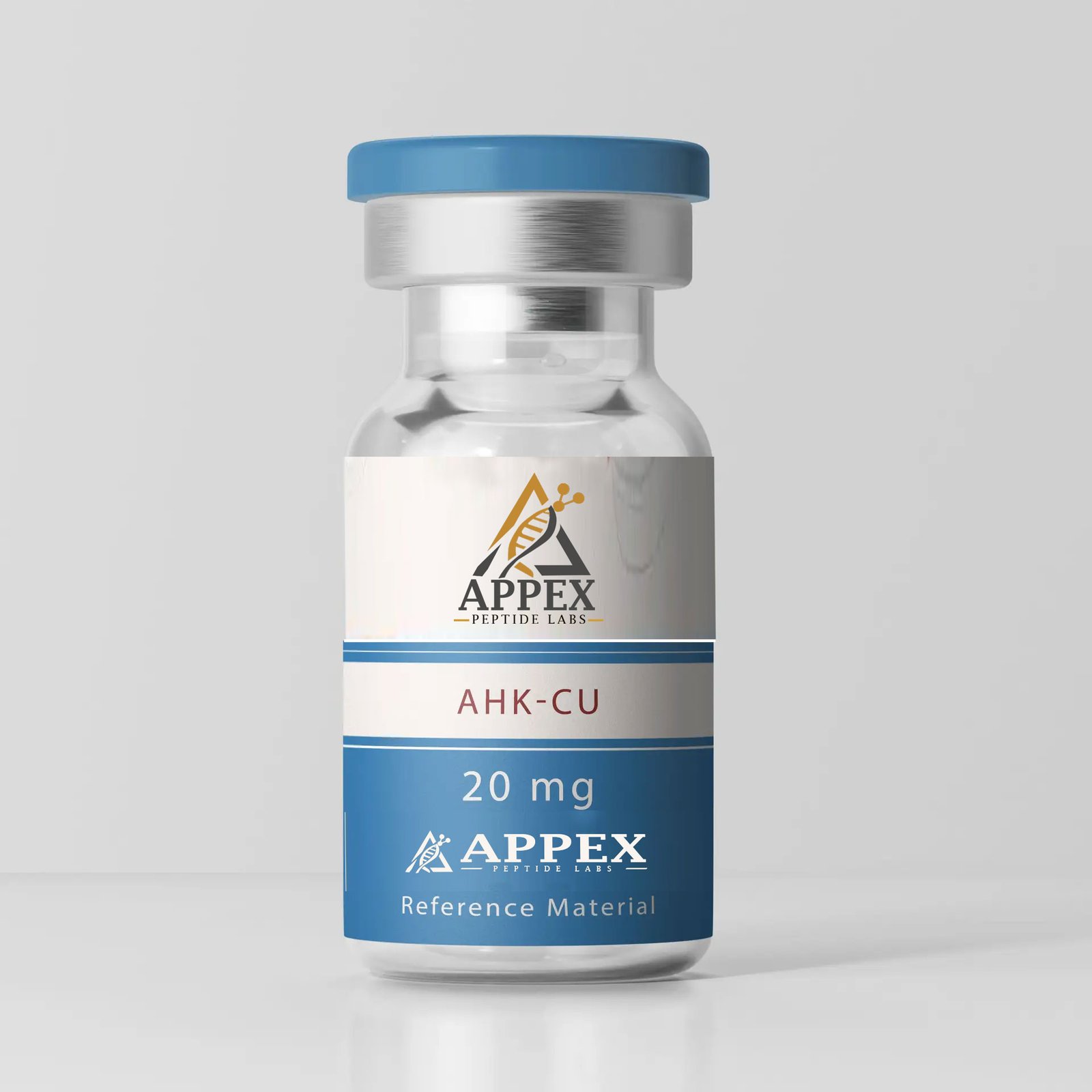
AHK-Cu Peptide is a synthetic copper-complexed tripeptide composed of alanine, histidine, and lysine coordinated with a copper ion. Within published scientific literature, copper peptides have attracted considerable attention because of their ability to participate in cellular signaling processes associated with extracellular matrix biology, fibroblast activity, angiogenic pathways, and peptide-mediated molecular communication.
In laboratory settings, AHK-Cu serves as a valuable research compound for investigating interactions between copper-dependent biochemical processes and cellular signaling networks. Researchers utilize controlled experimental models to evaluate its influence on dermal papilla cells, extracellular matrix proteins, collagen-associated gene expression, growth factor regulation, and cellular proliferation under defined laboratory conditions.
Its relatively small molecular structure facilitates investigations into peptide transport, copper ion coordination chemistry, and receptor-independent signaling mechanisms involved in tissue-derived cell cultures. These characteristics make AHK-Cu a versatile research tool across multiple areas of molecular biology and peptide science.
Manufactured under stringent quality standards and supplied as a lyophilized powder, AHK-Cu Peptide provides laboratories with consistent material suitable for reproducible experimental protocols. Every production lot undergoes analytical identity confirmation and purity verification to support reliable scientific investigations.
For research use only. Not intended for human consumption or clinical use.
AHK-Cu Peptide is widely investigated in cultured dermal papilla cell models to examine peptide-mediated cellular communication, proliferation, differentiation, and gene expression associated with connective tissue biology.
Researchers employ AHK-Cu to study extracellular matrix remodeling, collagen-associated molecular pathways, glycosaminoglycan regulation, and interactions between matrix proteins within controlled laboratory environments.
Experimental investigations utilize AHK-Cu to evaluate fibroblast activity, cellular metabolism, peptide signaling, and protein synthesis associated with extracellular structural components.
The copper-complexed structure enables research into copper ion transport, metal-peptide coordination chemistry, enzymatic regulation, and intracellular signaling mechanisms influenced by biologically active copper complexes.
Researchers investigate AHK-Cu within laboratory models examining vascular endothelial growth factor (VEGF)-associated pathways, endothelial cell behavior, and signaling interactions relevant to vascular biology.
AHK-Cu serves as a valuable model compound for studying peptide stability, cellular uptake, intracellular trafficking, peptide metabolism, and structure-function relationships in experimental systems.
| Specification | Details |
|---|---|
| Product Name | AHK-Cu Peptide |
| Purity | ≥99% (HPLC Verified) |
| Molecular Formula | C₁₄H₂₄CuN₆O₄ |
| Molecular Weight | 401.91 g/mol |
| CAS Number | 89030-95-5* |
| Appearance | Blue to blue-violet lyophilized powder |
| Storage Conditions | Store refrigerated at 2–8°C. For extended storage, keep at -20°C in a dry, light-protected environment. |
| Solubility | Soluble in sterile laboratory-grade water or appropriate research buffers |
| Sequence | Ala-His-Lys-Cu (AHK-Cu) |
| Available Sizes | 20 mg, 50 mg, 100 mg |
*CAS numbers may vary depending on supplier registration and formulation. Verify against your batch documentation if applicable.
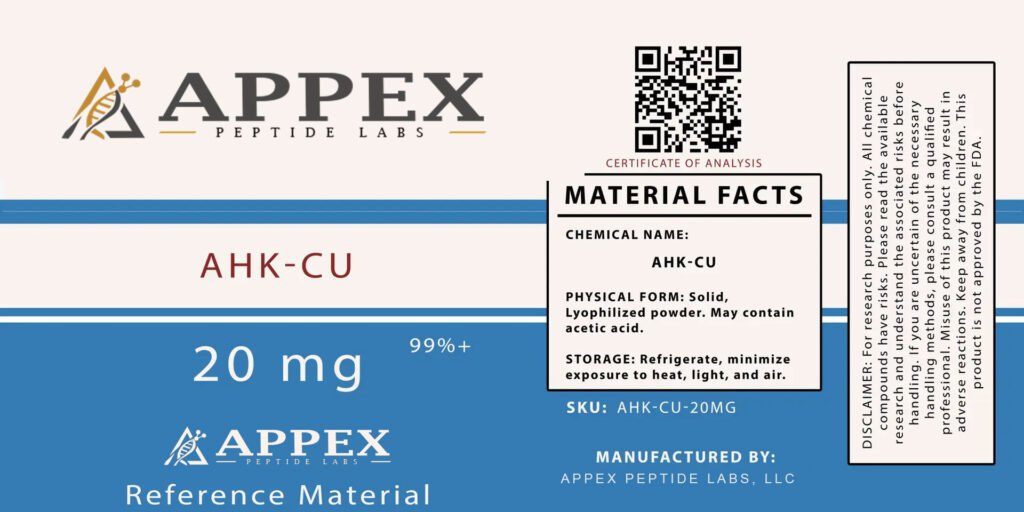
AHK-Cu Peptide is a synthetic copper-coordinated tripeptide consisting of alanine, histidine, and lysine bound to a divalent copper ion. Its biological activity in laboratory research is primarily attributed to the unique chemical properties of peptide-bound copper and the peptide’s ability to participate in multiple intracellular signaling processes rather than interaction with a single receptor target.
Within experimental systems, AHK-Cu functions as a biologically active copper carrier capable of facilitating copper-dependent biochemical reactions essential for numerous cellular processes. Copper serves as an important cofactor for enzymes involved in oxidative metabolism, extracellular matrix organization, antioxidant defense mechanisms, and connective tissue biology. The peptide-copper complex provides researchers with a model for investigating regulated copper delivery and its influence on cellular physiology.
Published research has demonstrated that AHK-Cu influences gene expression patterns associated with extracellular matrix proteins, including collagen-related pathways, matrix metalloproteinases (MMPs), tissue inhibitors of metalloproteinases (TIMPs), and proteins involved in structural matrix homeostasis. These investigations suggest that copper-peptide complexes participate in signaling events regulating matrix remodeling and fibroblast function under controlled laboratory conditions.
Experimental studies have also examined the peptide’s relationship with vascular endothelial growth factor (VEGF)-associated signaling pathways, intracellular kinase activation, and transcriptional responses that influence endothelial and dermal cell behavior. Rather than acting through classical receptor agonism, AHK-Cu appears to modulate multiple downstream signaling networks involved in cellular communication, proliferation, migration, and protein synthesis.
At the cellular level, researchers continue investigating interactions between AHK-Cu and pathways associated with oxidative stress regulation, mitochondrial metabolism, growth factor expression, and peptide-mediated signal transduction. Copper coordination may influence enzymatic activity involved in maintaining cellular redox balance and supporting biochemical processes dependent on trace metal availability.
Because of its relatively small molecular size and well-characterized peptide chemistry, AHK-Cu remains an important research tool for studying copper-dependent molecular biology, extracellular matrix regulation, fibroblast physiology, and peptide-mediated signaling networks. Ongoing laboratory investigations continue to expand understanding of its molecular interactions, pharmacodynamic characteristics, and role in complex cellular systems.
For research use only. Not intended for human consumption or clinical use.
| Size | 100mg, 20mg, 50mg |
|---|---|
| Dimensions | 9 × 7 × .5 in |
| Weight | .125 lbs |
AHK-Cu Peptide is a synthetic copper-complexed tripeptide composed of alanine, histidine, and lysine coordinated with a copper ion. Within published scientific literature, copper peptides have attracted considerable attention because of their ability to participate in cellular signaling processes associated with extracellular matrix biology, fibroblast activity, angiogenic pathways, and peptide-mediated molecular communication.
In laboratory settings, AHK-Cu serves as a valuable research compound for investigating interactions between copper-dependent biochemical processes and cellular signaling networks. Researchers utilize controlled experimental models to evaluate its influence on dermal papilla cells, extracellular matrix proteins, collagen-associated gene expression, growth factor regulation, and cellular proliferation under defined laboratory conditions.
Its relatively small molecular structure facilitates investigations into peptide transport, copper ion coordination chemistry, and receptor-independent signaling mechanisms involved in tissue-derived cell cultures. These characteristics make AHK-Cu a versatile research tool across multiple areas of molecular biology and peptide science.
Manufactured under stringent quality standards and supplied as a lyophilized powder, AHK-Cu Peptide provides laboratories with consistent material suitable for reproducible experimental protocols. Every production lot undergoes analytical identity confirmation and purity verification to support reliable scientific investigations.
For research use only. Not intended for human consumption or clinical use.
AHK-Cu Peptide is widely investigated in cultured dermal papilla cell models to examine peptide-mediated cellular communication, proliferation, differentiation, and gene expression associated with connective tissue biology.
Researchers employ AHK-Cu to study extracellular matrix remodeling, collagen-associated molecular pathways, glycosaminoglycan regulation, and interactions between matrix proteins within controlled laboratory environments.
Experimental investigations utilize AHK-Cu to evaluate fibroblast activity, cellular metabolism, peptide signaling, and protein synthesis associated with extracellular structural components.
The copper-complexed structure enables research into copper ion transport, metal-peptide coordination chemistry, enzymatic regulation, and intracellular signaling mechanisms influenced by biologically active copper complexes.
Researchers investigate AHK-Cu within laboratory models examining vascular endothelial growth factor (VEGF)-associated pathways, endothelial cell behavior, and signaling interactions relevant to vascular biology.
AHK-Cu serves as a valuable model compound for studying peptide stability, cellular uptake, intracellular trafficking, peptide metabolism, and structure-function relationships in experimental systems.
| Specification | Details |
|---|---|
| Product Name | AHK-Cu Peptide |
| Purity | ≥99% (HPLC Verified) |
| Molecular Formula | C₁₄H₂₄CuN₆O₄ |
| Molecular Weight | 401.91 g/mol |
| CAS Number | 89030-95-5* |
| Appearance | Blue to blue-violet lyophilized powder |
| Storage Conditions | Store refrigerated at 2–8°C. For extended storage, keep at -20°C in a dry, light-protected environment. |
| Solubility | Soluble in sterile laboratory-grade water or appropriate research buffers |
| Sequence | Ala-His-Lys-Cu (AHK-Cu) |
| Available Sizes | 20 mg, 50 mg, 100 mg |
*CAS numbers may vary depending on supplier registration and formulation. Verify against your batch documentation if applicable.
AHK-Cu Peptide is a synthetic copper-coordinated tripeptide consisting of alanine, histidine, and lysine bound to a divalent copper ion. Its biological activity in laboratory research is primarily attributed to the unique chemical properties of peptide-bound copper and the peptide’s ability to participate in multiple intracellular signaling processes rather than interaction with a single receptor target.
Within experimental systems, AHK-Cu functions as a biologically active copper carrier capable of facilitating copper-dependent biochemical reactions essential for numerous cellular processes. Copper serves as an important cofactor for enzymes involved in oxidative metabolism, extracellular matrix organization, antioxidant defense mechanisms, and connective tissue biology. The peptide-copper complex provides researchers with a model for investigating regulated copper delivery and its influence on cellular physiology.
Published research has demonstrated that AHK-Cu influences gene expression patterns associated with extracellular matrix proteins, including collagen-related pathways, matrix metalloproteinases (MMPs), tissue inhibitors of metalloproteinases (TIMPs), and proteins involved in structural matrix homeostasis. These investigations suggest that copper-peptide complexes participate in signaling events regulating matrix remodeling and fibroblast function under controlled laboratory conditions.
Experimental studies have also examined the peptide’s relationship with vascular endothelial growth factor (VEGF)-associated signaling pathways, intracellular kinase activation, and transcriptional responses that influence endothelial and dermal cell behavior. Rather than acting through classical receptor agonism, AHK-Cu appears to modulate multiple downstream signaling networks involved in cellular communication, proliferation, migration, and protein synthesis.
At the cellular level, researchers continue investigating interactions between AHK-Cu and pathways associated with oxidative stress regulation, mitochondrial metabolism, growth factor expression, and peptide-mediated signal transduction. Copper coordination may influence enzymatic activity involved in maintaining cellular redox balance and supporting biochemical processes dependent on trace metal availability.
Because of its relatively small molecular size and well-characterized peptide chemistry, AHK-Cu remains an important research tool for studying copper-dependent molecular biology, extracellular matrix regulation, fibroblast physiology, and peptide-mediated signaling networks. Ongoing laboratory investigations continue to expand understanding of its molecular interactions, pharmacodynamic characteristics, and role in complex cellular systems.
For research use only. Not intended for human consumption or clinical use.
| Size | 100mg, 20mg, 50mg |
|---|---|
| Dimensions | 9 × 7 × .5 in |
| Weight | .125 lbs |