Bulk Orders. Better Value.
Research institutions, universities and clinical teams qualify for volume discounts. Contact our team to discuss custom formulations and bulk pricing.

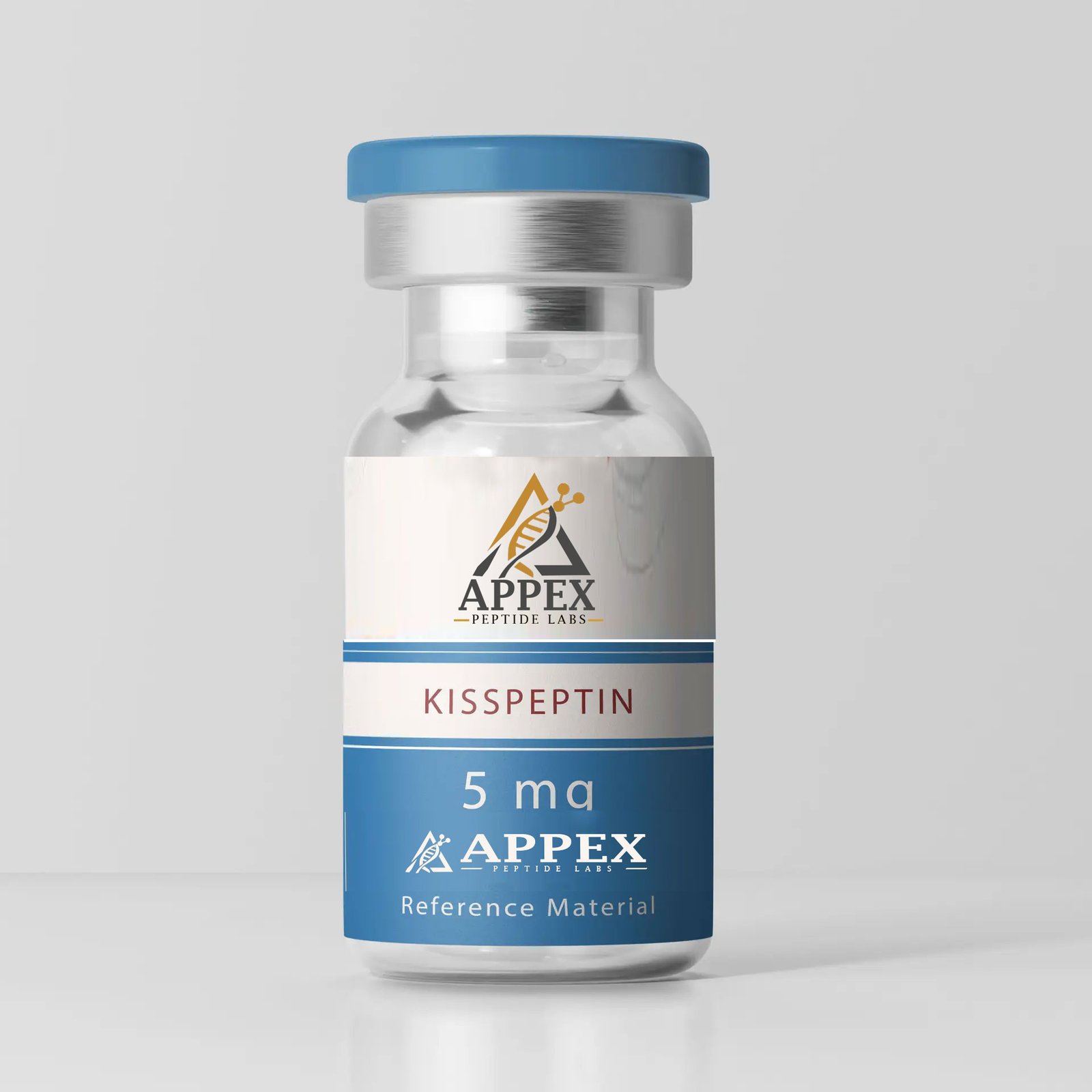
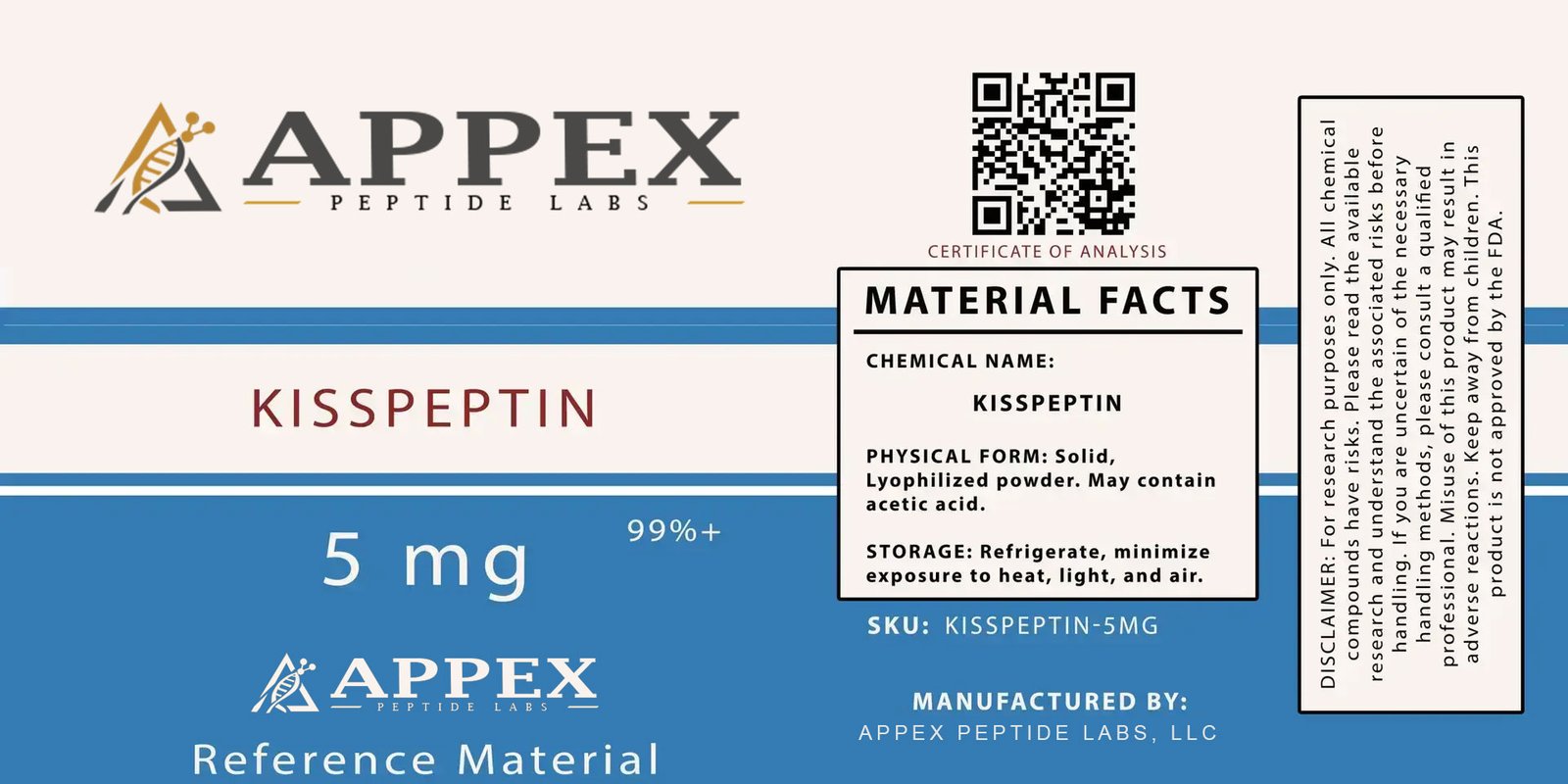

Kisspeptin Peptide, commonly supplied as Kisspeptin-10, represents the minimal biologically active region of the endogenous KISS1 peptide while retaining full affinity for the KISS1 receptor (KISS1R/GPR54). Since the discovery of the KISS1 signaling system, this peptide has become one of the most important experimental tools for investigating reproductive neuroendocrinology and hypothalamic regulation.
Published scientific literature has established Kisspeptin Peptide as a principal upstream regulator of gonadotropin-releasing hormone (GnRH) neurons. Laboratory investigations utilize this peptide to study receptor activation, pulsatile GnRH secretion, luteinizing hormone (LH) and follicle-stimulating hormone (FSH) regulation, intracellular signaling cascades, and endocrine feedback mechanisms governing reproductive physiology.
Beyond reproductive biology, researchers employ Kisspeptin Peptide in molecular pharmacology, receptor biology, developmental neuroscience, and peptide chemistry to investigate G protein-coupled receptor signaling, calcium-dependent intracellular communication, transcriptional regulation, and neuropeptide interactions.
Each batch is synthesized under stringent quality-controlled manufacturing procedures, analytically verified for purity and identity, and supplied as a stable lyophilized powder accompanied by a comprehensive Certificate of Analysis to ensure reproducible scientific research.
For research use only. Not intended for human consumption or clinical use.
Kisspeptin Peptide is widely utilized in laboratory investigations examining hypothalamic-pituitary-gonadal axis regulation, reproductive hormone signaling, and neuroendocrine communication.
Researchers employ Kisspeptin Peptide to investigate activation of gonadotropin-releasing hormone neurons, neuronal signaling networks, and mechanisms governing pulsatile hormone secretion.
Experimental models utilize Kisspeptin Peptide to study receptor binding kinetics, GPCR activation, ligand specificity, receptor internalization, and downstream intracellular signaling.
Scientists investigate molecular pathways regulating luteinizing hormone (LH) and follicle-stimulating hormone (FSH) secretion, endocrine feedback mechanisms, and pituitary cellular responses.
Kisspeptin Peptide is incorporated into studies examining phospholipase C activation, intracellular calcium mobilization, protein kinase signaling, MAPK/ERK pathways, and transcription factor regulation.
Researchers utilize Kisspeptin Peptide to investigate peptide stability, receptor selectivity, pharmacokinetics, structure-function relationships, and analytical characterization.
| Specification | Details |
|---|---|
| Product Name | Kisspeptin Peptide (Kisspeptin-10) |
| Synonyms | Kisspeptin-10, Metastin (45–54), KISS1 Peptide |
| Purity | ≥99% (HPLC Verified) |
| Molecular Formula | C₆₃H₈₃N₁₇O₁₄ |
| Molecular Weight | 1302.45 g/mol |
| CAS Number | 374675-21-5 |
| Sequence | Tyr-Asn-Trp-Asn-Ser-Phe-Gly-Leu-Arg-Phe-NH₂ |
| Appearance | White to off-white lyophilized powder |
| Solubility | Soluble in sterile bacteriostatic water and laboratory-grade aqueous buffers |
| Storage Conditions | Store lyophilized peptide at 2–8°C. For long-term storage, maintain at −20°C in a dry, light-protected environment. Avoid repeated freeze-thaw cycles after reconstitution. |
| Available Sizes | 5 mg, 10 mg |
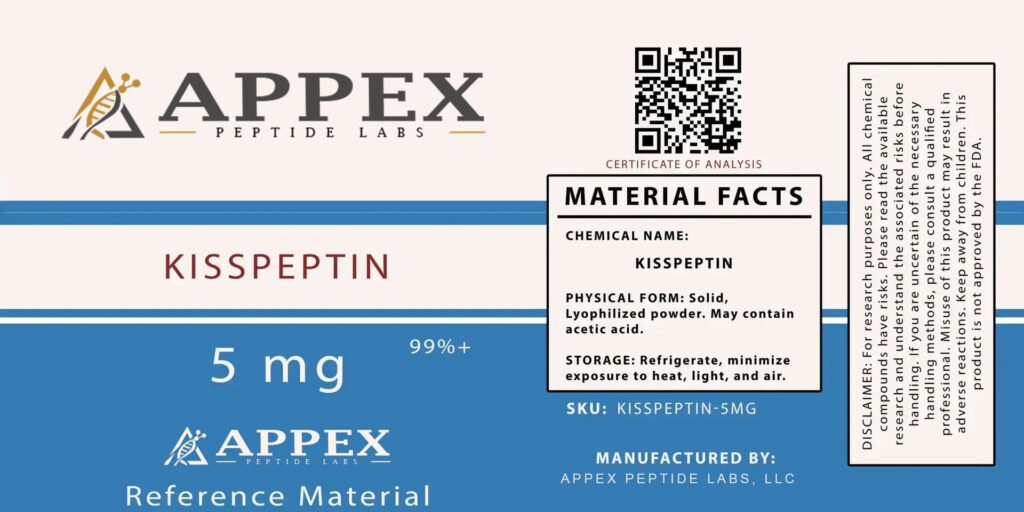
Kisspeptin Peptide (Kisspeptin-10) is the minimal biologically active fragment of the endogenous KISS1 peptide and functions as a highly potent agonist of the KISS1 receptor (KISS1R/GPR54), a Class A G protein-coupled receptor expressed predominantly on hypothalamic gonadotropin-releasing hormone (GnRH) neurons. Laboratory investigations utilize Kisspeptin-10 to study the molecular mechanisms governing reproductive neuroendocrine signaling and hypothalamic regulation.
Upon binding to KISS1R, Kisspeptin Peptide primarily activates Gq/11 proteins, stimulating phospholipase C (PLC) and promoting hydrolysis of phosphatidylinositol 4,5-bisphosphate (PIP₂) into inositol 1,4,5-trisphosphate (IP₃) and diacylglycerol (DAG). These second messengers initiate intracellular calcium release from the endoplasmic reticulum while activating protein kinase C (PKC). The resulting calcium signaling cascade increases neuronal excitability and promotes GnRH secretion in experimental models.
Published laboratory studies have further demonstrated activation of downstream signaling pathways including MAPK/ERK, ERK1/2, PI3K/Akt, and calcium/calmodulin-dependent signaling. These intracellular networks regulate transcriptional activity, neuronal communication, receptor trafficking, and peptide-mediated endocrine signaling. Researchers continue to investigate these molecular pathways to better understand the regulation of reproductive neuroendocrine physiology.
Activation of hypothalamic GnRH neurons initiates downstream signaling within the anterior pituitary, where GnRH stimulates synthesis and secretion of luteinizing hormone (LH) and follicle-stimulating hormone (FSH). Because Kisspeptin functions upstream of GnRH release, it serves as an essential research tool for investigating hypothalamic control of endocrine communication, pulsatile hormone secretion, and feedback regulation within the hypothalamic-pituitary-gonadal axis.
Beyond reproductive endocrinology, laboratory investigations have explored Kisspeptin signaling in developmental neurobiology, energy homeostasis, circadian regulation, and broader neuropeptide communication networks. Its defined amino acid sequence, receptor specificity, and reproducible biochemical activity make Kisspeptin Peptide an indispensable reagent for neuroscience, molecular endocrinology, peptide pharmacology, receptor biology, and biotechnology research.
For research use only. Not intended for human consumption or clinical use.
| Size | 10mg, 5mg |
|---|---|
| Dimensions | 9 × 7 × .5 in |
| Weight | .125 lbs |
Kisspeptin Peptide, commonly supplied as Kisspeptin-10, represents the minimal biologically active region of the endogenous KISS1 peptide while retaining full affinity for the KISS1 receptor (KISS1R/GPR54). Since the discovery of the KISS1 signaling system, this peptide has become one of the most important experimental tools for investigating reproductive neuroendocrinology and hypothalamic regulation.
Published scientific literature has established Kisspeptin Peptide as a principal upstream regulator of gonadotropin-releasing hormone (GnRH) neurons. Laboratory investigations utilize this peptide to study receptor activation, pulsatile GnRH secretion, luteinizing hormone (LH) and follicle-stimulating hormone (FSH) regulation, intracellular signaling cascades, and endocrine feedback mechanisms governing reproductive physiology.
Beyond reproductive biology, researchers employ Kisspeptin Peptide in molecular pharmacology, receptor biology, developmental neuroscience, and peptide chemistry to investigate G protein-coupled receptor signaling, calcium-dependent intracellular communication, transcriptional regulation, and neuropeptide interactions.
Each batch is synthesized under stringent quality-controlled manufacturing procedures, analytically verified for purity and identity, and supplied as a stable lyophilized powder accompanied by a comprehensive Certificate of Analysis to ensure reproducible scientific research.
For research use only. Not intended for human consumption or clinical use.
Kisspeptin Peptide is widely utilized in laboratory investigations examining hypothalamic-pituitary-gonadal axis regulation, reproductive hormone signaling, and neuroendocrine communication.
Researchers employ Kisspeptin Peptide to investigate activation of gonadotropin-releasing hormone neurons, neuronal signaling networks, and mechanisms governing pulsatile hormone secretion.
Experimental models utilize Kisspeptin Peptide to study receptor binding kinetics, GPCR activation, ligand specificity, receptor internalization, and downstream intracellular signaling.
Scientists investigate molecular pathways regulating luteinizing hormone (LH) and follicle-stimulating hormone (FSH) secretion, endocrine feedback mechanisms, and pituitary cellular responses.
Kisspeptin Peptide is incorporated into studies examining phospholipase C activation, intracellular calcium mobilization, protein kinase signaling, MAPK/ERK pathways, and transcription factor regulation.
Researchers utilize Kisspeptin Peptide to investigate peptide stability, receptor selectivity, pharmacokinetics, structure-function relationships, and analytical characterization.
| Specification | Details |
|---|---|
| Product Name | Kisspeptin Peptide (Kisspeptin-10) |
| Synonyms | Kisspeptin-10, Metastin (45–54), KISS1 Peptide |
| Purity | ≥99% (HPLC Verified) |
| Molecular Formula | C₆₃H₈₃N₁₇O₁₄ |
| Molecular Weight | 1302.45 g/mol |
| CAS Number | 374675-21-5 |
| Sequence | Tyr-Asn-Trp-Asn-Ser-Phe-Gly-Leu-Arg-Phe-NH₂ |
| Appearance | White to off-white lyophilized powder |
| Solubility | Soluble in sterile bacteriostatic water and laboratory-grade aqueous buffers |
| Storage Conditions | Store lyophilized peptide at 2–8°C. For long-term storage, maintain at −20°C in a dry, light-protected environment. Avoid repeated freeze-thaw cycles after reconstitution. |
| Available Sizes | 5 mg, 10 mg |
Kisspeptin Peptide (Kisspeptin-10) is the minimal biologically active fragment of the endogenous KISS1 peptide and functions as a highly potent agonist of the KISS1 receptor (KISS1R/GPR54), a Class A G protein-coupled receptor expressed predominantly on hypothalamic gonadotropin-releasing hormone (GnRH) neurons. Laboratory investigations utilize Kisspeptin-10 to study the molecular mechanisms governing reproductive neuroendocrine signaling and hypothalamic regulation.
Upon binding to KISS1R, Kisspeptin Peptide primarily activates Gq/11 proteins, stimulating phospholipase C (PLC) and promoting hydrolysis of phosphatidylinositol 4,5-bisphosphate (PIP₂) into inositol 1,4,5-trisphosphate (IP₃) and diacylglycerol (DAG). These second messengers initiate intracellular calcium release from the endoplasmic reticulum while activating protein kinase C (PKC). The resulting calcium signaling cascade increases neuronal excitability and promotes GnRH secretion in experimental models.
Published laboratory studies have further demonstrated activation of downstream signaling pathways including MAPK/ERK, ERK1/2, PI3K/Akt, and calcium/calmodulin-dependent signaling. These intracellular networks regulate transcriptional activity, neuronal communication, receptor trafficking, and peptide-mediated endocrine signaling. Researchers continue to investigate these molecular pathways to better understand the regulation of reproductive neuroendocrine physiology.
Activation of hypothalamic GnRH neurons initiates downstream signaling within the anterior pituitary, where GnRH stimulates synthesis and secretion of luteinizing hormone (LH) and follicle-stimulating hormone (FSH). Because Kisspeptin functions upstream of GnRH release, it serves as an essential research tool for investigating hypothalamic control of endocrine communication, pulsatile hormone secretion, and feedback regulation within the hypothalamic-pituitary-gonadal axis.
Beyond reproductive endocrinology, laboratory investigations have explored Kisspeptin signaling in developmental neurobiology, energy homeostasis, circadian regulation, and broader neuropeptide communication networks. Its defined amino acid sequence, receptor specificity, and reproducible biochemical activity make Kisspeptin Peptide an indispensable reagent for neuroscience, molecular endocrinology, peptide pharmacology, receptor biology, and biotechnology research.
For research use only. Not intended for human consumption or clinical use.
| Size | 10mg, 5mg |
|---|---|
| Dimensions | 9 × 7 × .5 in |
| Weight | .125 lbs |