Bulk Orders. Better Value.
Research institutions, universities and clinical teams qualify for volume discounts. Contact our team to discuss custom formulations and bulk pricing.

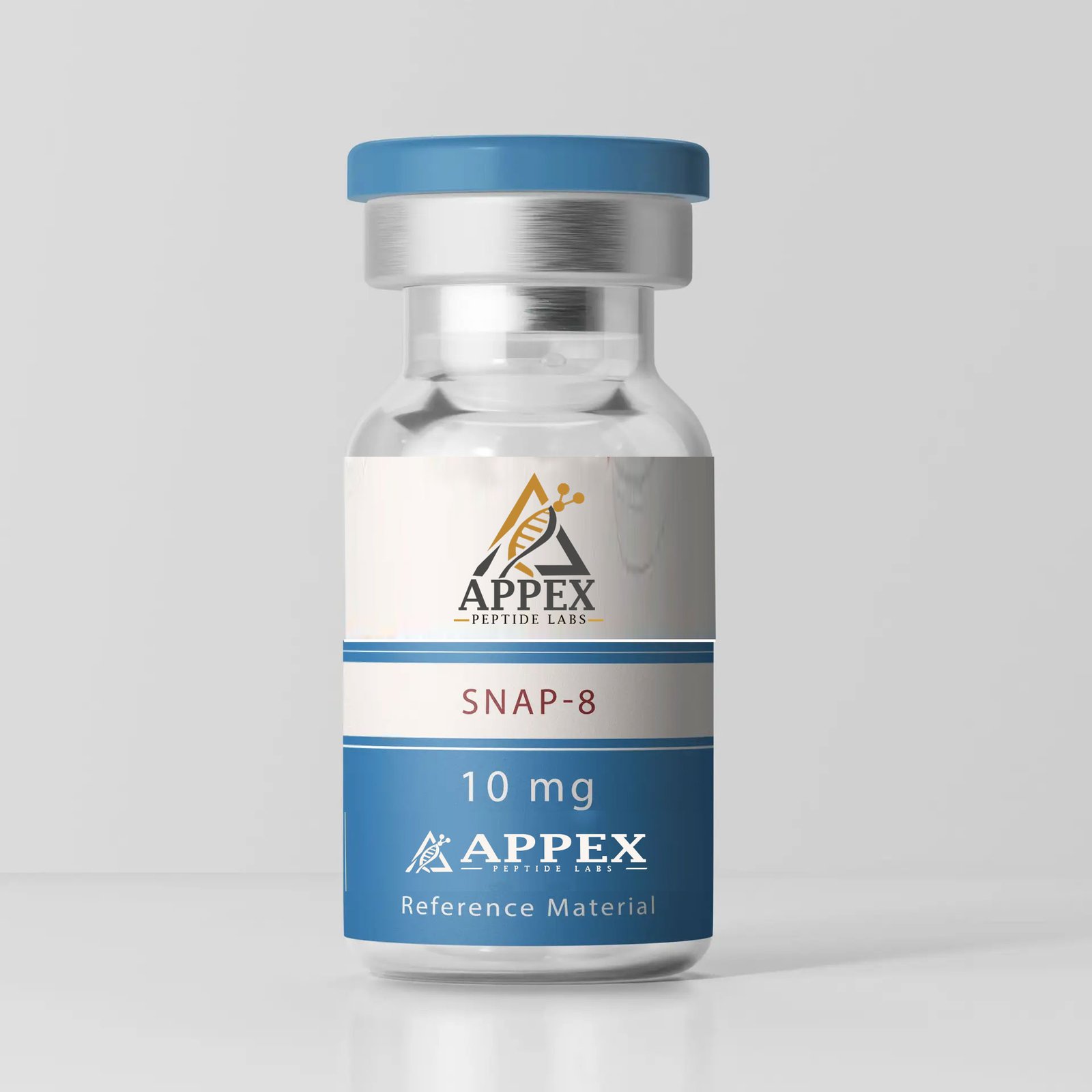
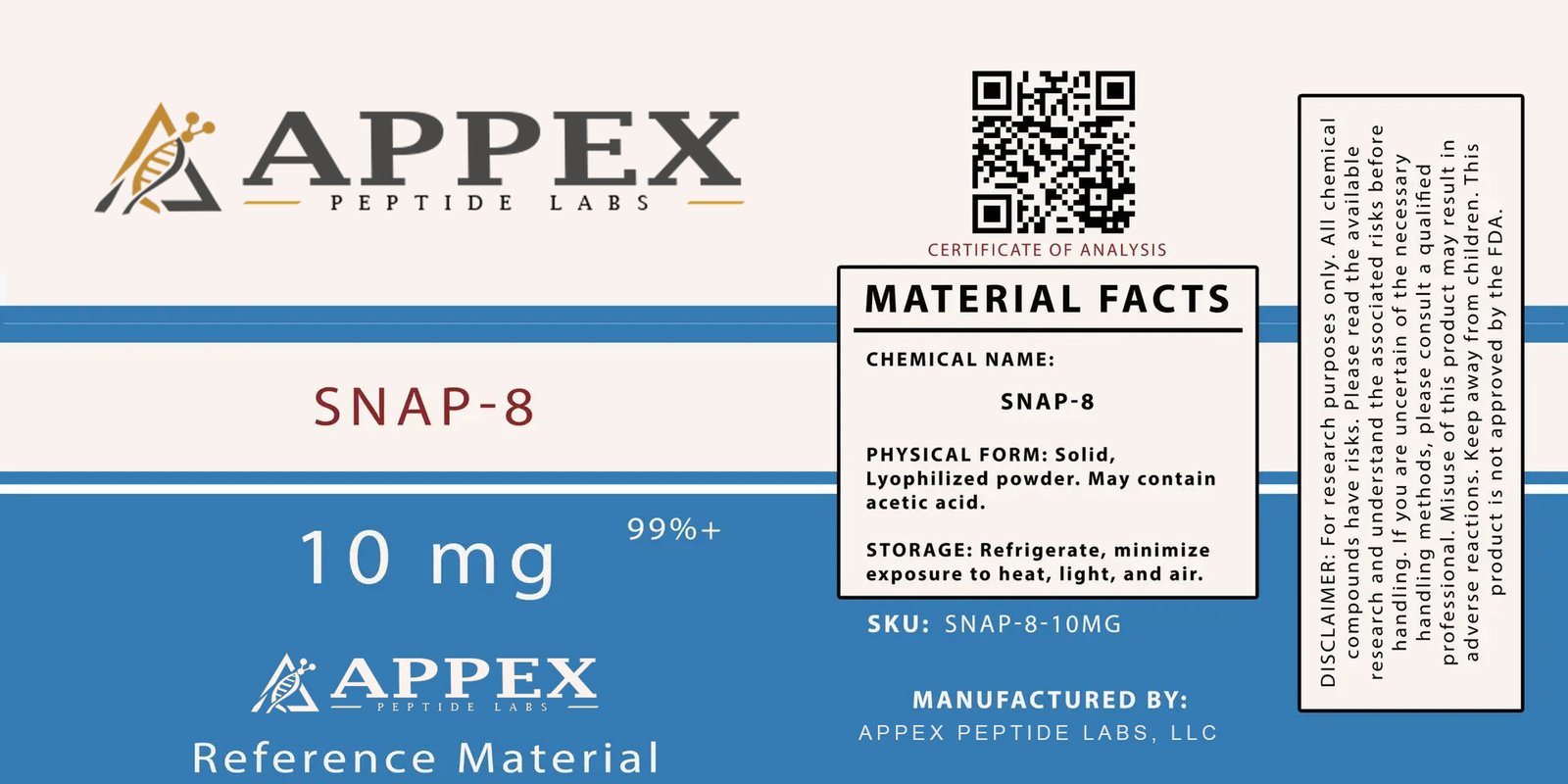

SNAP-8 Peptide, also known as Acetyl Octapeptide-3, is a synthetic biomimetic peptide derived from the N-terminal region of SNAP-25 (Synaptosomal-Associated Protein 25). It extends the sequence of Acetyl Hexapeptide-8 by two additional amino acids, providing enhanced structural stability and increased competitive interaction with components of the SNARE (Soluble NSF Attachment Protein Receptor) complex in laboratory investigations.
Scientific studies utilize SNAP-8 Peptide to investigate molecular mechanisms governing vesicle docking, membrane fusion, regulated exocytosis, and intracellular protein-protein interactions. Researchers employ this peptide in peptide chemistry, cellular biology, membrane trafficking, cosmetic formulation science, and molecular pharmacology to better understand SNARE-mediated cellular communication and peptide structure-function relationships.
Beyond SNARE biology, SNAP-8 serves as a valuable research reagent for analytical characterization, peptide formulation development, biomolecular interaction studies, and cosmetic ingredient research. Its defined amino acid sequence and reproducible biochemical properties make it suitable for universities, biotechnology companies, pharmaceutical organizations, cosmetic science laboratories, and life science research institutions.
Each batch is synthesized under rigorous quality-controlled manufacturing procedures, analytically verified for purity and structural identity, and supplied as a stable lyophilized peptide accompanied by a comprehensive Certificate of Analysis to ensure reproducible laboratory investigations.
For research use only. Not intended for human consumption or clinical use.
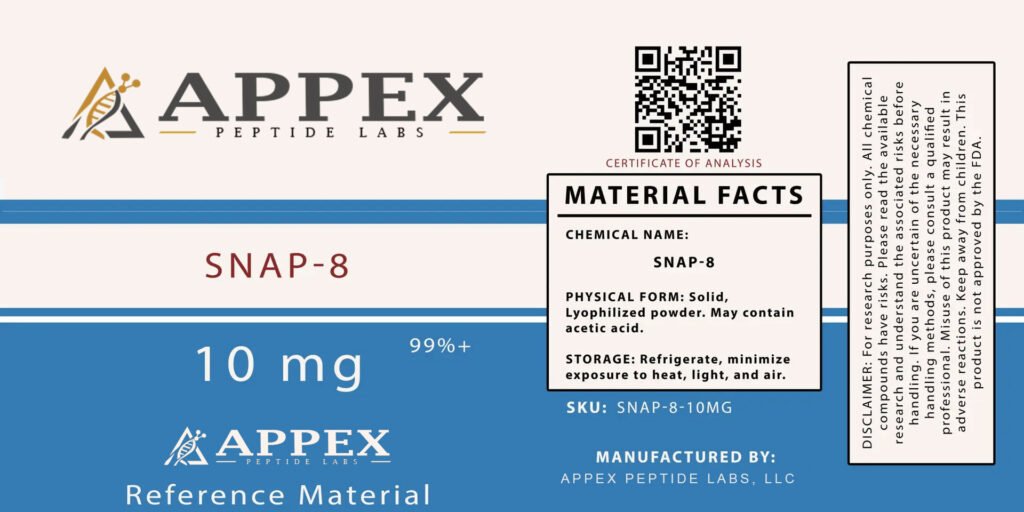
SNAP-8 Peptide is extensively utilized in laboratory investigations examining SNARE complex assembly, vesicle docking mechanisms, membrane fusion events, and protein interaction dynamics.
Researchers employ SNAP-8 to investigate regulated exocytosis, intracellular vesicle trafficking, neurotransmitter release mechanisms, and secretory pathway regulation.
Experimental models utilize SNAP-8 to evaluate competitive binding to SNAP-25, molecular recognition, peptide interaction kinetics, and structural biology.
Scientists investigate peptide-based cosmetic formulations, biomimetic peptide stability, formulation compatibility, and ingredient performance under controlled laboratory conditions.
Laboratory investigations incorporate SNAP-8 into studies examining membrane dynamics, intracellular transport systems, cytoskeletal organization, and cellular communication pathways.
Researchers utilize SNAP-8 for analytical characterization, formulation development, peptide stability studies, structure-activity relationship investigations, and quality control validation.
| Specification | Details |
|---|---|
| Product Name | SNAP-8 Peptide |
| Synonyms | Acetyl Octapeptide-3 |
| Purity | ≥99% (HPLC Verified) |
| Molecular Formula | C₄₁H₇₀N₁₆O₁₆S |
| Molecular Weight | 1,075.20 g/mol |
| CAS Number | 868844-74-0 |
| Sequence | Ac-Glu-Glu-Met-Gln-Arg-Arg-Ala-Asp-NH₂ |
| Appearance | White to off-white lyophilized powder |
| Solubility | Soluble in sterile water and laboratory-grade aqueous buffers |
| Storage Conditions | Store lyophilized peptide at 2–8°C. For long-term storage, maintain at −20°C in a dry, light-protected environment. Avoid repeated freeze-thaw cycles following reconstitution. |
| Available Sizes | 10 mg, 100 mg |
SNAP-8 Peptide (Acetyl Octapeptide-3) is a synthetic biomimetic peptide derived from the N-terminal region of SNAP-25 (Synaptosomal-Associated Protein 25), a core component of the SNARE (Soluble NSF Attachment Protein Receptor) complex responsible for regulated membrane fusion and vesicle exocytosis. The peptide was engineered by extending the sequence of Acetyl Hexapeptide-8 with two additional amino acids, enhancing structural stability and increasing competitive interaction with SNARE-associated proteins during laboratory investigations.
In physiological systems, the SNARE complex is composed primarily of SNAP-25, syntaxin-1, and synaptobrevin (VAMP). These proteins assemble into a highly stable four-helix bundle that facilitates membrane docking and fusion, enabling regulated release of neurotransmitters and other vesicular contents. SNAP-8 serves as a competitive experimental model for studying these molecular interactions by mimicking part of the SNAP-25 binding interface.
Laboratory studies demonstrate that SNAP-8 can interfere with SNARE complex assembly by competing for interactions required during formation of the functional fusion complex. Researchers utilize this property to investigate mechanisms governing vesicle docking, membrane fusion kinetics, intracellular trafficking, and regulated exocytosis using biochemical assays, molecular biology techniques, and cellular imaging.
Experimental investigations also examine downstream effects on intracellular signaling pathways associated with calcium-dependent vesicle release, cytoskeletal organization, membrane remodeling, and protein trafficking. Additional studies explore peptide stability, formulation compatibility, molecular recognition, and structure-function relationships in cosmetic science and peptide chemistry research.
Because of its well-defined synthetic structure, reproducible biochemical properties, and established role as a biomimetic SNARE research peptide, SNAP-8 Peptide remains an important experimental reagent for molecular biology, peptide chemistry, cosmetic science, cell biology, membrane trafficking research, and biotechnology laboratories investigating vesicle fusion and intracellular protein interactions.
For research use only. Not intended for human consumption or clinical use.
| Size | 100mg, 10mg |
|---|---|
| Dimensions | 9 × 7 × .5 in |
| Weight | .125 lbs |
SNAP-8 Peptide, also known as Acetyl Octapeptide-3, is a synthetic biomimetic peptide derived from the N-terminal region of SNAP-25 (Synaptosomal-Associated Protein 25). It extends the sequence of Acetyl Hexapeptide-8 by two additional amino acids, providing enhanced structural stability and increased competitive interaction with components of the SNARE (Soluble NSF Attachment Protein Receptor) complex in laboratory investigations.
Scientific studies utilize SNAP-8 Peptide to investigate molecular mechanisms governing vesicle docking, membrane fusion, regulated exocytosis, and intracellular protein-protein interactions. Researchers employ this peptide in peptide chemistry, cellular biology, membrane trafficking, cosmetic formulation science, and molecular pharmacology to better understand SNARE-mediated cellular communication and peptide structure-function relationships.
Beyond SNARE biology, SNAP-8 serves as a valuable research reagent for analytical characterization, peptide formulation development, biomolecular interaction studies, and cosmetic ingredient research. Its defined amino acid sequence and reproducible biochemical properties make it suitable for universities, biotechnology companies, pharmaceutical organizations, cosmetic science laboratories, and life science research institutions.
Each batch is synthesized under rigorous quality-controlled manufacturing procedures, analytically verified for purity and structural identity, and supplied as a stable lyophilized peptide accompanied by a comprehensive Certificate of Analysis to ensure reproducible laboratory investigations.
For research use only. Not intended for human consumption or clinical use.
SNAP-8 Peptide is extensively utilized in laboratory investigations examining SNARE complex assembly, vesicle docking mechanisms, membrane fusion events, and protein interaction dynamics.
Researchers employ SNAP-8 to investigate regulated exocytosis, intracellular vesicle trafficking, neurotransmitter release mechanisms, and secretory pathway regulation.
Experimental models utilize SNAP-8 to evaluate competitive binding to SNAP-25, molecular recognition, peptide interaction kinetics, and structural biology.
Scientists investigate peptide-based cosmetic formulations, biomimetic peptide stability, formulation compatibility, and ingredient performance under controlled laboratory conditions.
Laboratory investigations incorporate SNAP-8 into studies examining membrane dynamics, intracellular transport systems, cytoskeletal organization, and cellular communication pathways.
Researchers utilize SNAP-8 for analytical characterization, formulation development, peptide stability studies, structure-activity relationship investigations, and quality control validation.
| Specification | Details |
|---|---|
| Product Name | SNAP-8 Peptide |
| Synonyms | Acetyl Octapeptide-3 |
| Purity | ≥99% (HPLC Verified) |
| Molecular Formula | C₄₁H₇₀N₁₆O₁₆S |
| Molecular Weight | 1,075.20 g/mol |
| CAS Number | 868844-74-0 |
| Sequence | Ac-Glu-Glu-Met-Gln-Arg-Arg-Ala-Asp-NH₂ |
| Appearance | White to off-white lyophilized powder |
| Solubility | Soluble in sterile water and laboratory-grade aqueous buffers |
| Storage Conditions | Store lyophilized peptide at 2–8°C. For long-term storage, maintain at −20°C in a dry, light-protected environment. Avoid repeated freeze-thaw cycles following reconstitution. |
| Available Sizes | 10 mg, 100 mg |
SNAP-8 Peptide (Acetyl Octapeptide-3) is a synthetic biomimetic peptide derived from the N-terminal region of SNAP-25 (Synaptosomal-Associated Protein 25), a core component of the SNARE (Soluble NSF Attachment Protein Receptor) complex responsible for regulated membrane fusion and vesicle exocytosis. The peptide was engineered by extending the sequence of Acetyl Hexapeptide-8 with two additional amino acids, enhancing structural stability and increasing competitive interaction with SNARE-associated proteins during laboratory investigations.
In physiological systems, the SNARE complex is composed primarily of SNAP-25, syntaxin-1, and synaptobrevin (VAMP). These proteins assemble into a highly stable four-helix bundle that facilitates membrane docking and fusion, enabling regulated release of neurotransmitters and other vesicular contents. SNAP-8 serves as a competitive experimental model for studying these molecular interactions by mimicking part of the SNAP-25 binding interface.
Laboratory studies demonstrate that SNAP-8 can interfere with SNARE complex assembly by competing for interactions required during formation of the functional fusion complex. Researchers utilize this property to investigate mechanisms governing vesicle docking, membrane fusion kinetics, intracellular trafficking, and regulated exocytosis using biochemical assays, molecular biology techniques, and cellular imaging.
Experimental investigations also examine downstream effects on intracellular signaling pathways associated with calcium-dependent vesicle release, cytoskeletal organization, membrane remodeling, and protein trafficking. Additional studies explore peptide stability, formulation compatibility, molecular recognition, and structure-function relationships in cosmetic science and peptide chemistry research.
Because of its well-defined synthetic structure, reproducible biochemical properties, and established role as a biomimetic SNARE research peptide, SNAP-8 Peptide remains an important experimental reagent for molecular biology, peptide chemistry, cosmetic science, cell biology, membrane trafficking research, and biotechnology laboratories investigating vesicle fusion and intracellular protein interactions.
For research use only. Not intended for human consumption or clinical use.
| Size | 100mg, 10mg |
|---|---|
| Dimensions | 9 × 7 × .5 in |
| Weight | .125 lbs |